
ESP32-C5 Relay Board Adds RS-485 and Wi-Fi 6 for $21
The Maker Go ESP32-C5-EVB pairs four 10A relays and four opto-isolated inputs with RS-485, dual-band Wi-Fi 6, Zigbee, and Thread, starting around $15.

The Board That Trades a GPIO Header for a Bus
Maker Go has released the ESP32-C5-EVB, a small automation controller with four relays, four opto-isolated inputs, and — the change that defines it — an RS-485 terminal block where earlier boards in the line put a GPIO header. That is a deliberate swap, and it tells you exactly which room this board is meant to live in.
- ESP32-C5 single-core 32-bit RISC-V at up to 240 MHz, 384 KB SRAM, 4MB SPI flash
- Four relays rated 10A / 240VAC on 3-pin terminal blocks, plus four opto-isolated inputs accepting up to 30VDC
- RS-485 terminal block replaces the GPIO header found on earlier boards in the series
- Dual-band Wi-Fi 6, Bluetooth 5.0 LE, and an 802.15.4 radio for Zigbee 3.0 and Thread 1.3; $14.95–$21.15 for the board, with a DIN rail enclosure from about $7
Why RS-485 Still Matters in 2026
Because the installed base is enormous and it is not going anywhere. RS-485 is the physical layer under Modbus RTU, and Modbus RTU is what a very large share of industrial sensors, VFDs, energy meters, and building controllers actually speak. A differential pair that runs a thousand meters through electrical noise, daisy-chained across dozens of devices, remains hard to beat for that job.
Putting RS-485 on a $15 Wi-Fi 6 board is the interesting move. It makes the ESP32-C5-EVB a bridge — read a bank of Modbus meters over the wire, publish over the network, and now equipment installed a decade before anyone said "IoT" is producing data your dashboard can consume. That is a much more common real-world problem than greenfield sensor deployment.
What Do the Opto-Isolated Inputs Protect Against?
Everything on the other side of the wire. An opto-isolated input passes the signal as light across a gap, so there is no electrical path from field wiring back to the microcontroller. When the field side is a 24V loop running to a limit switch in a machine room, that gap is what stands between a wiring fault and a dead board.
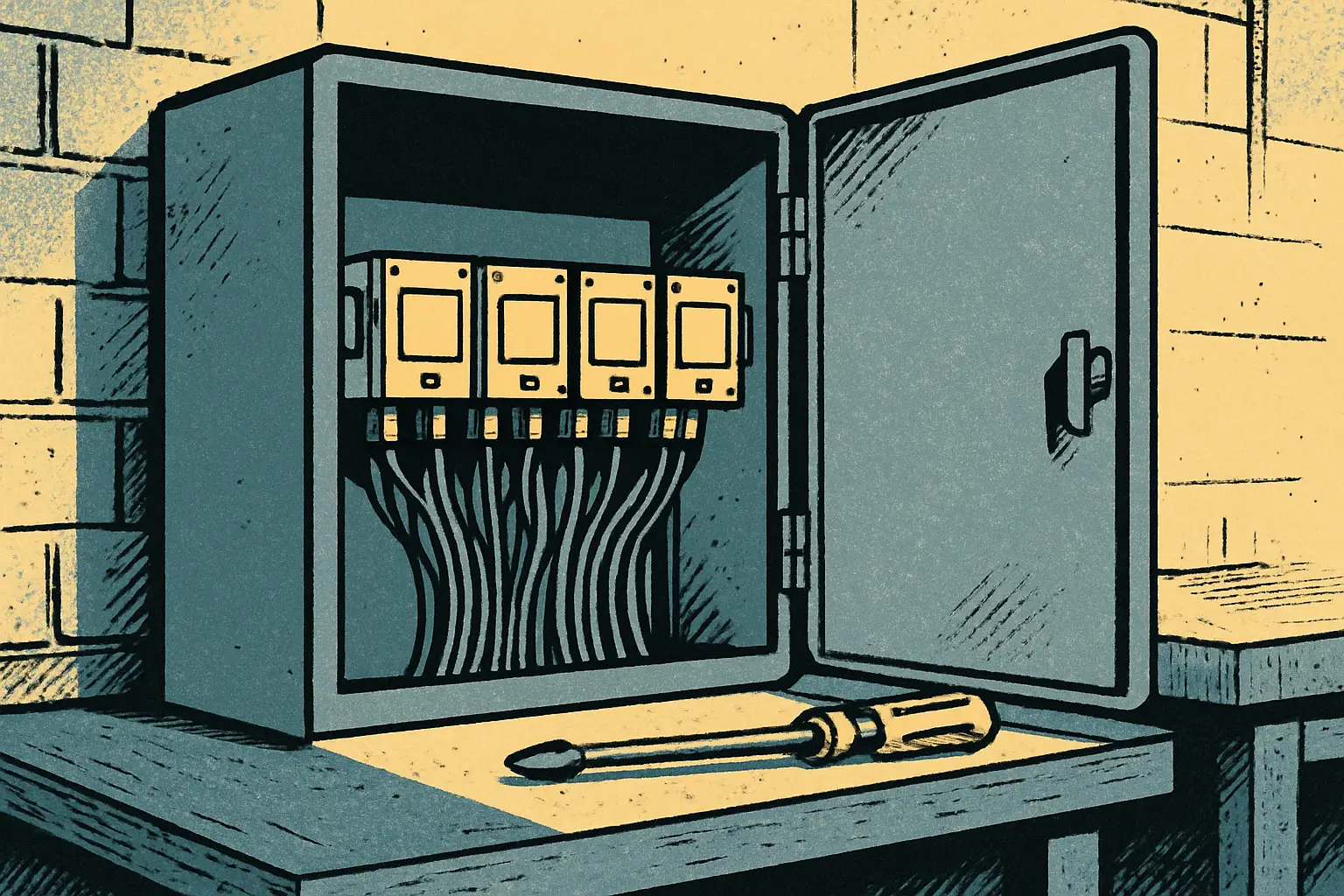
The same reasoning applies to the relay side. Four contacts rated 10A at 240VAC are enough to switch real loads — pumps, contactors, lighting circuits — rather than only signaling. Combined with a DIN rail enclosure for about $7, this is a device intended to be mounted in a cabinet and forgotten, which is a different design target from most ESP32 development boards.
Which Radio Should You Actually Use?
All three are present for a reason. Dual-band Wi-Fi 6 gives you the 5 GHz band, which in an industrial setting is frequently the only clean spectrum available — 2.4 GHz in a plant is crowded in ways a home network never is. The 802.15.4 radio covers Zigbee 3.0 and Thread 1.3, so the board can join a mesh instead of needing an access point in range.
Thread support is the forward-looking one. A board that can sit on a Thread network and switch mains loads is a legitimate building block for home automation work as well as industrial control, and it lands in the same territory our low-power wireless MCU guide maps out across the nRF54L, ESP32, and RP2350 families.
Documentation and What to Expect
Maker Go publishes PDF schematics and Arduino sketches for the RS-485 interface, the relays, and the opto-isolated inputs on a wiki hosted by ICBBuy. That is the right minimum — example code for each peripheral means the first hour is spent on your application rather than on working out register access.
Pricing runs $14.95 on Tindie for the bare board and $21.15 on AliExpress, with the enclosure combo around $20.95. Anyone who has priced a comparable industrial relay module with a bus interface from a traditional automation vendor will find those numbers difficult to argue with, and the ESP32-C5's recent run of cheap Wi-Fi 6 boards suggests the part is settling in nicely.
Sources: CNX Software — July 31, 2026; Maker Go wiki hosted by ICBBuy — July 2026.
More Mini Computers Stories
ESP32-S3 Runs Linux 6.11 With 3.7MB of RAM to Spare
Release 0.8 of the native ESP32-S3 Linux port fixes the crash that hit one boot in ten and halves the memory cost of every fork. One file to flash.

Alif StartKits Put an Ethos-U55 NPU on a $50 Board
Alif's Balletto B1 and Ensemble E1C StartKits pair a 160MHz Cortex-M55 with an Ethos-U55 NPU, two mics and a camera header for $49.99.

JetKVM Mini Cuts IP KVM Cost to $39 With ESP32-P4X
JetKVM Mini drops Linux for FreeRTOS on an ESP32-P4X, landing a 42mm IP KVM with HDMI capture and WebRTC streaming at $39, or $33 in a 3-pack.