
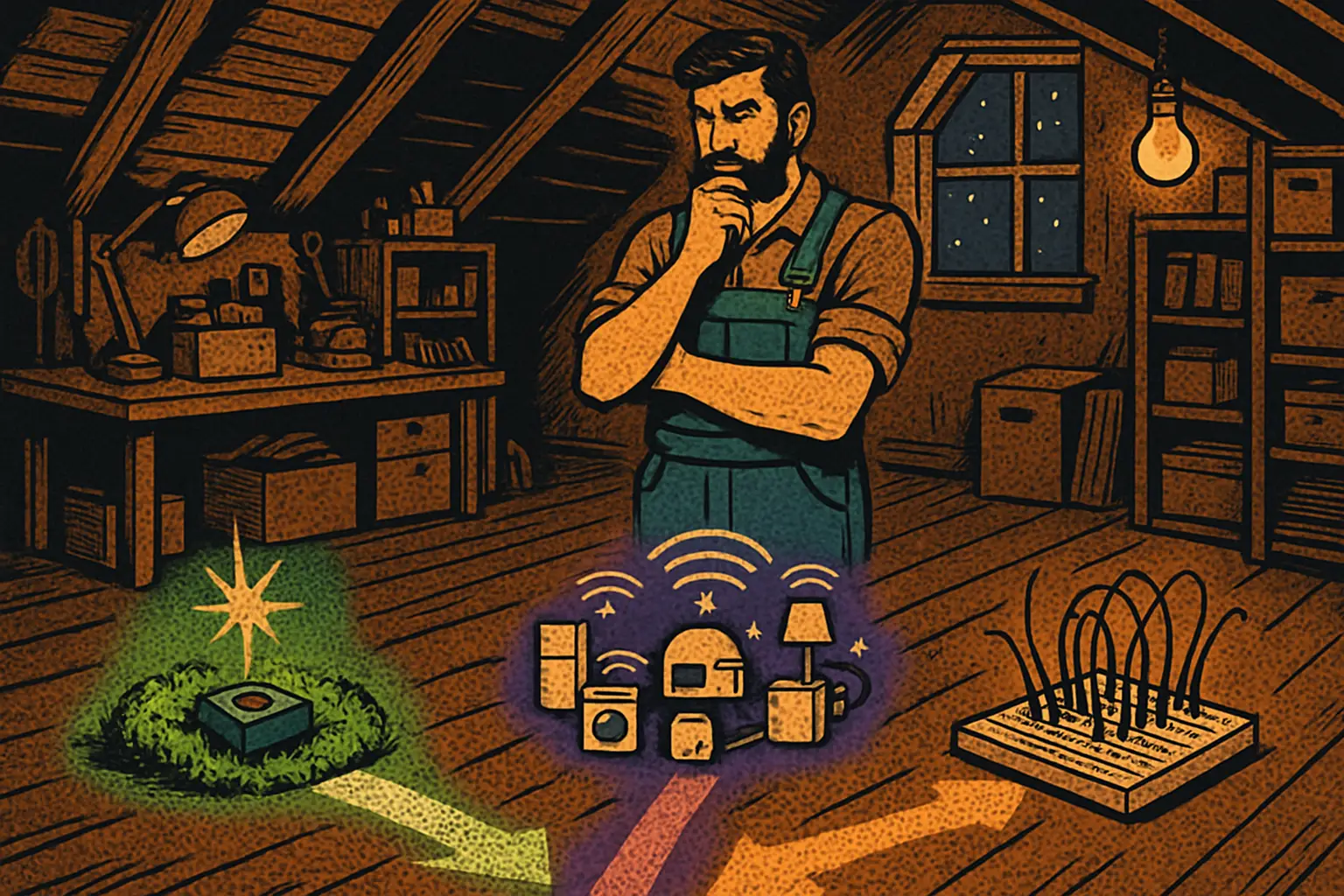
Low-Power Wireless MCU Guide: nRF54L, ESP32, RP2350
Compare nRF54L15, ESP32-C6, and RP2350 for battery-powered projects: radios, sleep current, memory, price, and which to pick for each build.

Picking the Right Wireless Microcontroller in 2026
Three families dominate hobbyist and small-volume commercial wireless projects right now, and they are genuinely different tools rather than competing versions of the same thing. Nordic's nRF54L series, Espressif's ESP32-C6, and Raspberry Pi's RP2350 each win decisively in a specific scenario and lose badly outside it. This guide is about matching the part to the project.
Quick Picks
- Longest battery life, BLE-first device → nRF54L15. Coin cells and multi-year deployments.
- Needs Wi-Fi, or talks to a phone app over the LAN → ESP32-C6. Wi-Fi 6, Thread and Zigbee in one part.
- Cheapest, wired, or you want two RISC-V cores to play with → RP2350. No radio, brilliant I/O.
- Matter smart-home device → ESP32-C6 if it is mains-powered, nRF54L15 if it runs on batteries.
- Best learning platform → RP2350 for the PIO and documentation, ESP32-C6 for the ecosystem breadth.
How the Three Compare
| | nRF54L15 | ESP32-C6 | RP2350 |
|---|---|---|---|
| Core | Cortex-M33 @ 128 MHz + RISC-V coprocessor | RISC-V @ 160 MHz + LP RISC-V core | 2× Cortex-M33 or 2× Hazard3 RISC-V @ 150 MHz |
| RAM | 256 KB SRAM | 512 KB SRAM | 520 KB SRAM |
| Non-volatile | 1.5 MB on-chip NVRAM | External flash | External flash |
| Wi-Fi | No | Wi-Fi 6 (2.4 GHz) | No |
| Bluetooth | BLE 6.0 with Channel Sounding | BLE 5.3 | No |
| 802.15.4 | Yes (Thread, Zigbee, Matter) | Yes (Thread, Zigbee, Matter) | No |
| Other radio | NFC, proprietary 2.4 GHz to 4 Mbps | — | — |
| Best at | Sleep current, BLE range | Multi-protocol, Wi-Fi | Price, I/O flexibility |
| Typical board price | $25–$35 | $8–$20 | $5–$15 |
Which Microcontroller Has the Best Battery Life?
The nRF54L15, and it is not especially close for BLE-first designs. Nordic has spent a decade optimising for the same profile: a device that sleeps almost all the time, wakes briefly to take a reading, transmits a small packet, and goes back to sleep. Everything in the architecture serves that pattern — including the RISC-V coprocessor, which handles software-defined peripherals so the main Cortex-M33 can stay asleep through routine I/O.
The general rule holds across the category: Wi-Fi costs far more power than BLE. If your device is battery-powered and mostly idle, a Wi-Fi radio is the single biggest thing standing between you and a year of runtime. The ESP32-C6's Wi-Fi 6 support includes target wake time, which improves matters considerably over older ESP32 parts, but it does not close the gap to a BLE-only design.
The RP2350 has no radio at all, which makes its own power story simple — excellent when idle, but you are adding an external module if you need wireless, and that module's power budget becomes the real number.
A Practical Sleep-Current Rule of Thumb
For planning purposes: a BLE sensor waking once a minute can realistically run for years on a coin cell. The same sensor over Wi-Fi, even with modern power-save modes, is usually a rechargeable-battery-and-monthly-top-up proposition unless you stretch the reporting interval a long way. Design the duty cycle first, then pick the radio.
When Should You Choose the ESP32-C6 Instead?
Whenever the device needs to be on your Wi-Fi network. That covers a large share of real projects: anything with a web interface, anything streaming more than trivial data, anything that needs to reach a cloud service without a hub in between, and anything replacing an existing Wi-Fi gadget.
The C6's genuine advantage is that it is multi-protocol in one chip — Wi-Fi 6, Bluetooth LE and 802.15.4 together. That means one part can be a Matter device over Thread *and* fall back to Wi-Fi provisioning, or act as a border router. We have seen this play out across a stream of ESP32-C5 and C6 boards this year, including the M5Stack Stamp-C5 Wi-Fi 6 module.
The ecosystem argument is also real. ESP-IDF, Arduino support, ESPHome and a decade of community examples mean that for most problems, someone has already published a working solution.
Where the RP2350 Wins
The RP2350 is the odd one out — no radio — and it earns its place anyway on three counts.
Price. The A-variant runs well under a dollar in volume, and complete boards start around $5. For a project that needs a capable MCU and gets connectivity elsewhere (or does not need it), nothing else in this comparison is close.
Cores you can choose. The chip carries both two Cortex-M33 cores and two Hazard3 RISC-V cores; you select which pair boots. That is a genuinely useful property for anyone learning RISC-V or evaluating a toolchain, and it is unusual at any price.
PIO. The programmable I/O blocks let you implement timing-exact protocols in hardware — DVI output, obscure sensor buses, precise pulse trains — that would otherwise need a dedicated peripheral or a much faster core. Boards like the Waveshare RP2350B Plus-W pair the chip with a separate wireless module when you do need a radio.
What About Matter and Thread Specifically?
Both the nRF54L15 and ESP32-C6 support 802.15.4, so both can be Matter-over-Thread devices. The choice comes down to power:
- Mains-powered (smart plugs, light switches, hub-adjacent devices) → ESP32-C6. Wi-Fi fallback and the wider ecosystem are worth more than sleep current you do not need.
- Battery-powered (door sensors, environmental monitors, buttons) → nRF54L15. This is exactly the workload it was designed for, and the coin-cell nRF54L15 Tag shows how small that design can get.
What Development Experience Should You Expect?
nRF54L15 uses Zephyr RTOS through Nordic's nRF Connect SDK. Zephyr is powerful and production-grade, with a real device tree and proper power management — and a steeper first week than Arduino. Several recent boards also offer MicroPython for prototyping, which softens the on-ramp considerably.
ESP32-C6 offers the widest choice: ESP-IDF for full control, Arduino for speed, MicroPython for scripting, ESPHome for smart-home devices with no code at all. That last option is genuinely underrated — a great many home-automation projects are a twenty-line YAML file away from done.
RP2350 has the best documentation of the three, full stop. The datasheet and the accompanying SDK book are unusually clear, and C/C++ and MicroPython are both first-class. If you are teaching someone embedded development, this is the gentlest serious platform.
Frequently Asked Questions
Can I use one chip for everything? The ESP32-C6 comes closest, since it covers Wi-Fi, BLE and Thread. You give up meaningful battery life versus the nRF54L15 and pay more than an RP2350. For a workshop stocking one part, it is the defensible choice.
Is the nRF54L15 worth it over an older nRF52840? For new designs, generally yes — more memory, a faster core, BLE 6.0 with Channel Sounding, and the RISC-V coprocessor. The nRF52840 remains fine for existing projects and has more community code.
Do I need a separate debugger? For Zephyr work on Nordic parts, a proper SWD probe makes a large difference. Some boards now integrate one — the Icy Electronics nRF54L15 Discovery even lets you snap the debugger off and reuse it. ESP32 and RP2350 boards typically expose USB debugging directly.
Which is best for a first wireless project? ESP32-C6 with ESPHome or Arduino. Get something working over Wi-Fi in an evening, then optimise power later if the project demands it.
The Short Version
Start from the power budget and the network, not the chip. Battery plus BLE points at Nordic. Mains plus Wi-Fi points at Espressif. No radio, tight budget, or unusual I/O points at Raspberry Pi. All three are well supported in 2026, and the wrong choice is usually not the chip — it is picking a Wi-Fi part for a device that needed to run a year on a coin cell. For more hardware breakdowns, browse our mini computer coverage.
Sources: CNX Software — nRF54L15 Discovery — July 23, 2026; Predictable Designs — ESP32 vs RP2350 — 2026; How-To Geek — low-power chips that beat the ESP32 for battery life — 2026; Universal-Solder — ESP32 Wi-Fi microcontroller comparison — 2026.
More Mini Computers Stories
ESP32-S3 Runs Linux 6.11 With 3.7MB of RAM to Spare
Release 0.8 of the native ESP32-S3 Linux port fixes the crash that hit one boot in ten and halves the memory cost of every fork. One file to flash.

Alif StartKits Put an Ethos-U55 NPU on a $50 Board
Alif's Balletto B1 and Ensemble E1C StartKits pair a 160MHz Cortex-M55 with an Ethos-U55 NPU, two mics and a camera header for $49.99.
JetKVM Mini Cuts IP KVM Cost to $39 With ESP32-P4X
JetKVM Mini drops Linux for FreeRTOS on an ESP32-P4X, landing a 42mm IP KVM with HDMI capture and WebRTC streaming at $39, or $33 in a 3-pack.