
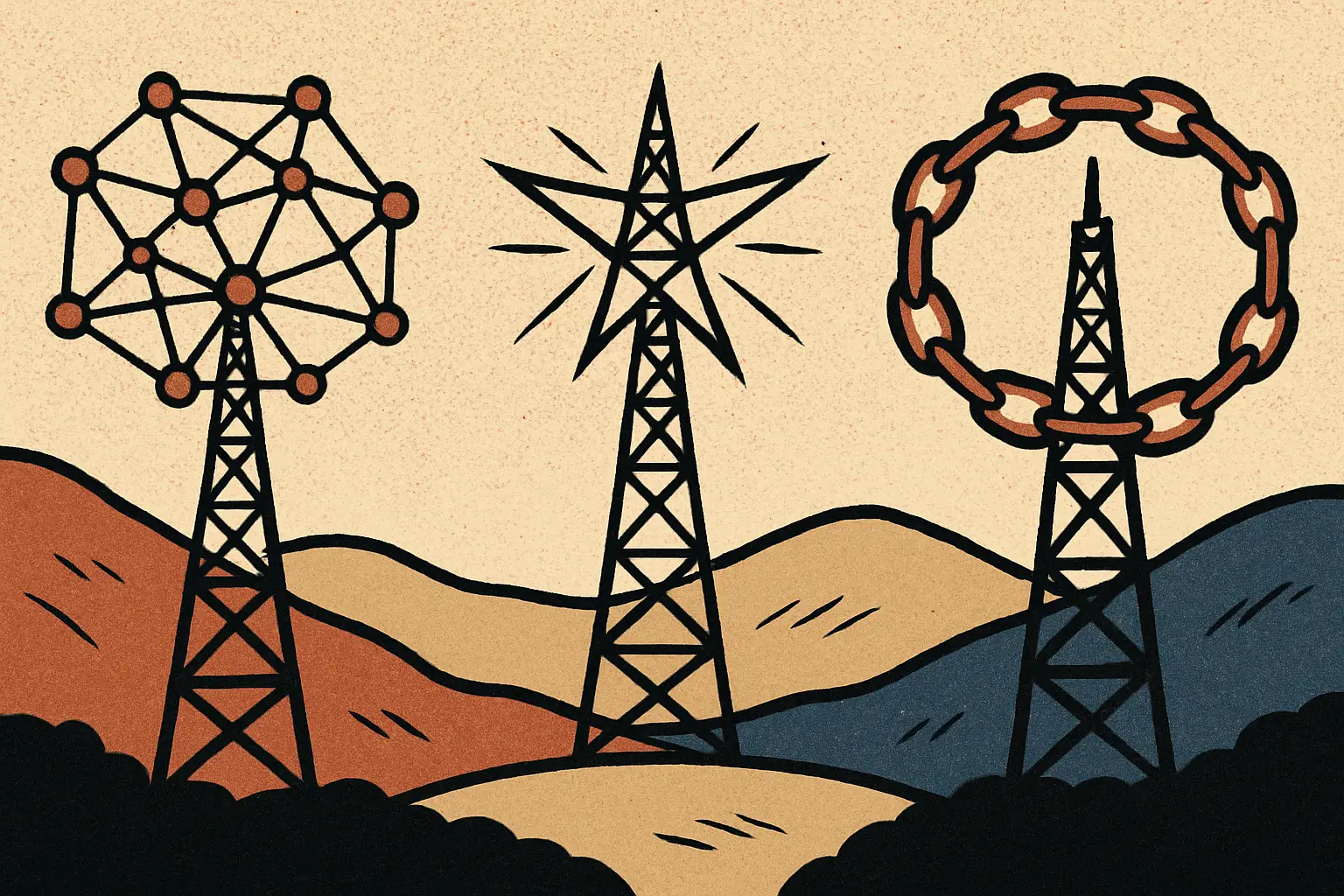
Meshtastic vs MeshCore vs LoRaWAN Explained for 2026
A plain-English guide to the three LoRa networking options: which one suits hikers, which scales to a city, and which needs gateway infrastructure.

Same Radio, Three Completely Different Networks
If you have started shopping for LoRa hardware, you have probably noticed something confusing: the same board shows up in a hiking forum, an industrial sensor catalogue, and a city-wide community network project, and in each context people describe it as a fundamentally different kind of device. They are not wrong. LoRa is a radio technology, and at least three distinct networking approaches are built on top of it. Choosing the wrong one is the most common and most expensive mistake in this space, because the hardware is often identical and the difference only becomes obvious once your network grows.
This guide explains what LoRa actually is, how LoRaWAN, Meshtastic, and MeshCore differ, and how to pick between them before you buy.
- LoRa is the physical radio layer — a long-range, low-power modulation scheme from Semtech, and nothing more
- LoRaWAN is an infrastructure protocol: nodes talk to gateways, gateways talk to a network server, and you need to run or rent that infrastructure
- Meshtastic is peer-to-peer mesh firmware where every node can relay, designed for maximum accessibility and zero infrastructure
- MeshCore is newer mesh firmware that separates roles into companions and repeaters, trading some simplicity for much better efficiency at scale
Quick Picks
If you want the short version, start here and read the detail below for the reasoning.
- Hiking, camping, festivals, or a handful of friends staying in touch off-grid: Meshtastic. It works within minutes of flashing, has the best mobile apps, and the largest community by a wide margin.
- A neighbourhood or city-scale community network with volunteers running rooftop relays: MeshCore. The companion and repeater split is what makes a large network stay usable.
- Battery sensors reporting to a dashboard, agriculture, utilities, building monitoring: LoRaWAN. You want the infrastructure model, the security architecture, and the ecosystem of managed network servers.
- You genuinely do not know yet: buy hardware that all three support — LILYGO T-Beam, T-Echo, T-Deck, Heltec WiFi LoRa, or a RAK Wireless module — and reflash later. The firmware choice is reversible; the hardware choice is less so.
- You need voice, video, or anything above a few hundred bytes per message: none of these. LoRa is a low-bandwidth technology and no firmware changes that.
What LoRa Actually Is
LoRa is a modulation scheme — chirp spread spectrum — developed by Semtech, and it exists to solve one problem extremely well: getting a very small amount of data a very long way on very little power. Range in open terrain is measured in kilometres. Power draw during transmission is measured in tens of milliamps, and idle draw on a well-designed board is microamps. Data rate is measured in hundreds of bits per second at long range.
That last number is the one people underestimate. LoRa is not slow internet; it is a different category of thing. A typical message is a couple of hundred bytes. You can send a GPS position, a sensor reading, or a short text message. You cannot send a photo in any reasonable time, and there is no version of this technology where you can.
It operates in unlicensed sub-GHz bands, which vary by region: roughly 902 to 928 MHz in the United States, 863 to 870 MHz in Europe, and other allocations elsewhere. This is why boards are sold in region-specific variants, and why buying the wrong regional variant is a genuine and common mistake. European deployments also face duty cycle restrictions — typically 1% airtime in the relevant sub-band — which limits how often any single device may legally transmit.
Crucially, LoRa itself says nothing about how devices find each other, how messages get routed, or how anything is encrypted. That is entirely the job of the layer above.
LoRaWAN: The Infrastructure Model
LoRaWAN is a specification from the LoRa Alliance that defines a complete network architecture. Its topology is a star of stars: end devices transmit to gateways, gateways forward everything to a central network server, and the network server handles deduplication, routing, and delivery to applications.
The important consequence is that devices do not talk to each other. A LoRaWAN sensor is not aware of other sensors; it broadcasts upward and the infrastructure sorts it out. That sounds like a limitation until you consider what it buys you: centralised key management, a clean security model with separate network and application session keys, adaptive data rate management that optimises each device's airtime automatically, and clear operational ownership of the network.
LoRaWAN also defines device classes with different power and latency profiles. Class A devices, the most common and most power-efficient, only listen for downlink messages briefly after transmitting — which is why a LoRaWAN sensor can run for years on a battery but cannot be reached on demand. Class C devices listen continuously and can be commanded at any time, at a substantial power cost.
Historically the awkward part of LoRaWAN was provisioning. Every device needed keys entered correctly before it could join a network, and at scale that meant either manual entry or bespoke tooling. The LoRa Alliance has been addressing this directly — recent specifications replace manual key entry with QR-code onboarding and add relay support for extending coverage, which we covered in our piece on large-scale LoRaWAN deployments.
Pick LoRaWAN when: you are deploying sensors rather than communicating between people, you need years of battery life, you want a documented security architecture, or you need to integrate with existing industrial or utility systems.
Skip it when: you do not want to run or pay for gateway infrastructure, or when the whole point is that devices talk directly to each other without a central authority.
Meshtastic: The Accessible Mesh
Meshtastic is open-source firmware that turns LoRa boards into a peer-to-peer mesh. There is no gateway, no network server, and no infrastructure. You flash two or more supported boards, they find each other, and they relay messages on each other's behalf. Pair one to your phone over Bluetooth and you have encrypted text messaging and position sharing with no cell service and no accounts.
Its defining architectural choice is that every node is a potential relay. Your handheld device forwards traffic for other people just as a rooftop node would. This is what makes Meshtastic so easy to start with — there are no roles to configure and no planning to do — and it is also the source of its scaling behaviour, which we will get to.
The community is the other genuine advantage. Meshtastic has by far the largest user base, the most polished mobile apps on both platforms, the widest hardware support, and the most documentation and troubleshooting material. If you run into a problem, someone has written about it.
Recent firmware releases have meaningfully improved routing behaviour and airtime management over earlier versions, so criticisms based on older releases have partly aged out. It remains, by design, a chattier protocol than the alternative.
Pick Meshtastic when: you want something working today, your network is a handful to a few dozen nodes, the mobile experience matters, or you value community support over raw efficiency.
Skip it when: you are planning a network with hundreds of nodes across a metropolitan area and delivery latency matters.
MeshCore: The Structured Mesh
MeshCore launched in early 2025 as an alternative mesh firmware for essentially the same hardware, and its central idea is that not every device should relay. It splits nodes into two roles. Companions are personal devices — the thing in your pocket — and they do not forward traffic for other users. Repeaters are fixed relay infrastructure, typically mounted somewhere with good line of sight, and they carry the network.
This mirrors how radio networks have always been built, and the efficiency gain is substantial. When every handheld in a crowded area stops rebroadcasting every packet it hears, the airtime freed up goes to actual delivery. Field reports from established community networks describe sub-second delivery to nearby peers and around five seconds across a nine-hop route, against ten to twenty seconds for comparable Meshtastic paths.
The cost is planning. A MeshCore network needs someone to decide where repeaters go and to maintain them. For a solo hiker that overhead is pure downside. For a city-wide volunteer network it is the thing that makes the network work at all.
Hardware compatibility overlaps almost entirely with Meshtastic — LILYGO T-Beam, T-Echo, T-Deck, Heltec WiFi LoRa, RAK Wireless modules — so this really is a firmware decision on shared hardware. The freshly announced LILYGO T-Echo Card supports both, which is increasingly typical of new boards.
Pick MeshCore when: you are building something regional, you have or can recruit people to host repeaters, or latency and airtime efficiency matter more than out-of-the-box simplicity.
Skip it when: you want to hand a device to a non-technical friend and have it just work, or your network is small enough that the efficiency gain is irrelevant.
How Do You Decide Without Guessing?
Work through these in order.
Are your endpoints people or sensors? People communicating with each other points to a mesh — Meshtastic or MeshCore. Sensors reporting to a dashboard points to LoRaWAN. This one question resolves most cases.
Who owns the network? If the answer is an organisation that can run gateways, LoRaWAN's infrastructure model is a feature. If the answer is nobody in particular, a mesh is the only workable option.
How many nodes, and how concentrated? Under roughly a few dozen nodes spread out geographically, Meshtastic's every-node-relays model is fine and its ease of use wins. Hundreds of nodes concentrated in a city is where MeshCore's role separation stops being an optimisation and becomes a requirement.
Does anything need to be reachable on demand? Mesh firmware handles bidirectional messaging naturally. LoRaWAN Class A devices do not, and moving to Class C costs you the battery life that made LoRaWAN attractive.
What is your actual data volume? Recheck this honestly. If any part of your plan involves more than a few hundred bytes per message or more than a handful of messages per minute per device, LoRa is the wrong radio and you should be looking at cellular IoT or Wi-Fi instead.
Buying Hardware Without Locking Yourself In
The good news is that the firmware decision is genuinely reversible on most hardware. Boards built around the Semtech SX1262 transceiver paired with either an ESP32 or a Nordic nRF52840 microcontroller cover all three ecosystems in practice.
A few purchasing notes worth internalising. Buy the correct regional frequency variant for where you live — this is not a software setting. Prefer nRF52840-based boards if battery life is your priority and ESP32-based boards if you want Wi-Fi alongside LoRa. Check antenna quality, because a good antenna does more for range than any firmware setting. And never power on a LoRa board without an antenna attached; transmitting into an unmatched load can damage the radio.
For anyone building sensor nodes rather than handhelds, boards like the Maker Go ESP32-C5 relay board with RS-485 show how the wider embedded ecosystem is converging on the same low-cost, well-supported silicon.
The Short Version
LoRa is the radio. LoRaWAN, Meshtastic, and MeshCore are three different opinions about what to build on it. LoRaWAN assumes infrastructure and gives you industrial-grade sensor networking in return. Meshtastic assumes nothing and gives you a working off-grid mesh in ten minutes. MeshCore assumes a bit of planning and gives you a mesh that stays fast as it grows.
Pick the one that matches who owns your network and what your endpoints are, buy hardware that supports all three, and reflash if you were wrong.
More hardware guides in our mini computers coverage.
Sources: Mesh America — April 26, 2026; NodakMesh protocol comparison — 2026; CNX Software on LoRaWAN provisioning — August 5, 2026; LoRa Alliance — 2026.
More Mini Computers Stories
MaTouch ESP32-S3 E Ink Board: A $60 Voice-Ready Dashboard
Makerfabs' MaTouch ESP32-S3 pairs a 7.5-inch four-color E Ink screen with a four-mic array for $59.80. Here are the specs and what you can build.
ASRock NUC 300 Mini PCs: Wildcat Lake With Dual 2.5GbE
ASRock Industrial's NUC 300 series brings Intel Core 5 320 and Core 3 304 to mini PCs and boards with up to 64GB of DDR5-6400 memory and dual 2.5GbE.

DGX Spark 64GB: Who NVIDIA's $4,999 Local AI Box Is For
NVIDIA's DGX Spark 64GB starts at $4,999 on Oct 23 and runs models up to 100B parameters. Here is who the local AI box suits and how clustering works.