
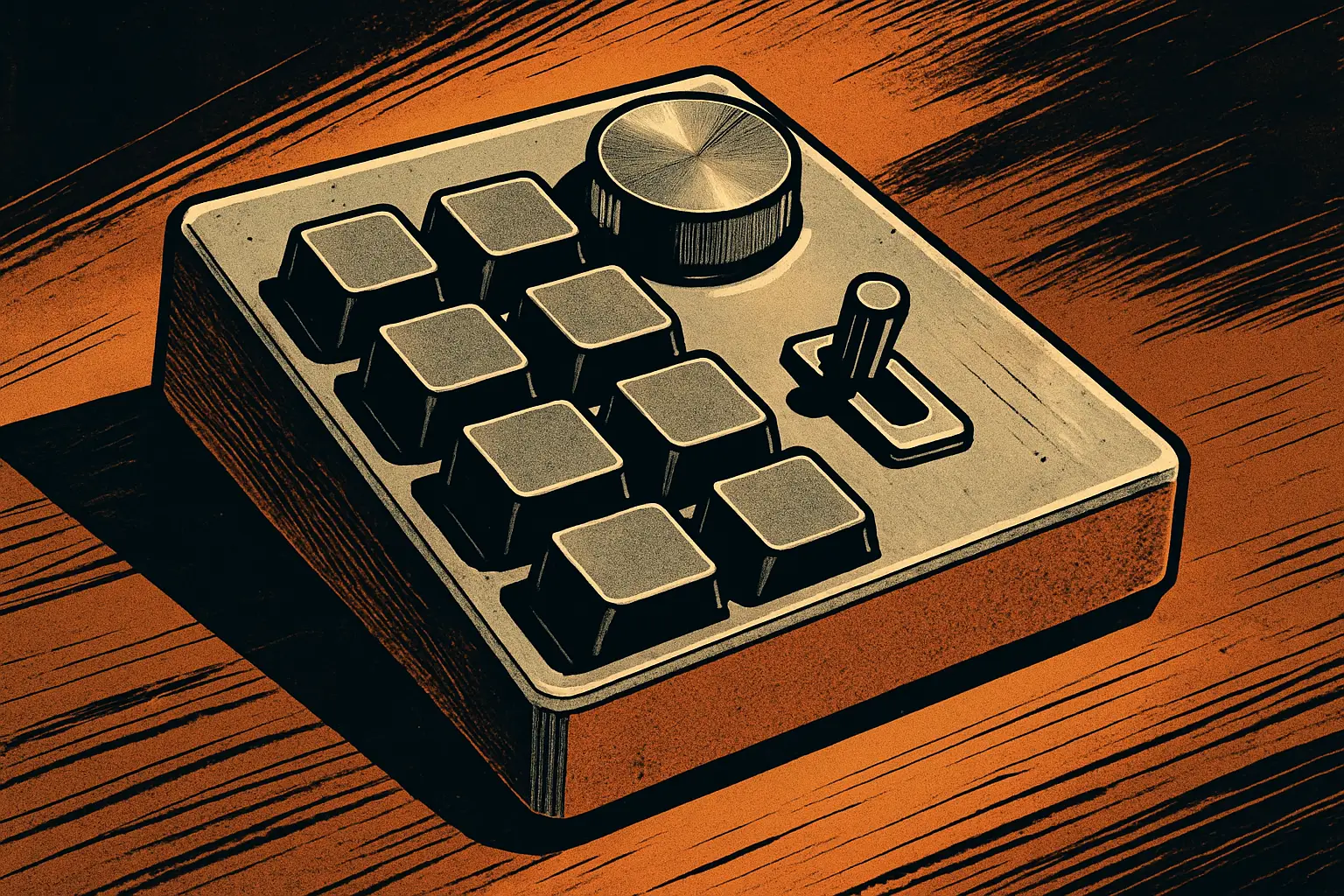
CtrlVibe AI Console Keypad Starts at $109 on Kickstarter
CtrlVibe AI Console packs nine hot-swappable keys, a rotary encoder, and a three-way permission toggle into a CNC aluminum keypad starting at $109.

Physical control surfaces for AI tooling are becoming a real product category, and the CtrlVibe AI Console is the most thoroughly specified one I have seen. It is a nine-key programmable keypad in a machined 6061 aluminum shell, aimed squarely at people who spend their day driving coding agents and want the common actions under their fingers instead of behind a keyboard shortcut.
- Nine hot-swappable mechanical keys mapped by default to Record, Run, Stop, Apply, Retry, Agent, Model, Diff, and Prompt
- A stepless rotary encoder for switching between AI apps and models, plus a three-position stainless steel toggle for Ask, Bypass, and Auto permission modes
- 1.14-inch color LCD, MEMS microphone array with noise reduction, and Bluetooth, 2.4 GHz wireless, and USB-C connectivity
- Super Early Bird pricing at $109 standard or $129 for the Carbon Matrix edition, with delivery estimated November 2026
What Makes the CtrlVibe AI Console Different?
The headline hardware feature is not the keys — it is the toggle switch. A three-position stainless steel lever selects the permission mode an agent runs under: Ask for confirmation on every action, Bypass for a looser mode, or Auto to let it run. Turning a software permission setting into a mechanical switch you can see across the room is a genuinely good ergonomics idea, because the state of the switch is unambiguous at a glance.
The rest is well-executed convention. The 120 x 89 x 30 mm case is CNC-milled 6061 aluminum with a brushed anodized finish over a multi-layer acrylic and ABS base. The 1.14-inch LCD shows the active application or model, and the stepless encoder cycles between them. The MEMS microphone array handles voice capture, with processing available locally or through a cloud service.
What AI Tools Does It Support?
CtrlVibe lists ChatGPT, Cursor, VS Code, Gemini, and plain terminal sessions. That breadth is the pitch against the Work Louder Codex Micro, which sells for $230 and is tuned to a narrower workflow. Configuration runs through a CtrlVibe Configurator app that ships when the campaign completes.
One honest caveat for the open hardware crowd: the companion software is proprietary, and the microcontroller has not been announced yet. If you want something fully open today, there is an existing open-source firmware project for the M5Stack Core2 that reproduces much of the same behavior — a close cousin of the approach behind the Stream32 open-source stream deck on ESP32.
Is $109 a Good Price for an AI Macropad?
For a machined aluminum case, hot-swap sockets, an encoder, a color LCD, and a microphone array, $109 is competitive — a comparable custom macropad build in parts alone lands close to that before you write any firmware. The Early Bird tier at $139 and up is still under the $230 Codex Micro.
The usual crowdfunding caveats apply: November 2026 is an estimate, and the MCU choice is still open. But the concept is sound, and it fits a trend we keep seeing in our mini computer coverage — small purpose-built input hardware showing up wherever a software workflow gets repetitive enough to deserve a dedicated button.
Sources: CNX Software — August 5, 2026.
More Mini Computers Stories

MaTouch ESP32-S3 E Ink Board: A $60 Voice-Ready Dashboard
Makerfabs' MaTouch ESP32-S3 pairs a 7.5-inch four-color E Ink screen with a four-mic array for $59.80. Here are the specs and what you can build.

ASRock NUC 300 Mini PCs: Wildcat Lake With Dual 2.5GbE
ASRock Industrial's NUC 300 series brings Intel Core 5 320 and Core 3 304 to mini PCs and boards with up to 64GB of DDR5-6400 memory and dual 2.5GbE.

DGX Spark 64GB: Who NVIDIA's $4,999 Local AI Box Is For
NVIDIA's DGX Spark 64GB starts at $4,999 on Oct 23 and runs models up to 100B parameters. Here is who the local AI box suits and how clustering works.