
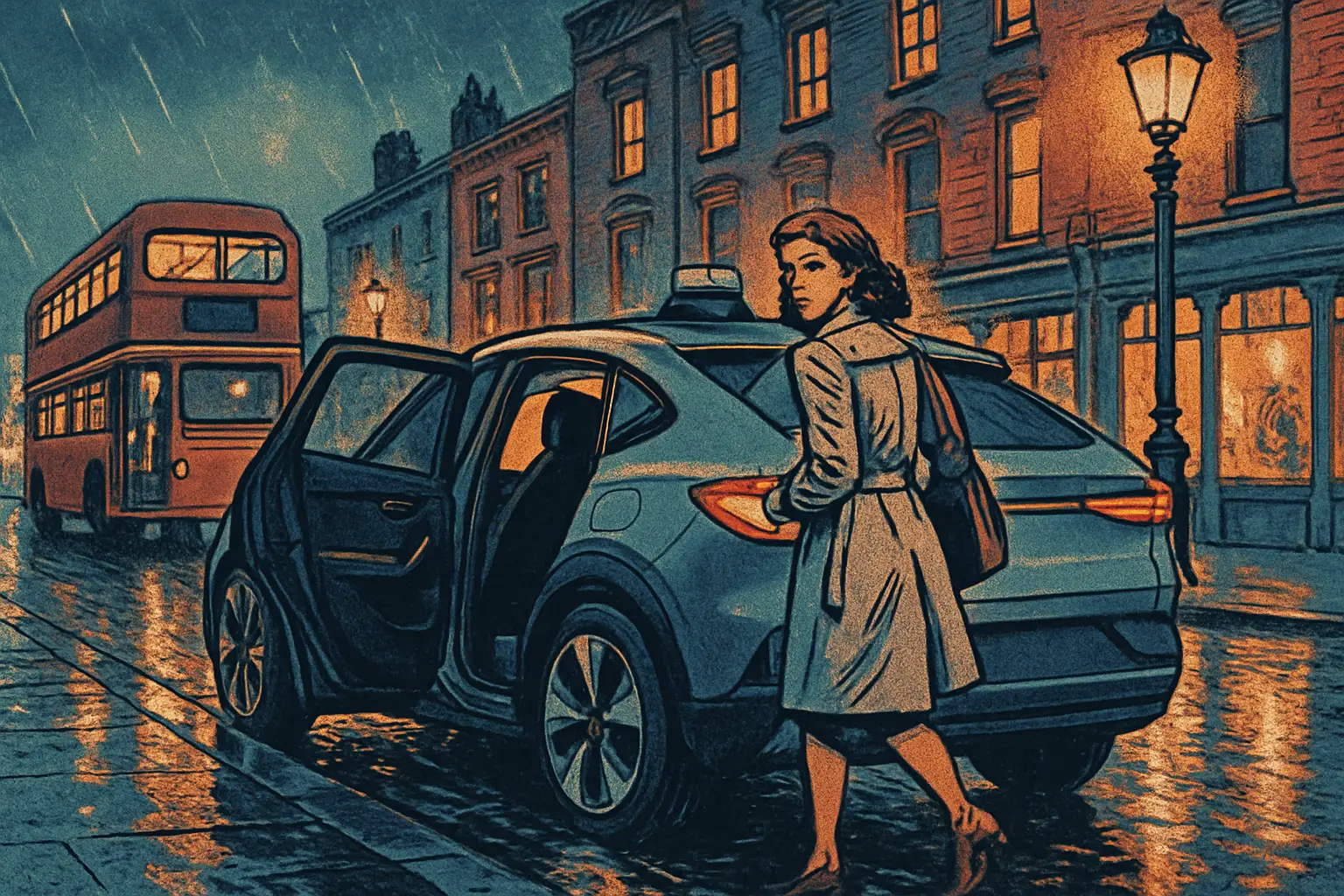
Wayve AI Driver Brings Robotaxi Rides to London Uber
Wayve and Uber launched the UK's first autonomous rides in London on September 3, with a safety driver aboard and no surcharge on UberX fares.

The UK's First Autonomous Rides Are Live on a Normal Uber Fare
On September 3, 2026, a Londoner opening the Uber app and requesting an UberX became eligible to be matched with a car driving itself. Wayve and Uber launched supervised autonomous rides in London that day — the first time autonomous trips have been available to the public anywhere in the United Kingdom — and the detail that makes it interesting is how ordinary the transaction is. Same app, same upfront fare, no surcharge.
- What launched: supervised autonomous rides on the Uber platform, powered by the Wayve AI Driver
- Vehicles: all-electric Ford Mustang Mach-E with surround sensors, matched to UberX, Uber Electric and Uber Comfort requests
- Supervision: a trained, TfL-licensed private hire driver is aboard every vehicle during the launch phase
- Coverage: anywhere in London except the airports, with more than 140,000 Londoners already opted in through Trip Preferences
How the Ride Actually Works
Riders are matched rather than opted-in per trip, and the match is disclosed before the car arrives — you can accept the autonomous ride or switch to a conventional one. Once it pulls up, the Uber app handles unlocking the doors and starting the trip, the same flow as any other ride.
Inside, Uber designed an interactive screen available in 64 languages that shows the vehicle's planned route as it drives. That is a small piece of interface design doing a large amount of work. The most common objection to autonomous rides is not safety statistics but the discomfort of not knowing what the car intends to do next, and showing the intended path is the cheapest available answer.
The fleet started small. Bloomberg reported 15 autonomous vehicles licensed to operate in the city, and Wayve says growth will be paced deliberately rather than by a headline number. Uber received its London autonomous vehicle licence last month, and that licence requires a human driver to remain present in a supervisory role.
What Makes the Wayve AI Driver Different?
Wayve's approach is end-to-end learning rather than a stack of hand-coded rules layered onto high-definition maps. The system learns driving behaviour from data and generalises to roads it has not been individually mapped for, which is the argument for why it can be dropped into a city as geometrically awkward as London — unsignposted junctions, bus lanes, cyclists, and streets laid out several centuries before cars existed.
That generalisation claim is also the commercially important one. A mapping-heavy approach scales city by city at the cost of a survey fleet. An approach that generalises scales with vehicles. Wayve has said it is working toward 12 global markets, with a Nissan LEAF rollout planned for Tokyo later in 2026.
Wayve chief executive Alex Kendall said the company was proud to introduce the Wayve AI Driver to the public for the first time in London. Uber's Sarfraz Maredia described it as bringing autonomous rides to Uber riders in the city for the very first time.
Why a Safety Driver Still Matters
It is tempting to read the onboard safety driver as a caveat that undercuts the announcement. It is more useful to read it as the regulatory shape of a first deployment. The vehicles are collecting supervised miles on public roads under a licence that requires supervision, which is how the evidence base for a later unsupervised licence gets built.
The comparison worth drawing is with the money already committed to this category. Uber's $1.25 billion investment in Rivian to deploy 50,000 robotaxis earlier this year and the five automakers building Level 4 vehicles on NVIDIA Drive Hyperion were both statements of intent. Fifteen cars carrying paying passengers in London is a smaller number and a larger fact.
What to Watch Next
Three things will tell you whether this generalises. First, whether the operating area expands to include airports, which is where ride-hailing demand concentrates and where the driving environment is hardest. Second, how quickly the fleet grows past the low tens of vehicles, since supervised miles are the input to everything that follows. Third, whether the Tokyo rollout on a different vehicle platform lands on schedule — porting an AI driver to a different car in a different country is the real test of the end-to-end thesis.
For readers tracking how machine learning moves off the screen and into the physical world, this is one of the clearer markers of the year. More on that shift in our AI coverage.
Sources: Wayve — Wayve and Uber launch autonomous rides — September 3, 2026; Bloomberg — September 2, 2026.
More AI Stories

Claude Quantum Circuit Design: What Mythos 5 Just Improved
Claude Mythos 5 designed quantum circuits that beat the best published designs on 8 tasks, including a decoder with 12x fewer gates. Here's what changed.
Elorian Glimpse: A Visual Thinking Model That Rewatches
Elorian Glimpse reasons with images, zooming and rewatching video as it thinks, and costs $0.60 per million input tokens. Here's how it stacks up.
DeepSeek V4.1 Flash 1017: Bigger Agent Gains, Same Price
DeepSeek V4.1-Flash-1017 lifts Terminal-Bench 4.0 from 31.2 to 42.3 with MIT-licensed open weights, unchanged API pricing, and a new Search API.