
SensWear Open-Source Wearable Kit Ships With 4 Sensors
SensWear is an open-source nRF54L15 wearable platform with four swappable sensor boards, MIT-licensed firmware, and a EUR 849.99 full bundle.

A Wearables Prototyping Stack Where Every Layer Is Open
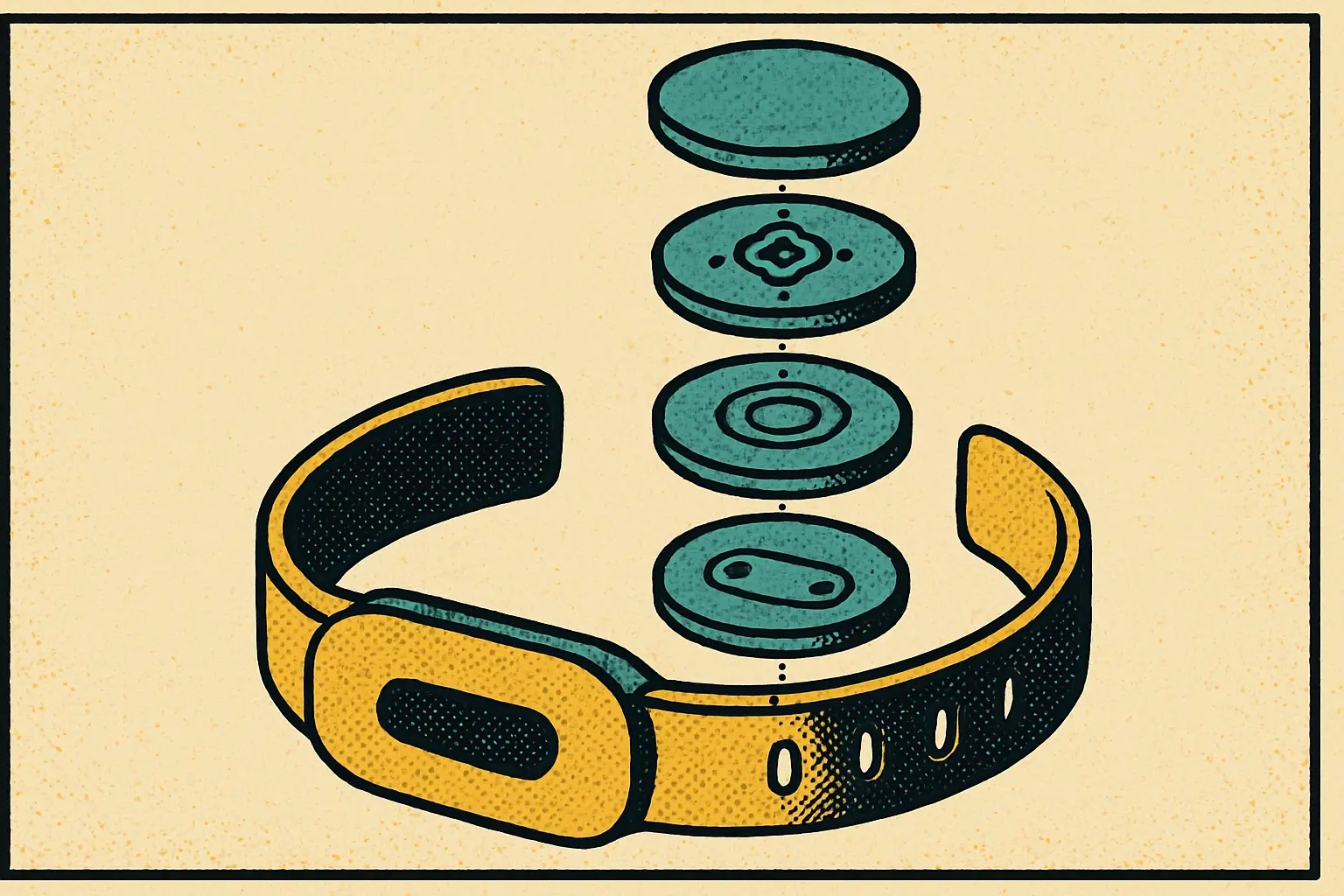
SensWear is a modular development platform for wearable devices built around Nordic Semiconductor's nRF54L15, and its distinguishing feature is how little of it is closed. The Sens-Wear team has published hardware design files, Zephyr-based firmware, raw sensor data pipelines, Android and iOS companion apps, and Python and TypeScript SDKs — all under the MIT license on GitHub. For researchers and product teams building smart rings, wristbands, or adhesive patches, that removes most of the reverse-engineering that normally precedes a first prototype.
- Nordic nRF54L15 core board with a 128 MHz Arm Cortex-M33, a RISC-V coprocessor, 256 KB SRAM, and 1.5 MB of non-volatile memory
- Radio support for Bluetooth LE 6.0, Thread, Zigbee, Matter, Amazon Sidewalk, and NFC, with a Bosch BHI360 six-axis IMU onboard
- Four swappable daughter boards: MAX30101 PPG optical sensing, MAX30208 temperature, MTCH6102 15-channel capacitive touch, and DRV2605 haptics
- EUR 849.99 for the complete bundle, EUR 699.99 for the core board alone, EUR 99.99 per daughter board, sold through sens-wear.com
Why the Daughter Board Interface Is the Real Product
The core board is a competent nRF54L15 design, but the standardized daughter board interface is what makes SensWear a platform rather than a devkit. Each sensor module plugs into the same connector with a programmable supply rail spanning 1.2 V to 5.5 V, which means swapping from optical heart-rate sensing to skin temperature to capacitive touch is a mechanical operation rather than a board respin.
Anyone who has prototyped a wearable knows why that matters. The hard question early in a project is rarely "can this MCU drive this sensor" — it is "which sensing modality actually produces a usable signal on a wrist, on a finger, under motion, across different skin tones and ambient light." Answering that empirically requires trying several sensors on the same platform with the same firmware, and every board revision in between costs weeks.
What Do You Get in Software?
The stack is more complete than most open hardware projects manage. Firmware is built on Zephyr, which brings a maintained BLE stack and a sane driver model rather than a vendor SDK you will be forking forever. Raw sensor data is exposed rather than pre-processed into vendor-defined metrics, which is the single most important property for research use — a heart-rate number is only as good as the algorithm that produced it, and researchers generally need to bring their own.
Around that sit Android and iOS applications for capture and inspection, plus Python and TypeScript SDKs for building custom analysis pipelines. A separate debug board with JTAG/SWD and J-Link support handles programming and tracing.
Who Is This Priced For?
At EUR 849.99 for the full bundle, SensWear is not competing with a EUR 20 hobbyist board, and it is not trying to. The comparison that makes sense is against the cost of designing a custom flex PCB, sourcing four sensor packages, writing the BLE plumbing, and building mobile capture apps — a sequence that consumes months before the first real measurement. Priced as research and product-development equipment, it looks reasonable; priced as a maker board, it does not. Buyers should read it as the former.
How It Fits the nRF54L Landscape
SensWear joins a growing set of nRF54L15 hardware, following the nRF54L15 Discovery board that splits into two usable boards. The two serve different purposes — Discovery is a general-purpose evaluation platform, SensWear is a body-worn sensing rig — but both point at the same thing: Nordic's newest low-power part is accumulating an ecosystem quickly. Our mini computer coverage has been tracking that build-out, and an MIT-licensed full-stack reference design is a meaningful addition to it.
Sources: CNX Software — July 29, 2026; Sens-Wear — July 2026.
More Mini Computers Stories

OpenMANET Runs Video Over Wi-Fi HaLow Mesh Networks
OpenMANET pushes 1-15 Mbps over 802.11ah mesh on a Raspberry Pi 4, adding voice, RTSP video and full IP where Meshtastic sends only short text.

Renesas RZ/G3L MPUs Hit 1 mW Standby With Cortex-A55
Renesas' new RZ/G3L and RZ/G3SE run four Cortex-A55 cores at 1.2 GHz and drop to roughly 1 mW in deep standby, from $14.28 in volume pricing.
ESP32-S3 Runs Linux 6.11 With 3.7MB of RAM to Spare
Release 0.8 of the native ESP32-S3 Linux port fixes the crash that hit one boot in ten and halves the memory cost of every fork. One file to flash.