
nRF54L15 Discovery Board Snaps Into Two Usable Boards
Icy Electronics' $27.19 nRF54L15 Discovery packs a Cortex-M33, a RISC-V coprocessor, and a snap-off CMSIS-DAP debugger you can reuse separately.

Two Boards for the Price of One, Literally
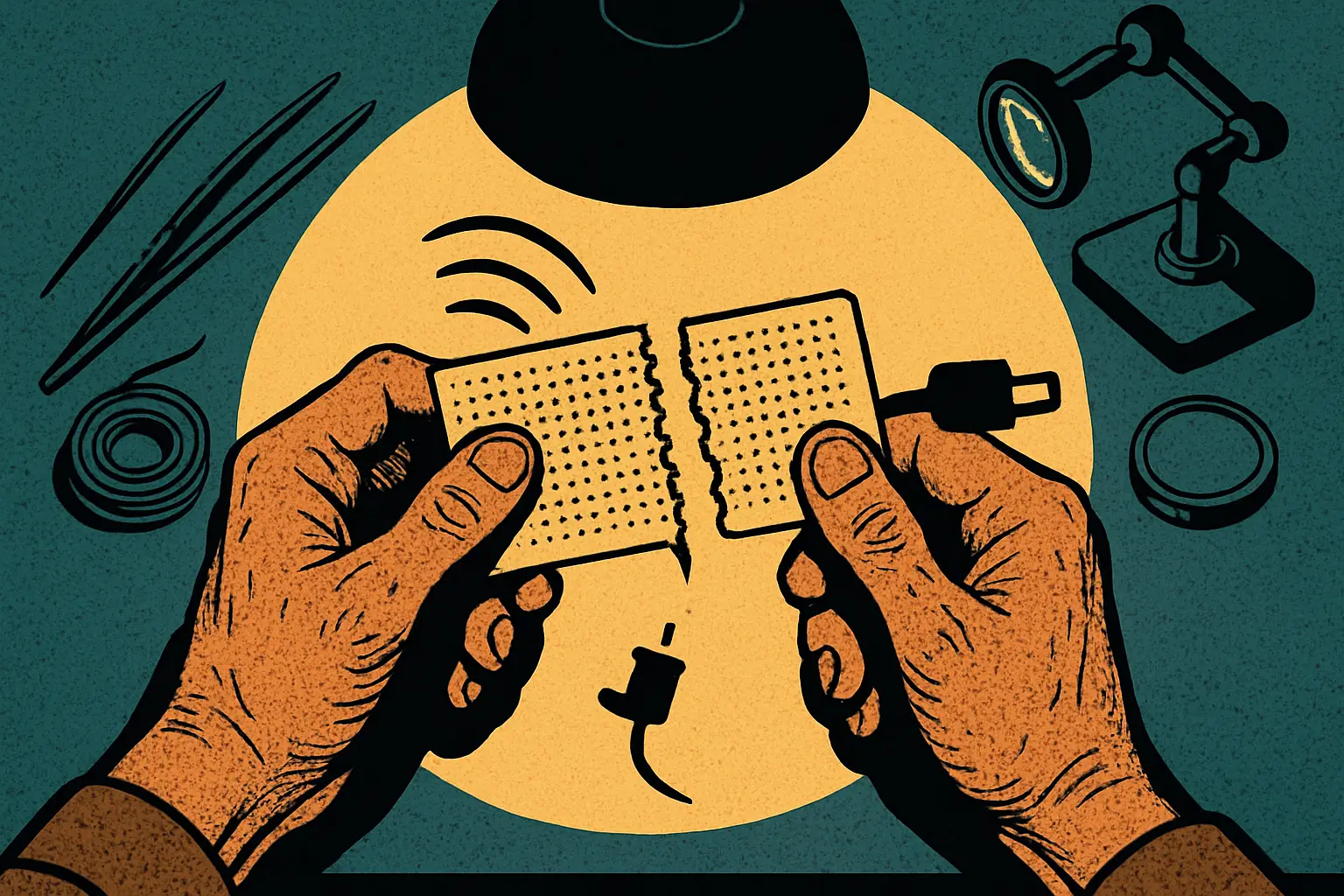
Most development kits bundle a debugger you can never use for anything else. Icy Electronics took a different approach with the nRF54L15 Discovery, detailed on July 23, 2026: the 91 × 21 mm board is designed to snap apart along a score line, leaving the target microcontroller on one piece and a fully functional CMSIS-DAP programmer on the other. Both halves keep working on their own.
- $27.19 on Tindie or Lectronz, with volume discounts starting at five units
- Target MCU: Nordic nRF54L15 — 128 MHz Arm Cortex-M33 plus a RISC-V coprocessor, 256KB SRAM, 1.5MB non-volatile memory, up to 48 GPIO
- Debugger MCU: nRF52820 (Cortex-M4 @ 64 MHz) pre-flashed with CMSIS-DAP firmware
- Radios: Bluetooth LE 6.0 with Channel Sounding, Thread, Zigbee, Matter, Amazon Sidewalk, proprietary 2.4 GHz at up to 4 Mbps, and NFC
Why Is the Snap-Apart Design Actually Useful?
Think about how a project ends. You prototype on a dev kit, then move the design to custom hardware — and now you need a programmer for the new board. Traditionally that means buying a separate probe, or keeping the entire old dev kit on the bench as an expensive dongle.
Snapping the nRF54L15 Discovery in half solves both problems at once. The debugger half becomes your general-purpose CMSIS-DAP probe for whatever you build next. The target half becomes a compact module you can wire into a prototype without dragging the programmer along. For $27, you effectively get a dev board and a reusable debug probe.
Each half also carries its own USB Type-C port, which is the detail that makes the split genuinely practical rather than a novelty. Neither piece depends on the other for power or connectivity.
What the nRF54L15 Brings
Nordic's nRF54L series is built around the pairing of a 128 MHz Cortex-M33 with a RISC-V coprocessor handling software-defined peripherals — a design that lets the main core sleep while the coprocessor services simple I/O. Combined with 256KB SRAM and 1.5MB NVRAM, it targets battery-powered devices that spend most of their life asleep.
The radio is the multi-protocol part that makes it broadly useful: Bluetooth LE 6.0 including Channel Sounding for accurate distance measurement, plus 802.15.4 for Thread and Zigbee, which is the path to Matter smart-home devices. NFC support rounds it out for tap-to-provision workflows.
What Do You Get on the I/O Side?
Breakout is generous for a board this small: dual-row headers with castellated edges for 60 total pins, U.FL connectors for both the 2.4 GHz and NFC antennas, five configurable SPI/UART/I2C interfaces, three PWM channels, two quadrature decoders, I2S, PDM and a 14-bit ADC.
Power management is the part hobbyist boards usually skimp on and this one does not. There is a Nordic nPM1300 PMIC with USB-C-compliant LiPo charging from 32 to 800 mA, power path management, a 200 mA buck-boost converter and configurable 1.0V–3.3V output, plus a TPS63900 buck-boost for selectable 1.8V or 3.3V I/O. For a battery project, having proper charge management on the dev board means your power measurements actually resemble the finished device.
Software support covers Zephyr RTOS, Nordic's nRF Connect SDK, and MicroPython — so you can start in Python and drop to Zephyr when you need the power numbers.
How It Compares to Nordic's Own Kit
Nordic's official nRF54L15 DK is the reference platform and remains the right choice if you want first-party support and the broadest example coverage. What the Icy Electronics board offers instead is form factor and reusability: a narrow 91 mm strip you can embed in a prototype, at a price well below a DK plus a separate probe. It joins a growing set of compact nRF54L options, including the coin-cell nRF54L15 Tag and Seeed's XIAO nRF54LM20A Sense.
What to Watch Next
Worth tracking: whether the snap-apart pattern spreads to other vendors' kits, how the CMSIS-DAP half performs as a general probe against dedicated debuggers, and community Zephyr board definitions as more makers get hardware. Shipping is from France, starting at $3.20 for untracked global delivery.
Sources: CNX Software — July 23, 2026; Hackster.io — July 2026; Lectronz product listing — July 2026.
More Mini Computers Stories

ESP32-S3 Runs Linux 6.11 With 3.7MB of RAM to Spare
Release 0.8 of the native ESP32-S3 Linux port fixes the crash that hit one boot in ten and halves the memory cost of every fork. One file to flash.

Alif StartKits Put an Ethos-U55 NPU on a $50 Board
Alif's Balletto B1 and Ensemble E1C StartKits pair a 160MHz Cortex-M55 with an Ethos-U55 NPU, two mics and a camera header for $49.99.

JetKVM Mini Cuts IP KVM Cost to $39 With ESP32-P4X
JetKVM Mini drops Linux for FreeRTOS on an ESP32-P4X, landing a 42mm IP KVM with HDMI capture and WebRTC streaming at $39, or $33 in a 3-pack.