
This $12.99 RISC-V Camera Board Ships USB 3.0 and Dual Cores
AnalogLamb's $12.99 Petros RISC-V camera board pairs dual cores with USB 3.0 SuperSpeed and an OV2640 module for cheap, plug-and-play embedded vision.

A $12.99 RISC-V Camera Board Packs USB 3.0 and Dual Cores
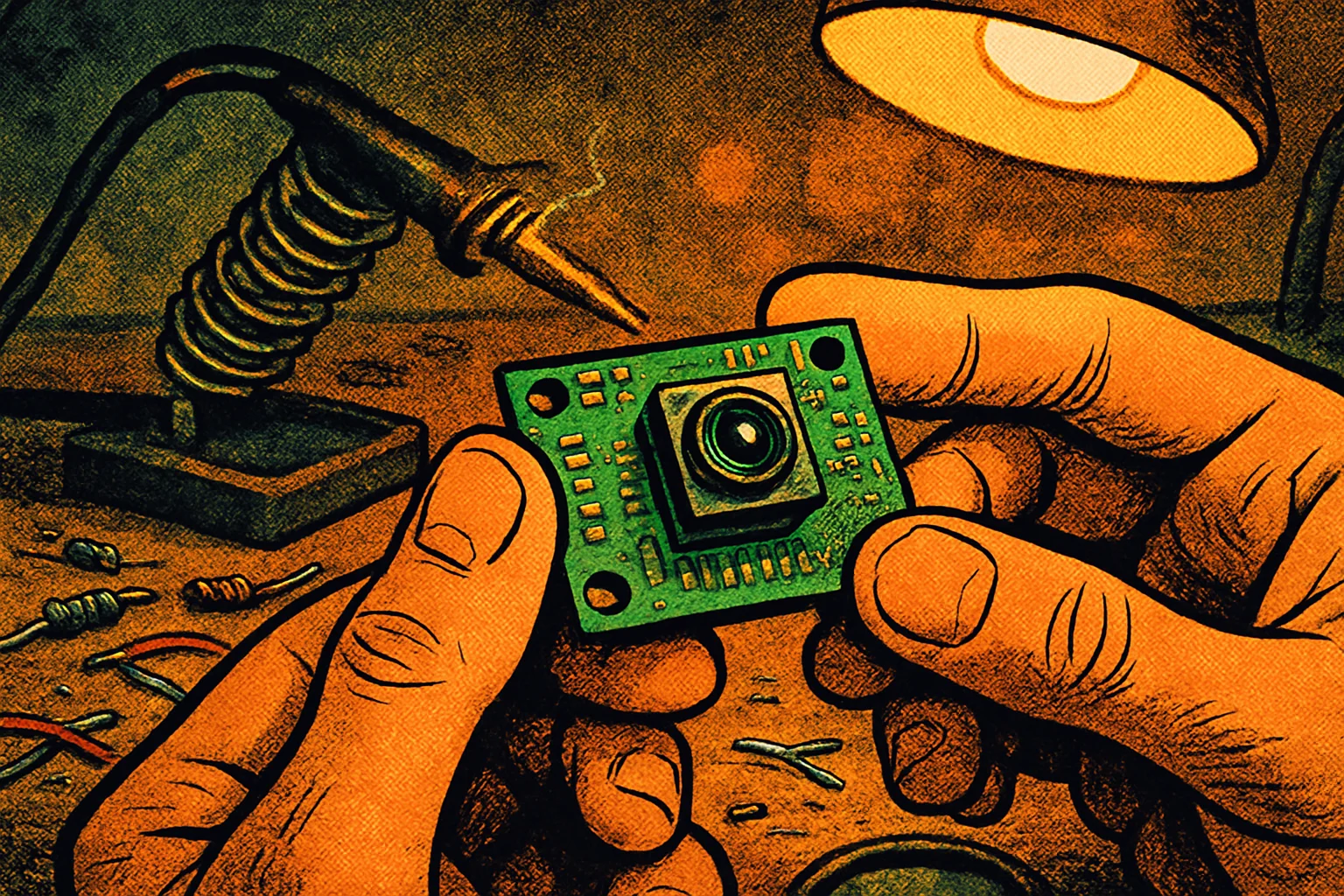
If you build embedded-vision gadgets, the new RISC-V camera board from AnalogLamb deserves a slot on your bench. Called the Petros CH32H417M Alef, it crams a dual-core RISC-V microcontroller, a full-size USB 3.0 SuperSpeed port, and a snap-on camera module onto a Raspberry Pi Pico-sized footprint that starts at just $12.99. For makers chasing cheap machine vision and low-cost USB webcam projects, this is one of the most spec-dense little boards to surface in a while.
Two RISC-V cores and a graphics accelerator
The brains here is WCH's CH32H417 microcontroller, and the core lineup is the part that made me look twice. You get a primary 400 MHz QingKe RISC-V5F core paired with a secondary 144 MHz RISC-V3F core, so there is real headroom to split duties: run your imaging pipeline hot on the fast core while the slower core babysits I/O and housekeeping. WCH also baked in a graphics hardware accelerator (GPHA), which is exactly the kind of fixed-function block you want when you are pushing pixels on a microcontroller budget.
Memory is generous for this class of part: 896KB of SRAM and 960KB of flash. That SRAM figure matters for a camera board, because frame buffers are hungry, and having nearly a megabyte on-chip means you can hold meaningful image data without bolting on external RAM.
USB 3.0 SuperSpeed is the headline spec
Here is where the Petros Alef separates itself from the usual hobbyist crowd. It carries a full USB 3.0 Type-A port rated at 5 Gbps SuperSpeed, and AnalogLamb's benchmarks clocked real throughput at roughly 430 MB/s. That is a wild number for a board this small and this cheap. Most microcontroller dev boards top out at USB 2.0, so seeing genuine SuperSpeed transfer rates here opens doors for streaming higher-resolution or higher-framerate data straight to a host without choking the pipe.
The camera side connects through a 40-pin board-to-board connector that accepts a 2MP OV2640 module over a 144 MHz DVP interface. The OV2640 is a well-known, well-documented sensor, so driver work and community examples are plentiful. Once the firmware is finalized, the board is designed to enumerate as a standard USB UVC webcam, meaning your operating system would treat it like any plug-and-play camera. No custom host drivers, no fuss.
Pico-style pinout makes prototyping painless
Physically, the RISC-V camera board measures 52mm x 21mm, matching the Raspberry Pi Pico, and it carries two 20-pin GPIO headers that follow the Pico pinout. If you have Pico-compatible carrier boards, breakouts, or jumper habits, they transfer straight over. AnalogLamb exposes SPI, I2C, and ADC on the headers, plus a dedicated 6-pin SWD/UART6 debug header for flashing and tracing.
The pricing tiers are tidy and aggressive. The bare board is $12.99. Add the OV2640 camera module and you are at $19.99. Tack on the debug board too and the full kit lands at $23.99. For under twenty-five dollars you get a dual-core RISC-V machine, SuperSpeed USB, and a working camera front end. The board design is credited to XPU Labs.
What makers can build with it
Price-to-performance is the whole story here, and the ratio is excellent. A sub-$20 camera-equipped RISC-V board with USB 3.0 throughput and a UVC webcam target is a natural fit for cheap embedded-vision experiments: motion-triggered loggers, simple object detection front ends, document scanners, lab automation eyes, or a tinkerer's homebrew webcam. The dual-core split plus the GPHA gives you room to do light on-device processing before the data ever hits the host.
A practical caveat worth flagging as analysis rather than fact: the UVC webcam behavior depends on firmware that AnalogLamb describes as not yet finalized, so early adopters should expect the software stack to mature over time. But the hardware foundation is unusually capable for the money. If you have been waiting for an affordable RISC-V camera board that does not make you choose between performance and price, the Petros CH32H417M Alef is a compelling place to start soldering.
Sources: CNX Software — May 29, 2026, AnalogLamb product listing — May 29, 2026, Tux Machines — May 30, 2026
More Mini Computers Stories

MaTouch ESP32-S3 E Ink Board: A $60 Voice-Ready Dashboard
Makerfabs' MaTouch ESP32-S3 pairs a 7.5-inch four-color E Ink screen with a four-mic array for $59.80. Here are the specs and what you can build.

ASRock NUC 300 Mini PCs: Wildcat Lake With Dual 2.5GbE
ASRock Industrial's NUC 300 series brings Intel Core 5 320 and Core 3 304 to mini PCs and boards with up to 64GB of DDR5-6400 memory and dual 2.5GbE.

DGX Spark 64GB: Who NVIDIA's $4,999 Local AI Box Is For
NVIDIA's DGX Spark 64GB starts at $4,999 on Oct 23 and runs models up to 100B parameters. Here is who the local AI box suits and how clustering works.