
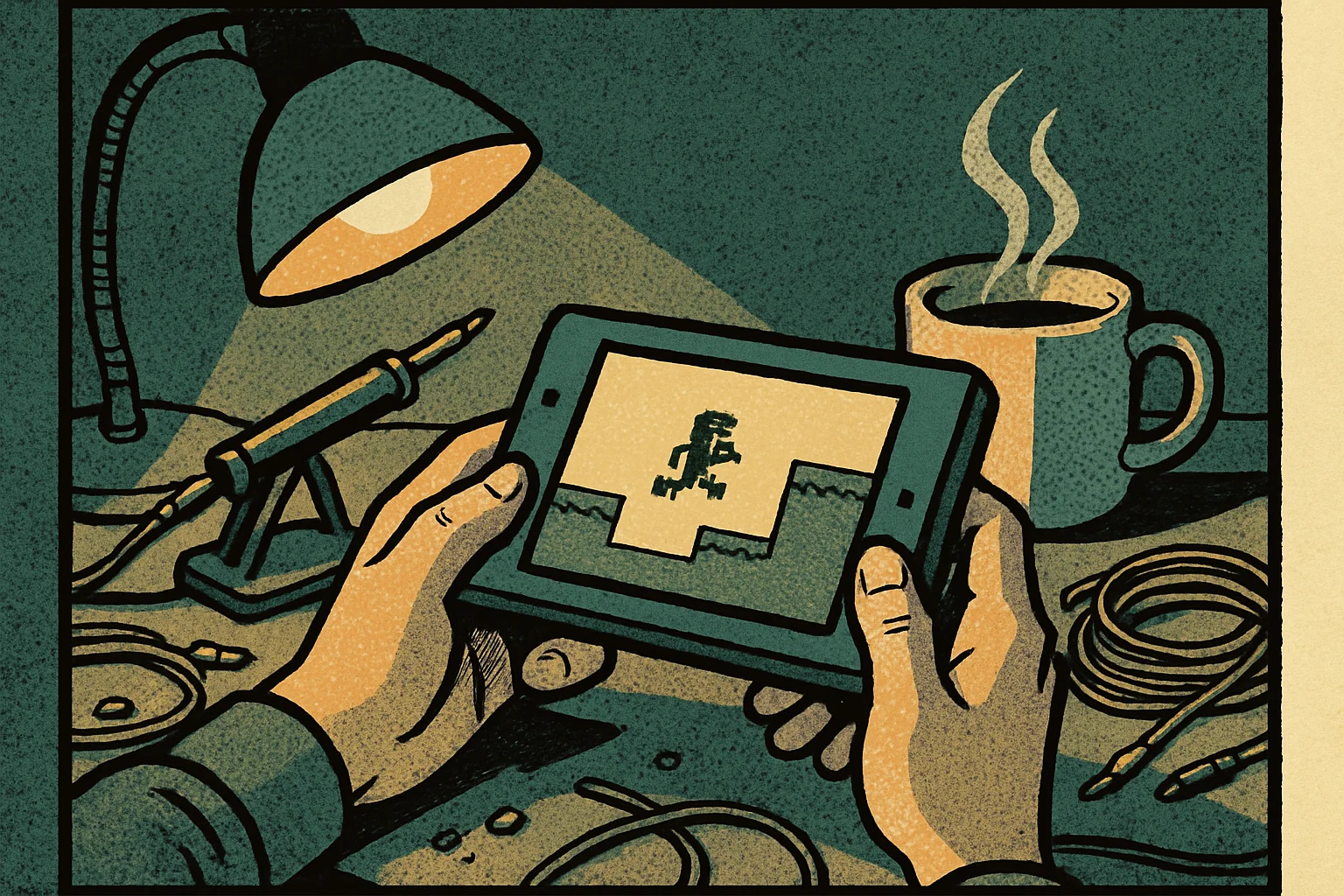
PaperBoy Runs a Game Boy Emulator at 60 FPS on E Ink
PaperBoy drives an ESP32-S3 E Ink devkit at a full 60 FPS, running a Game Boy emulator with a BLE gamepad by bypassing the normal e-paper waveform. It's open source.

The Trick That Shouldn't Work, But Does
Ask anyone who has tinkered with electronic paper and they will tell you the same thing: E Ink is beautiful, and E Ink is slow. It is built for still pages, not motion. So when engineer Wenting Zhang got a Game Boy emulator running at a full 60 FPS on an E Ink screen — a project called PaperBoy, written up on July 2, 2026 — it landed as one of those wonderful "wait, that's not supposed to be possible" maker moments.
The hardware is refreshingly off-the-shelf: an M5Stack PaperS3, which pairs an ESP32-S3 microcontroller with a 4.7-inch, 960x540 E Ink display. This is a devkit you can buy, not a bespoke lab rig, which is a big part of what makes the achievement so shareable.
How You Get 60 FPS Out of Electronic Paper
Here is the clever part. Normally you drive an e-paper panel through its controller's built-in waveform tables — carefully tuned voltage sequences that flip the display's pigment particles cleanly, at the cost of speed. Zhang bypassed that entirely, driving the panel's raw row and column drivers directly instead.
By taking manual control of the display at that low level, PaperBoy trades the usual crisp-but-slow refresh for a fast, good-enough one, and suddenly the panel can keep pace with a game running at 60 frames per second. It is a beautiful example of understanding hardware deeply enough to break the rules productively — the kind of low-level insight that separates a clever hack from a spec sheet.
A Playable Handheld, Not Just a Demo
Crucially, this is not a jittery proof of concept. PaperBoy runs the CrankBoy emulator and adds Bluetooth LE gamepad support, so you get real controls rather than fiddly onboard buttons. The result plays actual games smoothly: reports have Pokemon Blue, Super Mario Land, and The Legend of Zelda: Link's Awakening all running well on that matte E Ink screen.
There is something genuinely charming about playing a Game Boy classic on electronic paper. The low-glare, easy-on-the-eyes quality of E Ink suits those chunky monochrome-era sprites remarkably well, and it makes for a handheld that is comfortable to stare at for hours.
Open Source, and Yours to Build
Best of all, PaperBoy is open. The source and firmware are available via GitHub and M5Burner, so if you own a PaperS3 you can flash it and try this yourself, or dig into the code to see exactly how the raw-driver trick is pulled off.
That openness is what turns a single impressive hack into a community resource. The technique here — bending an e-paper panel's driver to your will — is transferable well beyond emulation, to any project that wants faster motion out of a low-power display. For makers, PaperBoy is both a delightful weekend build and a small masterclass in squeezing unexpected performance out of humble, inexpensive hardware. This is exactly the kind of project that makes the ESP32-S3 scene so much fun to follow.
Sources: CNX Software (July 2, 2026); Tom's Hardware (July 2026); Liliputing (July 2026).
More Mini Computers Stories

MaTouch ESP32-S3 E Ink Board: A $60 Voice-Ready Dashboard
Makerfabs' MaTouch ESP32-S3 pairs a 7.5-inch four-color E Ink screen with a four-mic array for $59.80. Here are the specs and what you can build.

ASRock NUC 300 Mini PCs: Wildcat Lake With Dual 2.5GbE
ASRock Industrial's NUC 300 series brings Intel Core 5 320 and Core 3 304 to mini PCs and boards with up to 64GB of DDR5-6400 memory and dual 2.5GbE.

DGX Spark 64GB: Who NVIDIA's $4,999 Local AI Box Is For
NVIDIA's DGX Spark 64GB starts at $4,999 on Oct 23 and runs models up to 100B parameters. Here is who the local AI box suits and how clustering works.