
Wi-Fi Sensing Turns an ESP32 and Pi Into a Motion Radar
WifiSense-Pi pairs an ESP32-S3 sampling 100 times a second with a Raspberry Pi 4 to detect people through walls — and the code is now open source.

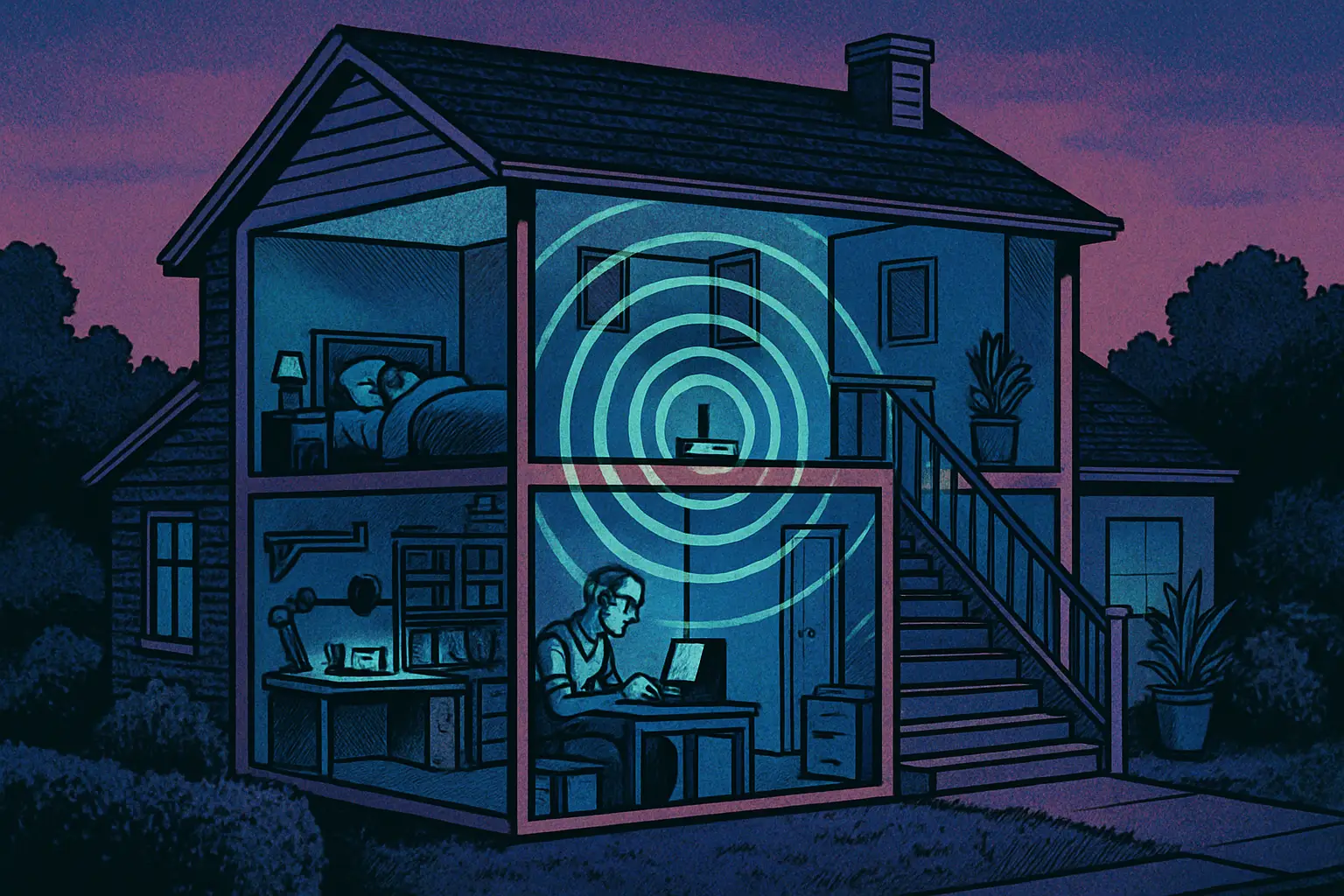
Every wireless router in your home is already flooding the place with 2.4GHz radio energy. WifiSense-Pi, a project from a maker going by The Masked Bear, treats that flood as a sensor rather than a nuisance — and the whole thing just landed on GitHub as open source.
- Hardware: An ESP32-S3 for radio sampling, a Raspberry Pi 4 for signal processing, plus whatever 2.4GHz Wi-Fi you already have
- Sample rate: The ESP32-S3 samples channel data 100 times per second
- Sensitivity: Detects stationary people by the micro-movements of breathing, and works through interior walls
- License: Released publicly at github.com/The-Masked-Bear/wifisense-pi
How Does Wi-Fi Motion Detection Actually Work?
The short version: a human body is mostly water, and water absorbs and reflects 2.4GHz radio waves. When you move through a room, you perturb the multipath pattern of every Wi-Fi signal bouncing around it. Sample that pattern fast enough and the disturbances become legible.
WifiSense-Pi splits the work across two chips, which is the smart part of the design. The ESP32-S3 does nothing but capture channel measurements at 100Hz — a job it is well suited to and cheap enough to place anywhere. The Raspberry Pi 4 handles the heavier signal processing that turns raw samples into a presence signal. If you are weighing which microcontroller to use for a build like this, our ESP32 variant buyer's guide covers where the S3 fits.
The breathing detection is the demo that makes people sit up. A person sitting perfectly still is still moving — the chest rises and falls, and that is enough perturbation to register. The documented failure case is charmingly specific: hold your breath and the system loses you.
What Wi-Fi Sensing Cannot Do
The project is refreshingly clear about its limits, which is rarer than it should be in maker documentation. WifiSense-Pi cannot pinpoint a location, and it cannot reliably tell multiple people apart. It gives you a presence and motion signal across a space, not a floor plan with dots on it.
That is still plenty for a lot of home automation. Occupancy-driven lighting, heating that does not run for an empty house, a gentle alert if an elderly relative has not moved in some hours — none of those need coordinates. And unlike a camera, there is no image to leak. Compare that with the 24GHz radar approach in the TongDou desktop robot, which needs dedicated millimeter-wave hardware to achieve a similar result.
Why This Matters for Maker Projects
Wi-Fi sensing is heading for formal standardization as IEEE 802.11bf, which will eventually bake this capability into commodity radios. Until that lands in shipping silicon, open-source implementations like this one are how the technique reaches single board computer and maker project builders.
The bill of materials is the appeal. An ESP32-S3 board and a Raspberry Pi 4 you may already own, against commercial presence sensors that charge a premium for the same physics. Publishing the code turns a clever demo into something the community can extend, and the multi-person problem is exactly the kind of thing a broader group of contributors tends to chip away at.
If you have a Pi gathering dust and a spare ESP32-S3, this is a weekend build with a genuinely novel payoff — a sensor that sees through walls using radio waves that were already there.
Sources: Hackaday — August 15, 2026; The Masked Bear on GitHub — August 2026.
More Mini Computers Stories

MaTouch ESP32-S3 E Ink Board: A $60 Voice-Ready Dashboard
Makerfabs' MaTouch ESP32-S3 pairs a 7.5-inch four-color E Ink screen with a four-mic array for $59.80. Here are the specs and what you can build.

ASRock NUC 300 Mini PCs: Wildcat Lake With Dual 2.5GbE
ASRock Industrial's NUC 300 series brings Intel Core 5 320 and Core 3 304 to mini PCs and boards with up to 64GB of DDR5-6400 memory and dual 2.5GbE.

DGX Spark 64GB: Who NVIDIA's $4,999 Local AI Box Is For
NVIDIA's DGX Spark 64GB starts at $4,999 on Oct 23 and runs models up to 100B parameters. Here is who the local AI box suits and how clustering works.