
MNT Station Puts 10+ Swappable CPU Modules in a Mini PC
MNT Research's fanless MNT Station takes 10 or more Arm and FPGA modules, starts at $299 for the case, and ships from Crowd Supply in January 2027.

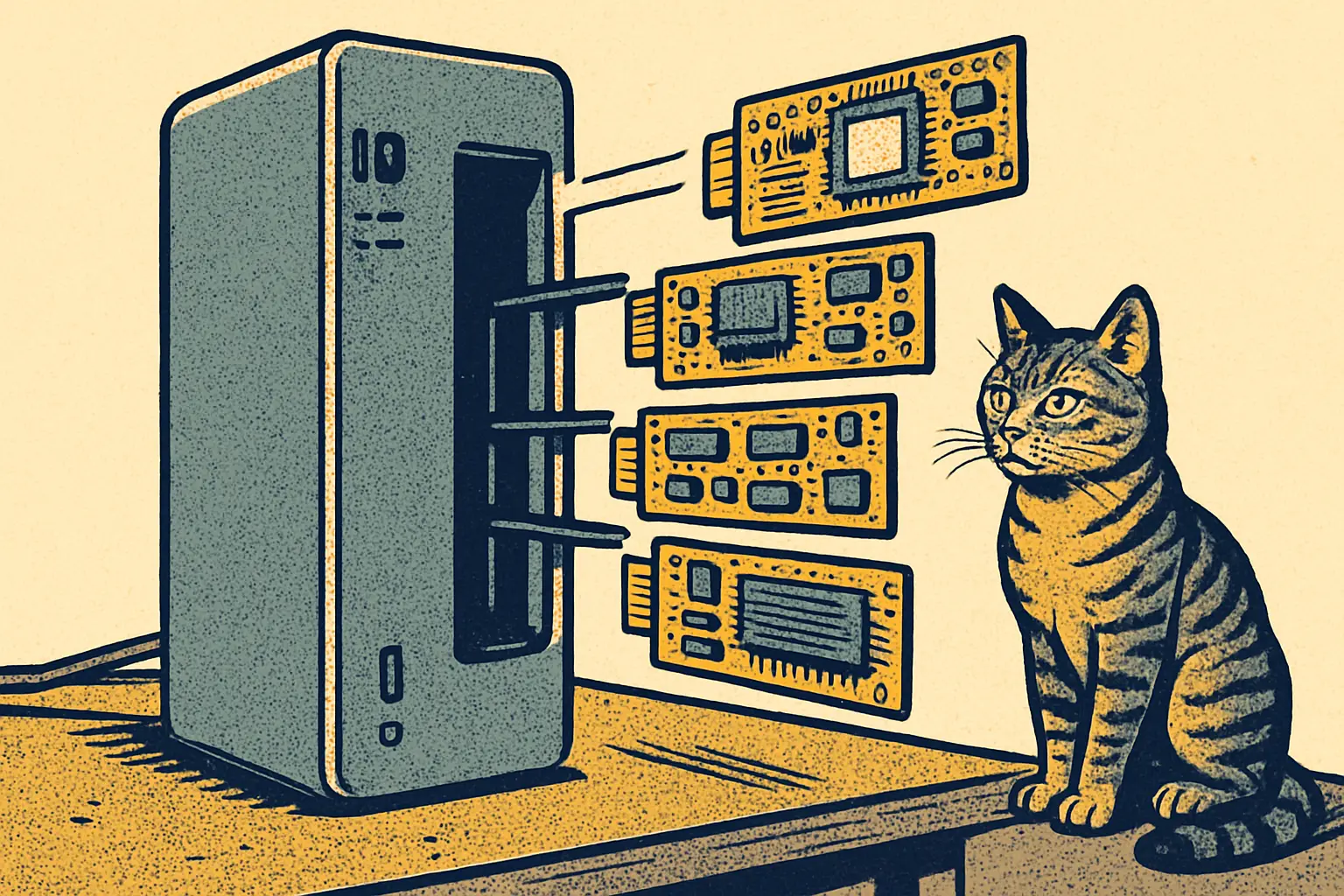
MNT Research has taken the most interesting idea in its laptop line and given it a desk to sit on. The MNT Station, announced on August 24, 2026, is a fanless open-hardware computer that accepts more than ten different processor modules, from a Rockchip RK3588 to an AMD Xilinx Kintex-7 FPGA. It is the same modular philosophy behind the MNT Reform laptop, minus the screen, keyboard, and battery, and it is now live on Crowd Supply.
- The CNC-milled anodized 6061 aluminum case is $299 on its own, with the MNT Reform Mainboard 3.0 at $429 and an RCORE RK3588 module at $899
- The chassis measures 279 x 133 x 26 mm, weighs 0.68 kg, and draws roughly 20W with the RK3588 module fitted
- Supported modules include the NXP Layerscape LS1028A, i.MX 8M Plus, i.MX 8MQ, Raspberry Pi CM4 via a $155 adapter, Amlogic A311D, Rockchip RK3566, and a Kintex-7 FPGA
- Crowd Supply orders are expected to ship in late January 2027
What Makes the MNT Station Different From Other Mini PCs
Most compact desktops are sealed appliances. You pick a processor at checkout and live with it for the life of the machine. The MNT Station inverts that. The 200-pin module slot is the whole point: the CPU is a card you can lift out and replace, and the rest of the box — case, mainboard, ports, storage — stays exactly where it is.
That matters most to people who already own an MNT Reform. Mainboards from version 2.0 onward drop straight into the Station, so a laptop that has been retired, damaged, or simply upgraded can become a home server, NAS, router, or low-power media box instead of a drawer ornament. It is the same second-life logic that makes the Framework Laptop 12 mainboard upgrade interesting, applied to a smaller and more stubbornly open ecosystem.
The module list is the unusual part. Very few machines let you choose between an Arm SoC and an FPGA in the same socket. MNT also lists the Quasar module, built around Qualcomm QCS6490 or QCS8550 silicon, as in development — which would put a modern NPU-equipped Arm part into the same chassis as a 2019-era i.MX 8MQ.
What Does the MNT Station Cost to Build?
There is no single sticker price, which is either the best or worst thing about it depending on your temperament. A realistic from-scratch build is the $299 case plus the $429 Mainboard 3.0 plus a processor module. The RCORE RK3588 module at $899 is the fast option; the $155 Raspberry Pi CM4 adapter is the cheap one, assuming you supply the compute module.
If you are coming from an existing Reform, the arithmetic is much friendlier — the case alone gets you a desktop. Liliputing notes bundles starting at $429 for mainboard-only configurations and running up to around $1,099 for an RK3588 module with 32GB of RAM.
Ports, Expansion, and Software
Connectivity is deliberately conventional: gigabit Ethernet, three USB Type-A ports, one USB Type-C with power delivery input, HDMI output, and optional DisplayPort Alt-Mode. Internally there is an M.2 M-key slot and an mPCIe slot, which is what turns this from a thin client into a plausible NAS or router. The port cover carries a power button and ten controllable LEDs, and the case supports flat, upright, and VESA mounting.
Software is Debian GNU/Linux with a choice of Sway or GNOME, backed by the community work at reform.debian.net. That is a meaningful advantage over the usual vendor-image situation on Arm hardware, where a board ships with one frozen kernel and no upgrade path.
For anyone tracking the wider mini PC and single board computer scene, the MNT Station lands in a year where modularity keeps resurfacing — the Youyeetoo K1 with its swappable N100 module made a similar argument at a lower price and with far less openness. MNT's version costs more and asks more of you, and in exchange it publishes the schematics.
Sources: CNX Software — August 24, 2026; Liliputing — August 21, 2026; Crowd Supply campaign — August 2026.
More Mini Computers Stories

Surface RTX Spark Dev Box: Is a $5,999 AI Box Worth It?
Microsoft opened Surface RTX Spark Dev Box pre-orders at $5,999: 128GB unified memory, up to 1 petaflop FP4, and support for 120B-plus parameter models.

Asus NUC 14 Essential Fanless: Silent Mini PC Built for 24/7
The Asus NUC 14 Essential Fanless packs Intel N100, N150 or N250 chips, 2.5GbE and triple 4K output into a silent 0.74L chassis built for 24/7 use.

Raspberry Pi 5 Cluster Runs Qwen3-30B at 15 Tokens a Second
Four 16GB Raspberry Pi 5 boards ran Qwen3-30B-A3B at 15.1 tokens per second on CPU alone, a 16% gain over the prior record with distributed-llama.