
Framework Laptop 12 Upgrade Adds 70% More Battery
Framework's Laptop 12 gains an Intel Core Series 3 mainboard, Thunderbolt 4, and Wi-Fi 7, with DIY kits from $549 and Fedora prebuilts at $699.

Framework has given the Laptop 12 a new brain. The company announced on August 18, 2026 that its 12.2-inch convertible now ships with Intel Core Series 3 processors, codenamed Wildcat Lake, replacing the 13th Gen Intel chips the machine launched with. The headline for anyone who actually carries the thing is battery life: Framework says the swap delivers up to 70% longer runtime while streaming 4K video, compared with the Core i5-1334U in the original model.
- DIY Edition pricing starts at $549 for the Core 3 304, $779 for the Core 5 320, and $999 for the Core 7 350
- Prebuilt configurations with Fedora Linux preloaded run $699, $1,099, and $1,399 respectively
- The mainboard is sold on its own from $299, so existing Laptop 12 owners can upgrade rather than replace
- Pre-orders are open now, with Framework saying the first batch ships in October 2026
What Does the New Framework Laptop 12 Cost?
The DIY Edition is the cheapest way in at $549 for a barebone Core 3 304 kit, and it is genuinely barebone: you supply the memory, storage, and operating system. Framework moves up to $779 for the Core 5 320 and $999 for the Core 7 350.
The prebuilt tier is where this refresh gets interesting for the wider Linux crowd. A Core 3 304 machine with Fedora 44 KDE Plasma already installed lands at $699. Windows 11 Home adds roughly $100 to a configuration and Windows 11 Pro adds about $150, which makes the Fedora option the value pick rather than the compromise. Framework says the Linux configuration is outselling the Windows one by a wide margin, on the order of ten to one.
Why Wildcat Lake Matters in a 12-Inch Convertible
Wildcat Lake is Intel's low-power Core Series 3 family, and Framework offers three parts. The Core 3 304 pairs five CPU cores with a single-core Xe3 graphics tile and a 15 TOPS NPU. The Core 5 320 and Core 7 350 each move to six CPU cores and a two-core Xe3 tile, with NPUs rated at 16 and 17 TOPS. Those are modest numbers next to the 100-plus TOPS parts in bigger machines, but they are aimed at a 1.3kg convertible, not a desktop replacement.
The rest of the platform gets a real generational bump. Thunderbolt 4 arrives alongside two USB 3.2 Gen 2 ports, Wi-Fi 7, and Bluetooth 5.4. The 12.2-inch 1920 by 1200 display keeps its 360-degree hinge, memory tops out at 64GB of DDR5-6400 in a standard SO-DIMM slot, and storage uses an M.2 2230 NVMe drive with options up to 2TB. Two long-requested features finally show up: a backlit keyboard and a fingerprint reader built into the power button, both available on the Core 5 and Core 7 configurations.
Four user-selectable expansion card slots remain, which is the part that keeps this machine relevant to the mini PC and modular computing crowd rather than just laptop shoppers.
A Mainboard, Not Just a Laptop
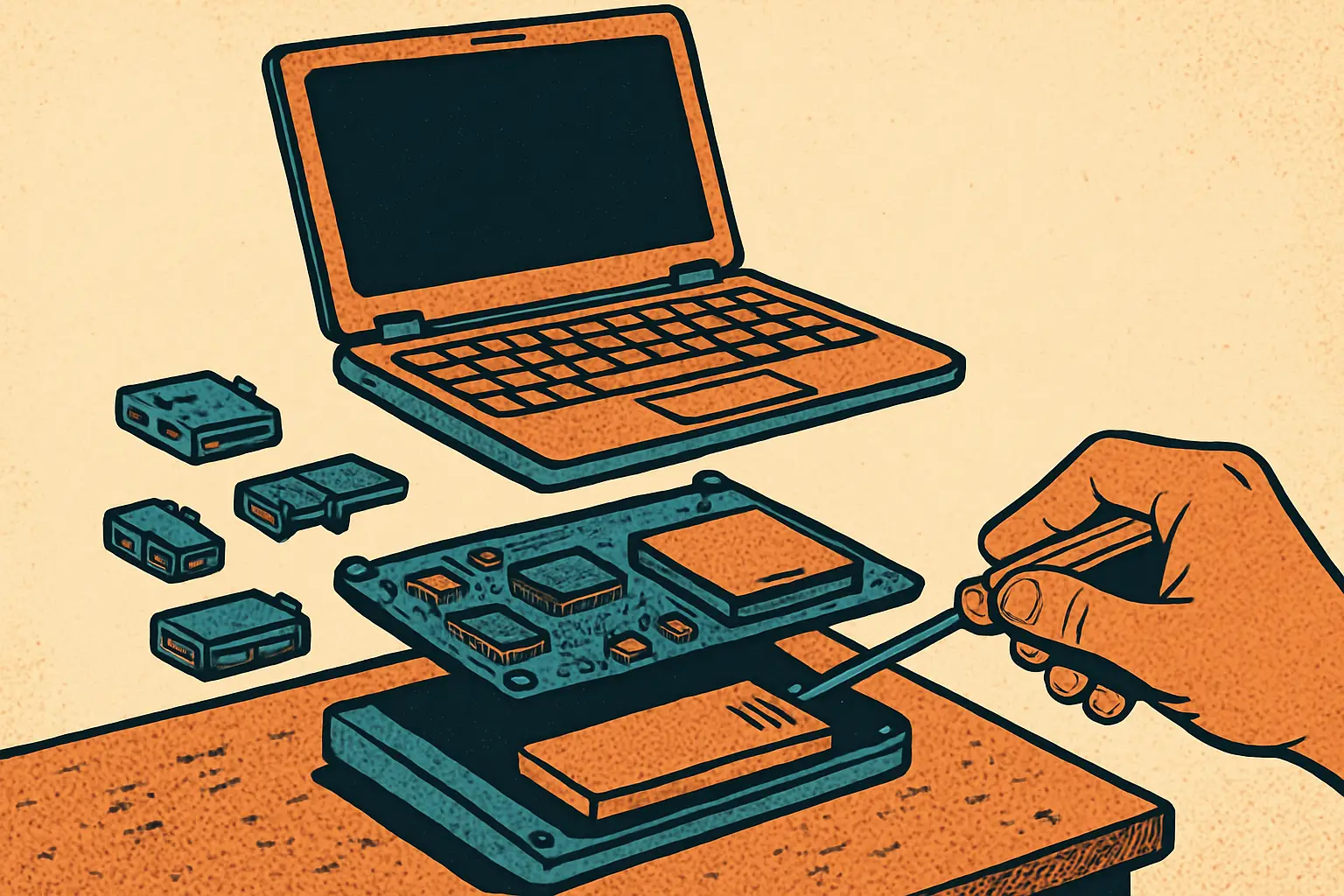
The most quietly important number in the announcement is $299. That is the entry price for the mainboard on its own, and it is what makes this a refresh rather than a replacement cycle. An existing Laptop 12 owner can buy the new board, swap it in, and keep the chassis, display, keyboard, and expansion cards they already paid for.
It also means the old board does not become landfill. Framework mainboards have a long second life as standalone single board computers in 3D-printed cases, and the same modularity let Deep Computing ship its RISC-V mainboard for the Framework Laptop 13 in May. Wildcat Lake is turning up across the compact PC world this year, from signage boxes the size of a deck of cards to barebone mini PCs under $300, and a repairable convertible is a genuinely different application of the same silicon.
Linux support looks healthy, which matters given the Fedora-first positioning. Wildcat Lake enablement has been landing in recent kernel releases, so the preloaded Fedora 44 build should not be fighting its own hardware.
Sources: CNX Software — August 23, 2026; Phoronix — August 18, 2026; Framework blog — August 18, 2026.
More Mini Computers Stories

Raspberry Pi 5 Cluster Runs Qwen3-30B at 15 Tokens a Second
Four 16GB Raspberry Pi 5 boards ran Qwen3-30B-A3B at 15.1 tokens per second on CPU alone, a 16% gain over the prior record with distributed-llama.

DSPi Firmware Turns a Raspberry Pi Pico Into a USB DSP Card
DSPi firmware turns a Raspberry Pi Pico or Pico 2 into a USB sound card with up to 110 EQ bands, active crossovers and room correction. Open source.

Raspberry Pi Desktop for PC and Mac: Revive an Old Laptop
Raspberry Pi Desktop returns for PCs and Intel Macs on 64-bit Debian Trixie, runs live from USB, and installs free on machines up to about 15 years old.