
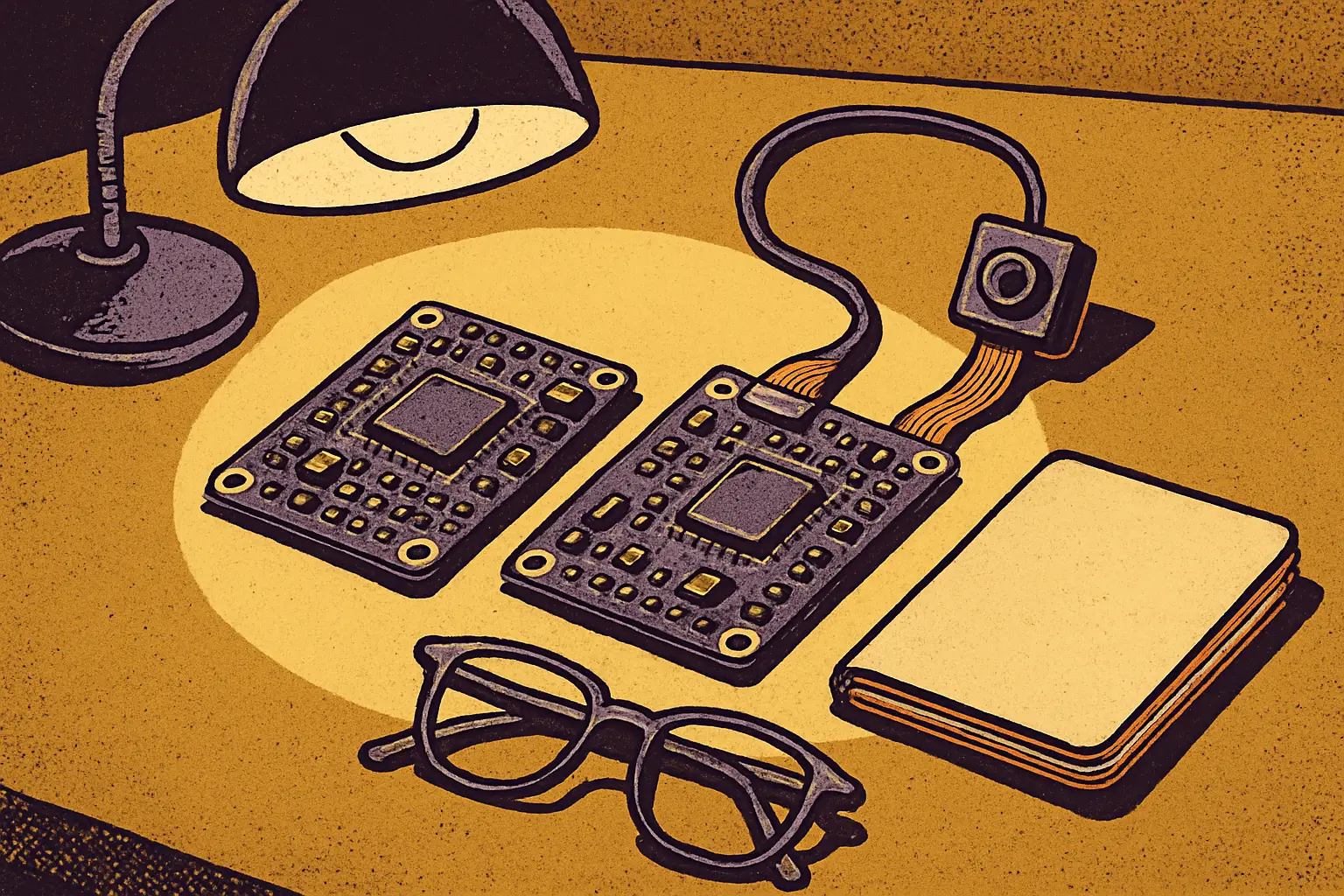
Edge AI SBCs From InHand Pack 2 or 8 TOPS on TI
InHand's credit card-sized Mo 62A and Mo 68A edge AI SBCs pair TI AM62A and AM68A silicon with 2 or 8 TOPS, Debian 13.2, and a 40-pin GPIO header.

Two Boards, One Footprint, a 4x Gap in AI Throughput
InHand Networks has introduced a pair of credit card-sized edge AI single board computers — the Mo 62A and the Mo 68A — built on Texas Instruments silicon and sharing an identical 85 x 56 mm footprint. The Mo 62A uses the AM62A74 at 2 TOPS; the Mo 68A steps up to the AM68A at 8 TOPS. Same board outline, same 40-pin GPIO header, same Debian image, four times the AI throughput. That is a genuinely useful way to lay out a product line.
- Mo 62A: TI AM62A74 with 2 TOPS, up to four Cortex-A53 cores at 1.4 GHz, 2/4/8 GB LPDDR4, 4x USB 2.0, GbE, WiFi 5, Micro HDMI, one MIPI CSI-2 camera input
- Mo 68A: TI AM68A (TDA4VE/J721S2 family) with 8 TOPS, 2x Cortex-A72 at 2.0 GHz, 4/8 GB LPDDR4, 4x USB 3.0, GbE, WiFi 5, MiniDP, dual MIPI CSI-2 and PCIe Gen 3.0
- Both measure 85 x 56 mm with a 40-pin GPIO header and microSD storage
- Debian 13.2 with Linux 6.12, TFLite and ONNX support, and TI's EdgeAI SDK for vision workloads; pricing not yet disclosed
Why Texas Instruments Silicon Instead of the Usual Suspects
The SBC market skews heavily toward Rockchip and Allwinner parts, so a TI-based board stands out. The AM62A and AM68A come out of TI's automotive and industrial vision lineage, and that heritage shows up in the things that are easy to overlook on a spec sheet: hardware video encode paths designed around camera pipelines, an SDK built specifically for vision inference, and the long production lifecycles that industrial customers require.
That last point is the one that decides real deployments. A maker board that goes end-of-life in two years is an inconvenience; a board inside a deployed inspection system that goes end-of-life is a redesign. TI's supply commitments are a large part of what buyers are paying for here, alongside the TOPS figure.
What Does the Extra Camera Input Buy You?
More than the spec line suggests. The Mo 68A's second MIPI CSI-2 input is what separates single-camera inference from the applications that actually need a board like this — stereo depth, multi-angle inspection where one view cannot see the whole part, and any setup where a wide-angle context camera feeds a detail camera.
The Mo 68A's other upgrades follow the same logic. USB 3.0 instead of 2.0 matters when you are pulling uncompressed frames off a peripheral. PCIe Gen 3.0 opens the door to NVMe storage for recording, or an additional accelerator. And the Cortex-A72 pair at 2.0 GHz handles the pre- and post-processing around the NPU that quietly becomes the bottleneck once the inference itself is fast.
Which One Fits Your Project?
The split is cleaner than most product ladders. Two TOPS is comfortable for a single camera running a detection or classification model at modest resolution — people counting, presence detection, reading a gauge. Eight TOPS with dual cameras is for multi-stream work, higher-resolution input, or running detection and a second model on the same frame.
Both ship with Debian 13.2 on Linux 6.12, which is a more current base than a lot of vendor images offer, and both accept TFLite and ONNX models through TI's EdgeAI SDK. For a broader comparison of what NPU-equipped boards deliver across vendors, our edge AI dev board buyer's guide is the place to start, and the rest of our mini computer coverage tracks new industrial boards as they land.
The Open Question Is Price
InHand has not disclosed pricing or availability, which is the one thing standing between an interesting spec sheet and a purchasing decision. The comparison set is crowded — the DFI X6X-ORN edge AI box sits well above these on both capability and cost, while plenty of Rockchip boards land below on both. The Mo 62A and Mo 68A occupy a sensible middle if they are priced for it.
Sources: CNX Software — July 30, 2026; InHand Networks — July 2026.
More Mini Computers Stories
ESP32-S3 Runs Linux 6.11 With 3.7MB of RAM to Spare
Release 0.8 of the native ESP32-S3 Linux port fixes the crash that hit one boot in ten and halves the memory cost of every fork. One file to flash.
Alif StartKits Put an Ethos-U55 NPU on a $50 Board
Alif's Balletto B1 and Ensemble E1C StartKits pair a 160MHz Cortex-M55 with an Ethos-U55 NPU, two mics and a camera header for $49.99.
JetKVM Mini Cuts IP KVM Cost to $39 With ESP32-P4X
JetKVM Mini drops Linux for FreeRTOS on an ESP32-P4X, landing a 42mm IP KVM with HDMI capture and WebRTC streaming at $39, or $33 in a 3-pack.