
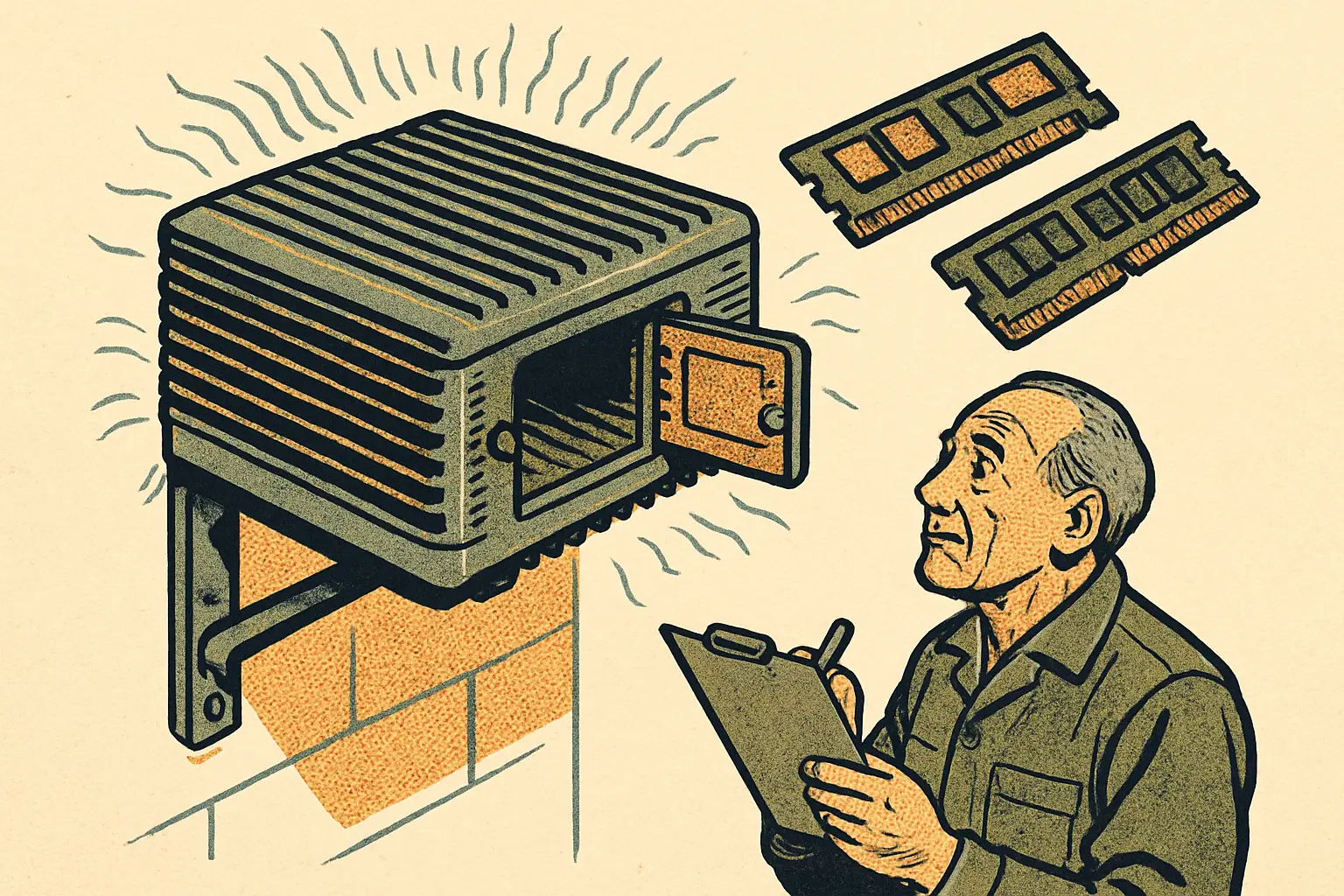
IBASE AA400-N Packs 256GB DDR5 in a Fanless Box
The fanless IBASE AA400-N pairs AMD Ryzen Embedded 8840U with up to 256GB of DDR5-5600 and 39 TOPS — a rare memory ceiling for silent edge AI boxes.

Most fanless edge AI computers top out at 64GB of memory, and that ceiling quietly decides what you can run on them. IBASE debuted the AA400-N on August 28, 2026, and it moves the ceiling a long way up: dual SO-DIMM sockets taking up to 256GB of DDR5-5600, in a silent chassis, on an AMD Ryzen Embedded part.
- The AA400-N takes up to 256GB of DDR5-5600 across two SO-DIMM sockets
- Two CPU options: Ryzen Embedded 8840U (8-core/16-thread, up to 5.1 GHz) or 8640U (6-core/12-thread, up to 4.9 GHz)
- Combined AI performance is quoted at 39 TOPS on the 8840U model and roughly 31 TOPS on the 8640U
- Fully fanless design with 8K-capable HDMI 2.1 and DisplayPort 2.1, dual 2.5GbE, and Ubuntu 22.04 or Windows 11 support
What Is Inside the IBASE AA400-N?
The AA400-NM ships with the AMD Ryzen Embedded 8840U — eight Zen 4 cores, sixteen threads, boosting to 5.1 GHz — while the AA400-N8640M drops to the six-core, twelve-thread 8640U at up to 4.9 GHz. Both are Ryzen Embedded parts, which is the line AMD builds for long product-availability windows rather than for the retail refresh cycle.
Storage is a 256GB NVMe SSD in an M.2 2280 slot on PCIe Gen4. Display output is unusually generous for an industrial box: HDMI 2.1 and DisplayPort 2.1, both capable of 8K. Networking is dual 2.5GbE, with optional Wi-Fi, Bluetooth, and 4G LTE or 5G added through M.2 expansion. Six USB ports round it out — two USB 3.2 and four USB 2.0 — plus a serial COM port, which tells you exactly which market this is aimed at.
IBASE has not announced pricing or availability.
Why Does 256GB of RAM Matter on an Edge Box?
Because on an integrated-graphics system, system memory is the model memory. A 256GB ceiling is the difference between running a quantised mid-size model and keeping a large mixture-of-experts model resident with room left for context. Readers who followed our best mini PC for local LLMs guide will recognise the pattern — the memory ceiling, not the TOPS figure, is usually what decides which models a small machine can actually host.
The 39 TOPS combined figure is a respectable number for this class, and comparable to what we saw from the Banana Pi BPI-AI2N vision AI module, but the two specs serve different jobs. TOPS governs how fast a fixed model runs. Memory governs whether the model fits at all.
Where Does a Fanless Design Win?
Fanless is not just a quiet-office nicety. Removing the fan removes the single most common mechanical failure point and the primary intake for dust — which is why it is the default for factory floors, roadside cabinets, digital signage, and anywhere a service call costs more than the computer. Getting a 45W-class CPU and 256GB of DDR5 into a passively cooled chassis is genuinely hard thermal engineering, and it is what distinguishes this from a desktop mini PC with the fan unplugged.
The trade-off is sustained clocks. A passively cooled 8840U will not hold 5.1 GHz under a long inference run, and IBASE has not published sustained-load figures. That is the number to ask for.
Who Is This Machine For?
Machine-vision inspection, industrial edge inference, medical imaging carts, and self-hosted LLM appliances in environments where a fan is a liability. If your workload is bursty and memory-hungry, this configuration is more interesting than a faster chip with half the RAM. If it is a sustained, thermally punishing load, wait for the throttling numbers.
Either way, it is a welcome data point for the mini computer coverage we run every week, and it sits nicely alongside the Mac mini M6 local LLM results as evidence that the small-machine memory ceiling is finally rising across the board.
Sources: CNX Software — August 28, 2026; IBASE Technology — product announcement, August 2026.
More Mini Computers Stories

Romu RP2354A Board: A $40 Raspberry Pi Chip in a USB Stick
Romu puts the Raspberry Pi RP2354A into a 15.5 x 12 mm USB stick for $40, running MicroPython for security keys, macro pads and MIDI controllers.

VIEWE ESP32-S31 Display: $39 Wi-Fi 6 Touch Panel for Makers
VIEWE's $38.99 4.3-inch touch display is one of the first ESP32-S31 boards, adding Wi-Fi 6, Thread, RS485 and CAN for smart home and industrial panels.

Wireless-Tag WT32P4C5-43S: A $32 ESP32-P4 Touch Display
The Wireless-Tag WT32P4C5-43S pairs an ESP32-P4 with an ESP32-C5 behind a 4.3-inch 800 x 480 touchscreen, adding dual-band Wi-Fi 6 and Thread for $32.