
Banana Pi BPI-AI2N Packs 15 TOPS Into a Vision SoM
Banana Pi's $266 BPI-AI2N pairs a Renesas RZ/V2N with a 15 TOPS DRP-AI accelerator, 8GB of LPDDR4X, 32GB eMMC and dual MIPI CSI camera inputs.

Most edge AI modules ask you to choose between a big NPU number and a power budget you can actually cool. The Banana Pi BPI-AI2N, detailed on August 26, 2026, takes the Renesas route instead: a vision-specialised accelerator tuned for sparse models, wrapped in a system-on-module with a matching carrier board and camera inputs already wired.
- Built on the Renesas RZ/V2N with four Cortex-A55 cores at 1.8GHz plus a Cortex-M33 coprocessor and a Mali-G31 GPU
- The DRP-AI accelerator is rated at 15 TOPS on sparse models and 4 TOPS dense, aimed squarely at vision inference
- The module carries 8GB of LPDDR4X, 32GB of eMMC and 64MB of SPI flash, with 4K H.265 encode and decode at 30fps
- Sold on AliExpress at $266 for the SoM and $26.70 for the carrier board, with Yocto and Armbian images based on Linux 6.1
Why Sparse TOPS Are the Number That Matters Here
The 15 TOPS sparse and 4 TOPS dense split is worth understanding rather than skimming. Sparse inference exploits the fact that a large share of weights in a pruned vision model are zero, so the accelerator can skip that arithmetic entirely. Renesas designed the DRP-AI pipeline around that assumption, which is why the headline figure is close to four times the dense rating.
For the workloads this module targets, object detection, classification, people counting, defect inspection, that assumption usually holds, because vision backbones prune well. For a general purpose transformer it does not, and you should plan around the 4 TOPS dense figure instead. Vendors reporting both numbers openly is a good sign, and it makes the module easier to evaluate than boards quoting a single unqualified TOPS headline.
What the Carrier Board Actually Gives You
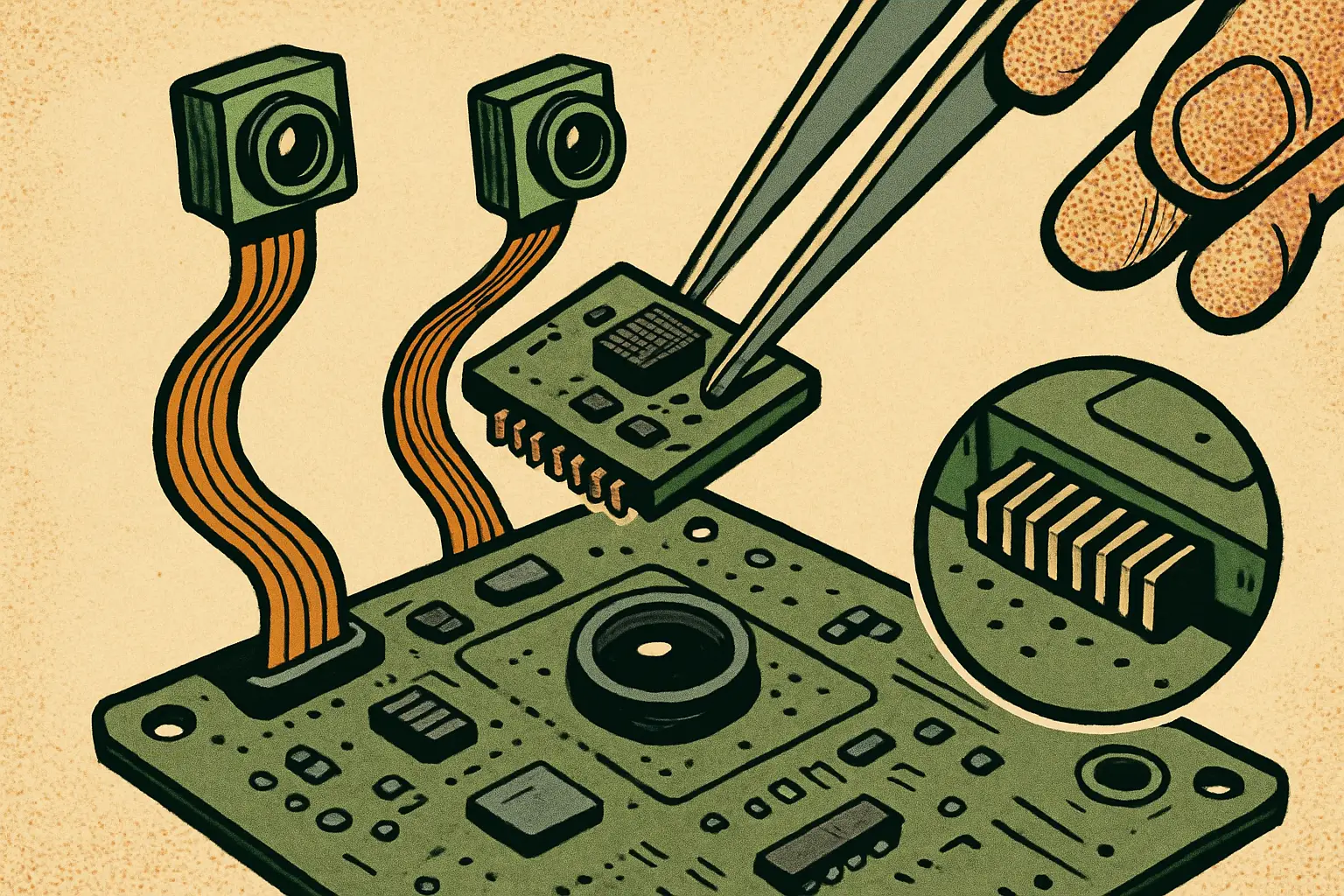
The carrier is where a vision module either becomes usable or stays a demo. This one provides two MIPI CSI camera connectors, a MIPI DSI display interface, two Gigabit Ethernet ports, dual USB 3.0 Type-A ports and a 40-pin GPIO header. Two cameras plus two network interfaces is the specific combination a smart-camera or inspection appliance needs: one lens for the subject, one for context or stereo, one network for the local device fabric and one for the uplink.
Banana Pi lists optional accessories including a heatsink at $6.70, a camera module at $21.28 and a MIPI-to-HDMI adapter at $14.36, so a complete evaluation setup lands around $335. That is competitive against dev kits from the larger silicon vendors, particularly with 8GB of RAM and 32GB of eMMC included rather than sold separately.
How Does It Compare to Other Edge AI Modules?
It sits deliberately below the very high end. The Advantech AOM-6741 SMARC module we covered yesterday hits 100 TOPS on a Qualcomm IQ-9075 and costs accordingly; the BPI-AI2N is a fraction of that, in a form factor aimed at products shipping in hundreds rather than tens of thousands. Against Banana Pi's own BPI-SM10 RISC-V module, this trades raw NPU headline for a mature Arm software stack and a vendor BSP that already boots.
Software is the usual caveat for any edge NPU. Yocto and Armbian images based on Linux 6.1 are available through Banana Pi's documentation, and getting a model onto DRP-AI means passing it through the Renesas conversion toolchain rather than running an off-the-shelf runtime. Budget real time for that step. More single board computer coverage lives on our mini computers page.
Sources: CNX Software — August 26, 2026; Banana Pi Documentation — August 2026; Renesas RZ/V2N product page — August 2026.
More Mini Computers Stories

Raspberry Pi Net Zero: How Pi Towers Swapped Gas for Pis
Raspberry Pi replaced a £150,000 building system with a £7,800 Pi-based one at Pi Towers, cut gas entirely in June 2026, and targets net zero in 2027.

Q8botOne Robot Dog: A Palm-Sized Open ESP32-C3 Quadruped
Q8botOne is a palm-sized open-source robot dog with an ESP32-C3 brain and 8 DYNAMIXEL actuators, from $199 as a kit or $599 assembled on Crowd Supply.

Surface RTX Spark Dev Box: Is a $5,999 AI Box Worth It?
Microsoft opened Surface RTX Spark Dev Box pre-orders at $5,999: 128GB unified memory, up to 1 petaflop FP4, and support for 120B-plus parameter models.