
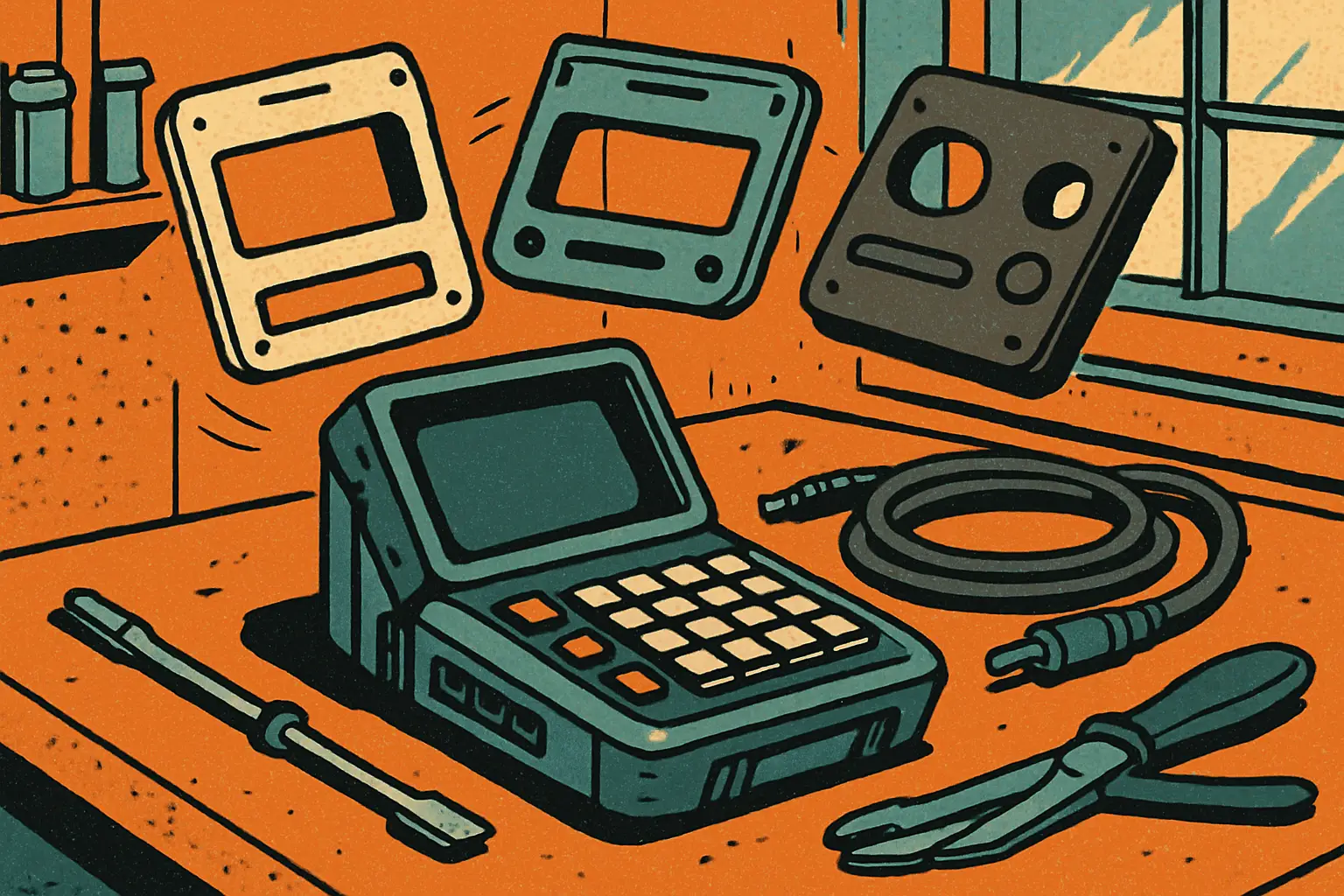
Globalscale Case8 Cyberdeck Snaps Into Four Editions
The Globalscale Case8 is a modular MediaTek Genio cyberdeck with up to a 10 TOPS NPU, sold in gaming, home, education, and hacker editions from $299.

A Cyberdeck You Configure for the Job
Every so often a piece of hardware nails the maker aesthetic and the practicality at once. The Globalscale Case8, which launched on Kickstarter on July 20, 2026, is a retro-futurist cyberdeck built around a swappable MediaTek Genio compute module and sold in task-specific editions — one tuned for gaming, one for home automation, one for education, and a bare board for hackers. It is playful, open, and genuinely useful, and early-bird pricing starts at $299. For fans of compact, buildable computing, this one is a treat.
- The Case8 launched on Kickstarter July 20, 2026, with early-bird pricing of $299–$399 (plus $40–$50 shipping)
- It uses an OSM-L compute module with a MediaTek Genio 520 or 720 (up to 8 cores, Mali-G67 GPU, 10 TOPS NPU)
- Configurations offer 4/8/16GB LPDDR5 and 64/128GB UFS storage, with GbE, Wi-Fi 6, Bluetooth 5.4, and optional 4G/5G
- Four editions target gaming, home automation, education, and hacking, each with its own screen and inputs
What Is Inside the Case8?
At the core is an OSM-L system-on-module carrying MediaTek's Genio 520 or 720 — up to eight CPU cores paired with a Mali-G67 GPU and a 10 TOPS NPU for on-device AI tasks. That is a capable, power-efficient foundation for edge workloads, sitting comfortably alongside the wave of NPU-equipped dev boards we have covered this year. Because the compute lives on a removable module, the platform can be upgraded over time rather than thrown away, which is exactly the kind of longevity a good cyberdeck should offer.
Four Editions, Four Personalities
The clever part is how Globalscale specializes the same core. The Gaming edition adds a 5-inch display, gamepad-style inputs, and a 5,000 mAh battery running AOSP 15. The Home Automation edition ships with a 7-inch touchscreen and Home Assistant on Yocto Linux, plus Zigbee, Z-Wave, Thread, and Matter radios to talk to smart-home gear. The Education edition pairs a 7-inch display with a folding QWERTY keyboard, dual cameras, and a big 10,000 mAh battery on NixOS. And the Hacker edition is simply the bare PCBA for builders who want to design their own enclosure and inputs. One platform, four clearly different jobs.
Who Is This For?
The Case8's appeal spans the maker spectrum. Students get a rugged, hackable learning machine; smart-home tinkerers get a self-contained Home Assistant hub with every major radio built in; and gamers get a pocketable retro-styled handheld. It slots naturally next to community-driven projects like the Arduino Uno Q arcade bundle in the growing world of open, buildable computing. At publication the campaign had already raised more than $13,600 toward an $18,500 goal, a healthy sign of interest.
Why Modular Open Hardware Wins
The reason to root for a project like this is sustainability, in both senses. A swappable compute module means the device can evolve; open operating systems mean it will not be stranded when a vendor loses interest. That combination — modular hardware plus open software — is how a gadget stays alive for years, and it fits the ethos we champion across our mini computers coverage.
The Takeaway
The Globalscale Case8 is a rare cyberdeck that balances charm with real configurability, letting you buy the exact machine your project needs. Whether you are teaching, automating a home, or just want a delightful handheld to tinker with, there is an edition with your name on it.
Sources: CNX Software — July 20, 2026; Hackster.io — July 2026.
More Mini Computers Stories

OpenMANET Runs Video Over Wi-Fi HaLow Mesh Networks
OpenMANET pushes 1-15 Mbps over 802.11ah mesh on a Raspberry Pi 4, adding voice, RTSP video and full IP where Meshtastic sends only short text.

Renesas RZ/G3L MPUs Hit 1 mW Standby With Cortex-A55
Renesas' new RZ/G3L and RZ/G3SE run four Cortex-A55 cores at 1.2 GHz and drop to roughly 1 mW in deep standby, from $14.28 in volume pricing.

ESP32-S3 Runs Linux 6.11 With 3.7MB of RAM to Spare
Release 0.8 of the native ESP32-S3 Linux port fixes the crash that hit one boot in ten and halves the memory cost of every fork. One file to flash.