
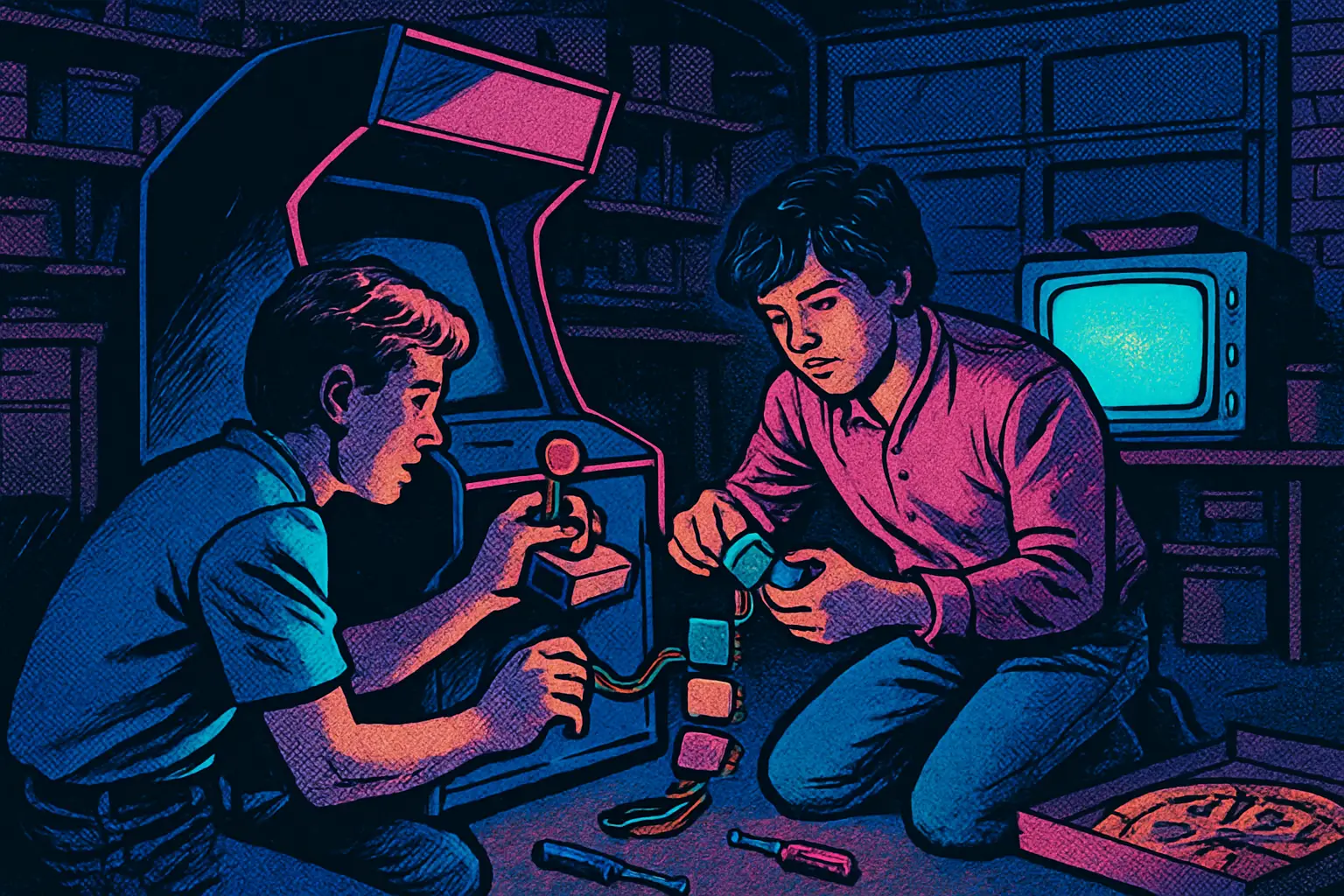
Arduino UNO Q Arcade Bundle Builds a $90 Retro Console
Arduino's UNO Q Arcade bundle pairs the 4GB UNO Q SBC with snap-together Modulino controls to build a DIY RetroArch console for about $90 at launch.

A Console You Assemble Like Building Blocks
Arduino launched the UNO Q Arcade bundle on July 22, 2026, and it is one of the cleanest on-ramps to DIY retro gaming I have seen in a while. The kit pairs the UNO Q — the Qualcomm Dragonwing QRB2210-powered single board computer Arduino ships with 4GB of RAM — with a set of daisy-chainable Modulino input modules, so you can wire up a custom game controller with zero breadboarding. Launch pricing lands at $90.90 with the 20% introductory discount, against a $113.64 list price.
- Bundle includes the UNO Q 4GB SBC plus Modulino Joystick, Buttons, and Movement modules
- Modules daisy-chain over Qwiic I2C connectors — no soldering, no breadboard
- The UNO Q presents the chain as a standard HID input device to Linux
- $113.64 list, $90.90 with the 20% launch discount while stocks last
How Does the Modulino Controller Chain Work?
This is the part that earns the bundle its spec-sheet respect. The three input nodes — a Joystick module configurable as a D-pad or mouse cursor, a Buttons module that maps single keys, multi-key shortcuts, or clicks, and a Movement module with a 6-axis IMU for motion control — chain together over Qwiic connectors. The UNO Q reads the chain and emulates a standard USB HID device, which means the Linux side sees an ordinary controller. No custom drivers, no udev wrestling. Any native Linux application just works with it.
That HID trick is what separates this from a typical microcontroller starter kit: the modules are inputs to a real computer, not peripherals locked to a sketch.
What Can It Actually Play?
Arduino's official tutorial walks through RetroArch with the mGBA, bsnes, and Nestopia cores — covering the Game Boy Advance, SNES, and NES catalogs of legally obtainable homebrew and personal backups — and goes a step further with the open-source Godot engine for building your own games on the same hardware. That second path is quietly the more interesting one: the same $90 kit is a legitimate little game-dev workstation for a first Godot project.
One spec-sheet footnote to plan for: the bundle does not include the Arduino USB-C Hub, and without it the UNO Q has no HDMI output. Budget the extra $16.34 if you want video on a monitor rather than streaming to another device — call it a $107 all-in build.
Where It Fits in the SBC Landscape
Arduino has been on a roll extending the UNO Q into approachable project bundles, and the formula — real Linux SBC, snap-together I/O, polished tutorial — is exactly what the maker ecosystem needs to pull newcomers past the blinking-LED stage. It slots neatly alongside the wave of compact boards we have covered recently, from the tiny Moddo Pinch to GPU-equipped MCU dev boards. For more compact computing news, our mini computers section has you covered.
Sources: CNX Software — July 22, 2026; Hackster.io — July 2026; Arduino Store — July 2026.
More Mini Computers Stories

Synergy Logic SLM-RP4: A $249 Raspberry Pi PLC With OpenPLC
The Synergy Logic SLM-RP4 turns a Raspberry Pi 4 into a $249 UL-listed PLC with OpenPLC preinstalled and up to 128 I/O points on a DIN rail.

LR2021 SDR: Turning a LoRa Chip Into a Software Radio
The open-source LR2021-SDR project unlocks raw I/Q samples in Semtech's LoRa chip, letting it receive from 100 MHz to 2.74 GHz with no SDR dongle.

Linux 7.3 for SBC Owners: New Boards, RISC-V and Pi Updates
Linux 7.3 is out with mainline support for Orange Pi 5 Pro, Milk-V Duo S and more SBCs, a faster Raspberry Pi GPU sleep and 5x quicker Btrfs fsync.