
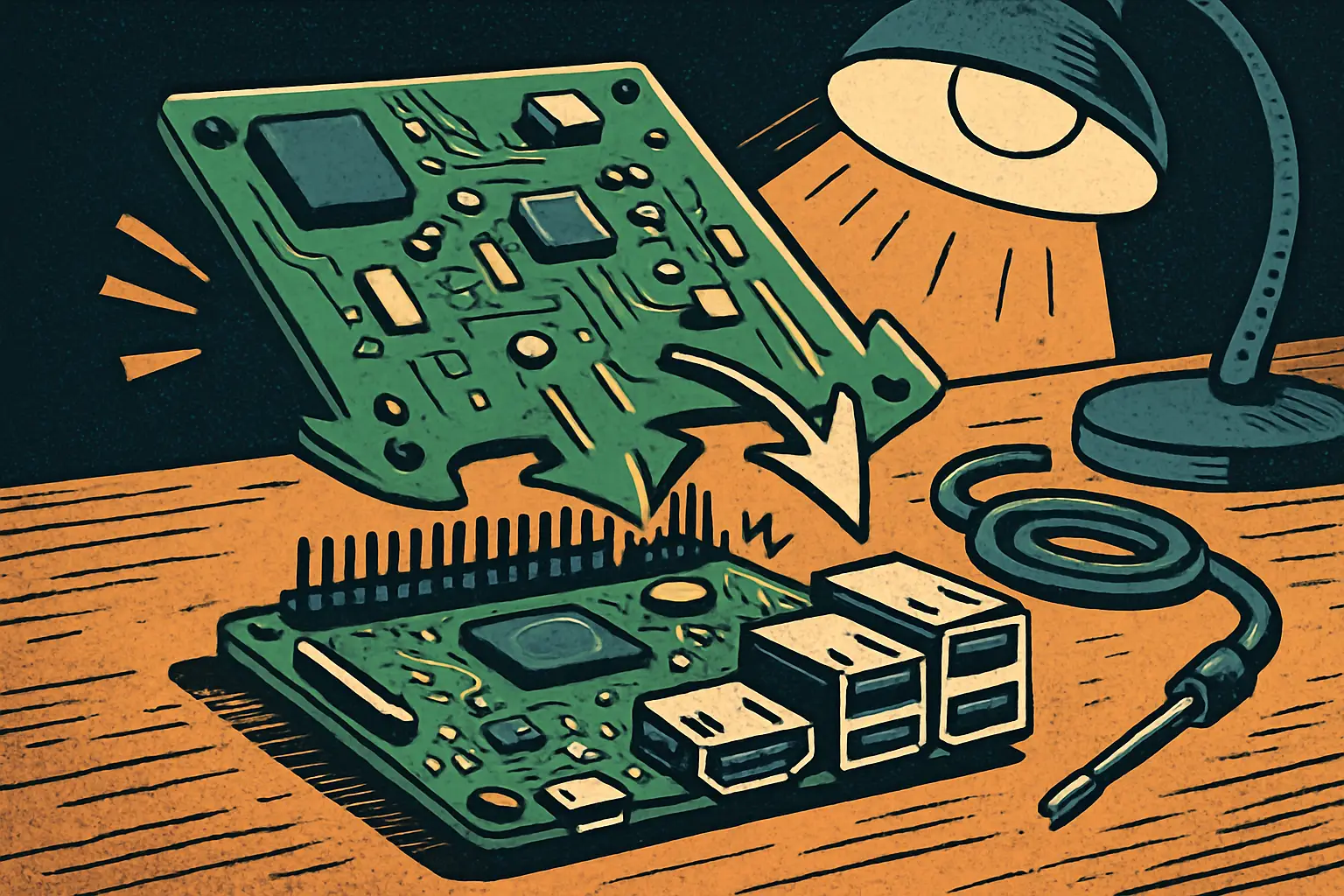
CirkitScape Top HAT Combines Four Pi Add-Ons in One
The $45 CirkitScape Top HAT adds 16 GPIOs, a 3-channel ADC, RS-485, and four USB ports to a Raspberry Pi using only standard Python libraries.

One Board Instead of a Wobbly Stack
Anyone who has built a serious Raspberry Pi project knows the problem: you end up stacking HAT on top of HAT — one for extra GPIO, another for analog input, a serial adapter, a USB hub — until your tidy little computer looks like a leaning tower. The CirkitScape Top HAT, detailed on July 24, 2026, consolidates the most common add-ons onto a single board. For $45, it hands makers extra digital pins, analog sensing, an industrial serial bus, and a four-port USB hub in one clean package — and it does it without any custom firmware.
- The CirkitScape Top HAT costs $45 direct (about $48.60 on Amazon); a Sensor Kit bundle is $73
- It adds 16 GPIOs via an MCP23017 I2C expander and a 3-channel 12-bit ADC (ADS1015)
- An RS-485 header enables industrial serial communication; a USB2514B hub adds four USB 2.0 ports at 480 Mbps
- It works with a Raspberry Pi 5, 4, 3B+, and Zero using standard Raspberry Pi OS and Python libraries
What Do You Actually Get for $45?
The value here is in breadth. The 16 extra GPIOs, delivered through a well-known MCP23017 I2C expander, give you room for more buttons, relays, and LEDs than the Pi's own header comfortably allows. The 3-channel, 12-bit ADS1015 analog-to-digital converter is the piece the Pi famously lacks — it lets the board read potentiometers, light sensors, and other analog signals natively. The RS-485 header opens the door to industrial gear and long-run serial links, while the USB2514B hub adds four 480 Mbps USB 2.0 ports for keyboards, storage, or sensors. It runs on 5V input with 3.3V logic and measures a compact 76.2 by 50.8 mm.
Why No Custom Firmware Is the Best Part
The detail I appreciate most is that the Top HAT needs no proprietary drivers. Every function is exposed through standard tools — pyserial for the RS-485 link, smbus for the I2C expander and ADC, and gpiozero for pins — so it slots straight into projects on ordinary Raspberry Pi OS. CirkitScape even includes a Python web dashboard served on port 5000, giving no-code users a browser-based way to toggle pins and read sensors. That standards-first design is exactly what keeps a maker board useful for years instead of orphaned by a firmware update, a principle we value across the mini computers category.
Where It Fits in a Maker's Toolbox
The Top HAT is aimed squarely at homelab tinkerers, classroom projects, and light industrial-automation prototyping — the same crowd reaching for boards like the Olimex Pico EVB automation board or building around tiny microcontrollers. By folding four common expansions into one HAT, it reduces both cost and the number of fragile inter-board connections, which is a real reliability win for anything you intend to leave running.
The Bottom Line
At $45, the CirkitScape Top HAT is a practical, no-nonsense way to give a Raspberry Pi a lot more real-world I/O without the stacking headaches. It is a small board that quietly removes friction — and that is exactly the kind of maker enablement worth celebrating. For more affordable SBC accessories, keep watching our mini computers coverage.
Sources: CNX Software — July 24, 2026; LinuxGizmos — July 2026.
More Mini Computers Stories

OpenMANET Runs Video Over Wi-Fi HaLow Mesh Networks
OpenMANET pushes 1-15 Mbps over 802.11ah mesh on a Raspberry Pi 4, adding voice, RTSP video and full IP where Meshtastic sends only short text.

Renesas RZ/G3L MPUs Hit 1 mW Standby With Cortex-A55
Renesas' new RZ/G3L and RZ/G3SE run four Cortex-A55 cores at 1.2 GHz and drop to roughly 1 mW in deep standby, from $14.28 in volume pricing.
ESP32-S3 Runs Linux 6.11 With 3.7MB of RAM to Spare
Release 0.8 of the native ESP32-S3 Linux port fixes the crash that hit one boot in ten and halves the memory cost of every fork. One file to flash.