
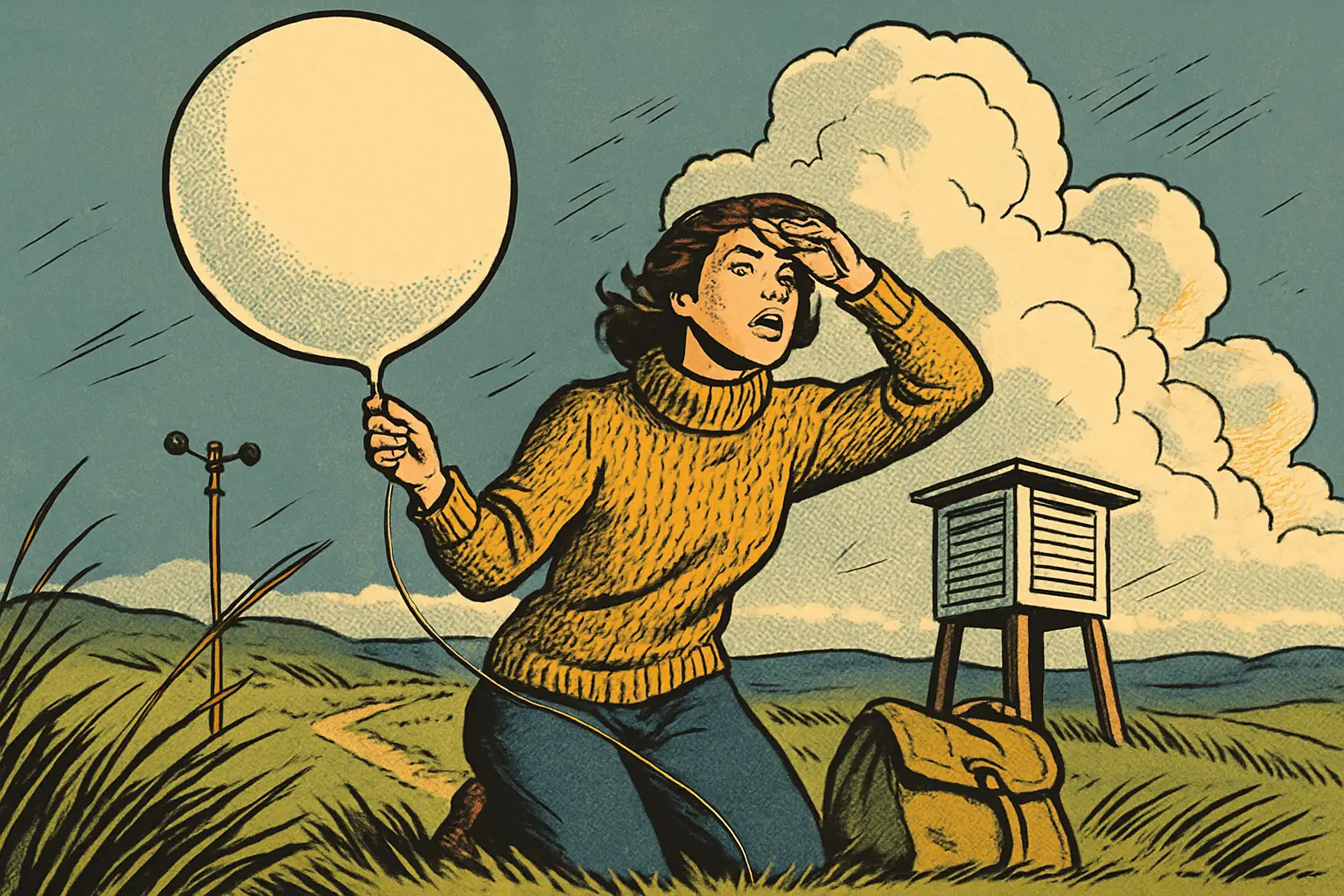
WeatherNext 3 Brings 5km Hourly Forecasts to Search
Google DeepMind's WeatherNext 3 forecasts at 5km resolution every hour and improves rain accuracy up to 60% over WeatherNext 2, live in Search now.

Google's Weather AI Model Gets Five Times Sharper
Google DeepMind and Google Research introduced WeatherNext 3 on September 3, 2026, and the headline change is resolution. The previous generation produced global forecasts on a grid measured in tens of kilometres. WeatherNext 3 produces key surface variables at roughly 5 kilometres, and it refreshes every hour instead of every six. For anyone who has watched a forecast miss a thunderstorm by two towns over, that is the difference that matters.
- Resolution: 5km for temperature and moisture, 10km for other surface variables, 25km for atmospheric variables such as upper-level wind — about five times sharper than WeatherNext 2
- Cadence: initialised hourly, producing 15-day global probabilistic forecasts across 64 ensemble members
- Accuracy: up to 60% CRPS improvement on precipitation against NASA IMERG satellite data, and up to 50% better precipitation accuracy for forecasts a day or more ahead
- Availability: rolling into Google Search, the Gemini app, Google Maps and the Maps Platform Weather API, plus Earth Engine, BigQuery and Cloud Storage for developers
What Makes WeatherNext 3 Different From Earlier Models
The technical shift is what the model eats. Most AI weather models — including Google's own earlier ones — train and run on reanalysis data, a cleaned-up gridded reconstruction of past weather assembled after the fact. WeatherNext 3 ingests live geostationary satellite observations directly as a model input, which is why it can initialise hourly rather than waiting on an assimilation cycle.
Google also trained the model to predict what specific weather stations will actually measure, not just what a grid cell average will look like. Daniel Rothenberg of Brightband, which runs independent live leaderboards for forecast models, described that as connecting the forecasting task closer to its core — the model is now scored against the thermometer at the airport, not an abstraction of the airport's neighbourhood.
The model carries about 2.4 times more parameters than its predecessor, and Google reports it topping Operational WeatherBench comparisons against models from Microsoft, Nvidia, ECMWF and the US National Weather Service. Worth noting for anyone reading the "first" claim carefully: WindBorne's model has been incorporating raw observations since late 2025, and Google's specific claim is about doing it at high resolution globally.
How Accurate Is WeatherNext 3 on Rain?
Precipitation is where the numbers are strongest, and precipitation is also the hardest thing in the field to get right. Google reports up to a 60% improvement in continuous ranked probability score for rain against IMERG, and says users planning a day or more ahead will see up to 50% more accurate precipitation forecasts, with the largest gains in regions where forecasts have historically been weakest.
That last clause is the part with real reach. Dense observation networks are unevenly distributed around the world, and a model that learns from global satellite coverage rather than ground stations alone improves fastest exactly where ground stations are sparse. The same pattern showed up when WeatherNext Cyclones added a day of tropical storm lead time earlier this summer.
Where You Can Actually Use It
Consumers get it without doing anything — the model is feeding forecasts in Search, Maps and the Gemini app. Developers get it through the Google Maps Platform Weather API for application use, and through Earth Engine, BigQuery and Cloud Storage for bulk analysis. Researchers can compare it against other models on Brightband's public leaderboards, which is the right way to treat any vendor benchmark: as a starting claim rather than a settled result.
Two specific outputs are aimed at energy operators rather than umbrella decisions. The model forecasts 100-metre wind speeds, which is turbine hub height, and it estimates cloud cover and solar radiation. Grid operators balancing renewable supply against demand are among the few users for whom an hourly refresh at 5km changes daily operations rather than just daily convenience.
Why an Hourly Refresh Matters More Than the Resolution
A sharper grid is easy to explain and easy to undersell. The hourly initialisation may be the bigger practical shift. A six-hour cycle means the forecast you check at 5pm was built on a picture of the atmosphere from lunchtime. Storms develop faster than that. Hourly initialisation with live satellite input narrows the gap between what the sky is doing and what the model believes it is doing, which is the axis on which short-range forecasting actually improves.
It also lands as the broader pattern in our AI coverage keeps repeating: the interesting frontier work in 2026 is increasingly domain-specific rather than general-purpose. A model that only does weather, trained on the right observations, is beating much larger general systems at weather — the same story as Gemini 3.8 Flash Cyber outperforming bigger models on Chrome patches this week.
Sources: Google — Introducing WeatherNext 3 — September 3, 2026; TechCrunch — September 3, 2026; Google for Developers — WeatherNext models — September 3, 2026.
More AI Stories

DeepSeek V4.1 Flash 1017: Bigger Agent Gains, Same Price
DeepSeek V4.1-Flash-1017 lifts Terminal-Bench 4.0 from 31.2 to 42.3 with MIT-licensed open weights, unchanged API pricing, and a new Search API.
Grok Voice 3.0 for Voice Agents: Upgrade Notes and Pricing
Grok Voice 3.0 scores 86.9 on Artificial Analysis' speech-to-speech index, adds 28 voices and 20 languages, and keeps the $0.08-per-minute price.

LFM2.5-24B-A2B: A 2B-Active Agent Model for Your Laptop
LFM2.5-24B-A2B activates just 2B of its 24B parameters per token, hitting 184 tokens/s on an M5 Max with a 131K context built for local AI agents.