
Raspberry Pi Bird Logger Identifies 11,000 Species
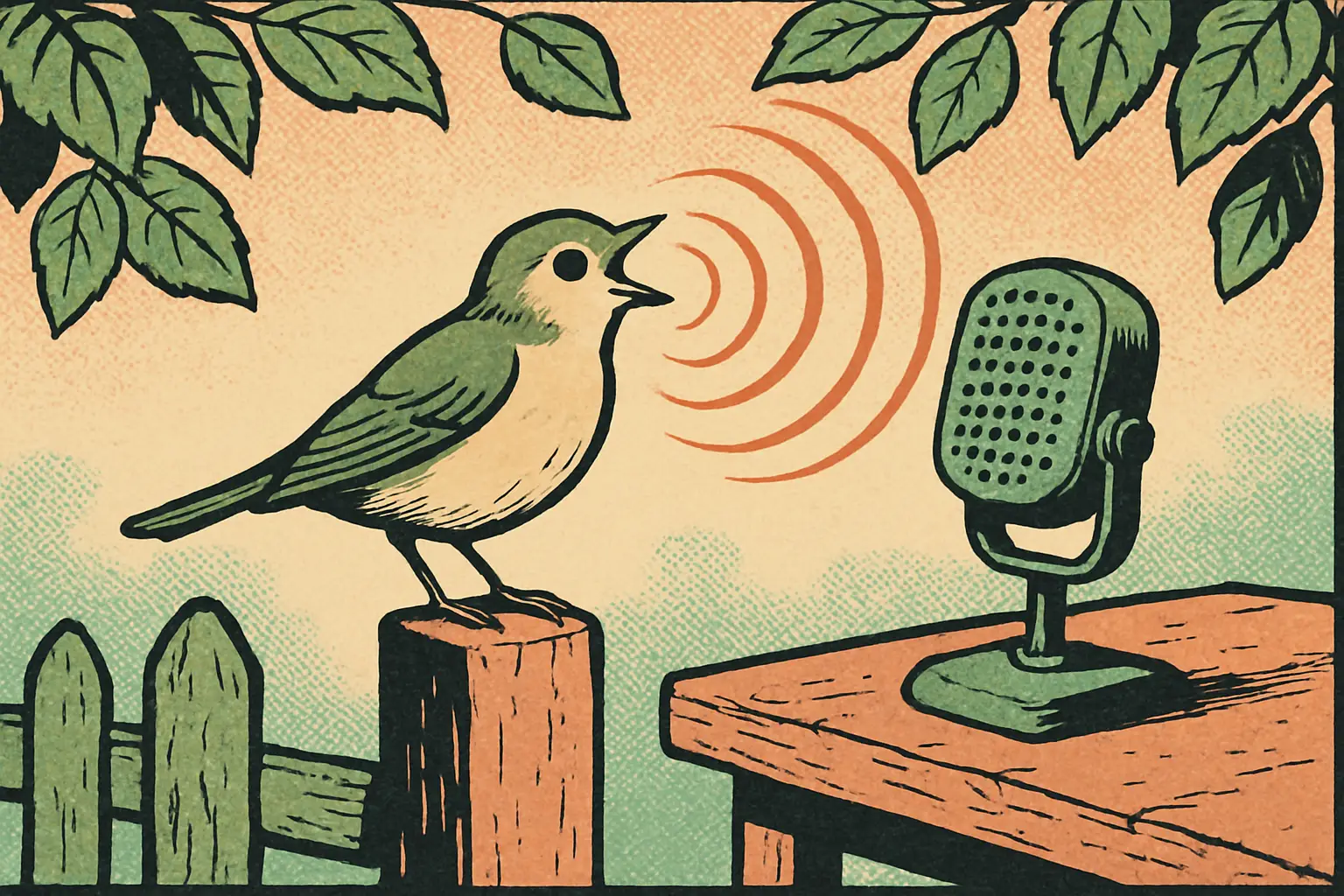
A Raspberry Pi and a USB microphone run BirdNET to identify over 11,000 bird species by sound, then render the day's visitors as an e-ink collage.

Here is a project that gets the balance right between clever and genuinely useful. Teddy Warner's Avian Visitors pairs a Raspberry Pi with a USB microphone and runs BirdNET — Cornell's deep-learning acoustic classifier — to identify which birds are visiting the yard, then renders the results as a visual collage where the more frequently a species is heard, the larger its picture appears.
- Runs BirdNET, a Cornell deep-learning classifier covering more than 11,000 species worldwide by sound alone
- Hardware is a Raspberry Pi plus a USB microphone, with an optional e-ink panel for a 24-hour summary
- A web interface shows detection history and visit patterns over time
- Home Assistant and MQTT integration allow automations triggered by specific species; source at github.com/Twarner491/AvianVisitors
Why BirdNET Is the Right Model for This Job
BirdNET is a strong example of a narrow model outperforming a general one. It does exactly one thing — classify bird vocalizations — and it covers over 11,000 species reliably from audio alone. That specificity is what lets it run on a Raspberry Pi rather than needing a GPU. A general-purpose audio model asked to identify birds would be larger, slower, and less accurate at the task.
That is a useful lesson for anyone spec'ing edge AI hardware. The instinct is to reach for the biggest model the board can hold. The better move is usually to find the model trained for your actual problem, which is frequently an order of magnitude smaller and considerably more accurate within its lane. It is the same principle behind the tightly-scoped builds in our mini computers coverage — and the inverse of the general-purpose approach that makes running a language model on a bare microcontroller an engineering stunt rather than a practical tool.
What the E-Ink Display Adds
The optional e-ink panel is the detail that elevates this from a data-logging project to something you would actually want in your kitchen. It shows a collage of the last 24 hours of visitors, sized by frequency, updating passively without a backlight or a fan.
E-ink is a good fit here for reasons beyond aesthetics. Bird activity changes on the scale of hours, not seconds, so a display technology that refreshes slowly and draws power only when it changes matches the data perfectly. A conventional LCD would spend most of its life redrawing an identical image at 60 frames per second. It is the same reasoning behind the ESP32-S3 e-paper builds we have seen this month — pick the display technology that matches the rate of change in your data.
How Does Home Assistant Integration Change the Project?
The MQTT and Home Assistant hooks are what turn a passive logger into something programmable. Because detections publish as events, you can build automations against species: a notification when something uncommon shows up, a camera trigger tied to a particular call, a running seasonal tally, or a simple log of first arrivals each spring.
That is where the citizen-science value lives. A single backyard microphone is a data point; a few thousand of them, timestamped and geotagged, become a real picture of local bird populations and how they shift across seasons. Long-running acoustic monitoring is genuinely hard to fund at scale, and hobbyist hardware in the $60 range is a legitimately good way to close that gap.
A Good Weekend Build
The hardware requirements are modest — a Pi you probably already own, a USB microphone, and optionally an e-ink panel — and the code is public. For anyone who has been looking for a Raspberry Pi project with an outcome you can enjoy without being a programmer, this one clears the bar comfortably.
Sources: Hackaday — August 8, 2026; Avian Visitors on GitHub — August 2026.
More Mini Computers Stories

MaTouch ESP32-S3 E Ink Board: A $60 Voice-Ready Dashboard
Makerfabs' MaTouch ESP32-S3 pairs a 7.5-inch four-color E Ink screen with a four-mic array for $59.80. Here are the specs and what you can build.

ASRock NUC 300 Mini PCs: Wildcat Lake With Dual 2.5GbE
ASRock Industrial's NUC 300 series brings Intel Core 5 320 and Core 3 304 to mini PCs and boards with up to 64GB of DDR5-6400 memory and dual 2.5GbE.

DGX Spark 64GB: Who NVIDIA's $4,999 Local AI Box Is For
NVIDIA's DGX Spark 64GB starts at $4,999 on Oct 23 and runs models up to 100B parameters. Here is who the local AI box suits and how clustering works.