
PewCB One Etches Circuit Boards With a Desktop Laser
PewCB One is a 20W laser PCB fab that ablates 0.1mm traces in under an hour with no chemicals, priced at $5,000 with production from September 1.

Same-Day Boards, No Chemistry Set
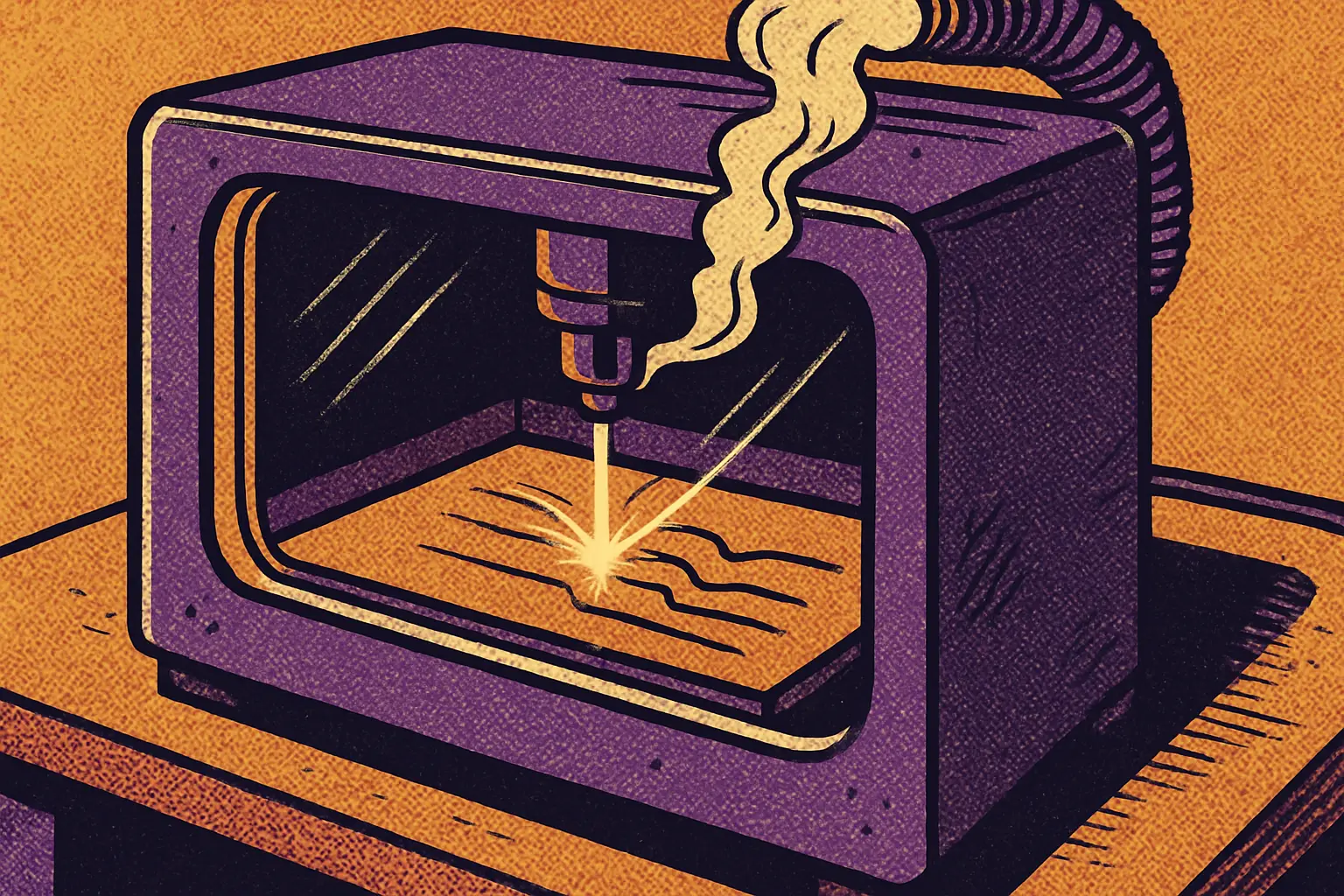
The gap between finishing a PCB layout and holding the board has been the slowest step in hardware prototyping for as long as most of us have been doing it. Order from a fab and you wait days. Etch at home and you deal with ferric chloride, uneven results, and a disposal problem. The PewCB One, detailed on August 11, 2026, takes a third route: a fully enclosed laser engraver that ablates traces directly off specialty PCB blanks.
- 1064 nm laser at 20W average optical power, roughly 100 ns pulses, 35 micron spot diameter
- Traces down to 0.1mm with 0.1mm spacing, tested as fine as 0.025mm traces and 0.04mm spacing
- Board sizes from 23x23mm up to 84x80mm, supporting QFN packages at 0.35mm pitch and 0201 passives
- $5,000 early-bird with a 30% deposit, including 20 PCB blanks; production begins September 1, 2026
How Does Laser Ablation Replace PCB Etching?
Conventional home etching is subtractive chemistry. You mask the traces you want to keep and dissolve the copper you do not. Laser ablation is subtractive physics: a short, high-energy pulse vaporizes material where the beam lands, and everything else stays put.
The practical differences stack up quickly. There is no mask to print and align, no chemical bath to mix or dispose of, and no undercut where the etchant creeps sideways beneath the resist. The precision limit becomes the beam rather than the process — which is why the specifications talk about a 35 micron spot and a 2 micron resolution with 30 micron repeatability rather than about copper thickness and bath temperature.
The system is fully enclosed with integrated air filtration, which is not an optional nicety when you are vaporizing fiberglass and copper on a desk. It handles the workflow from blank board through to a finished, populated assembly.
What Are the PewCB One Specifications?
Beyond the laser itself, the numbers describe a machine sized for a bench rather than a workshop. It measures 464 x 290 x 155 mm and weighs 11 kg, draws 200W from a standard 110-230V AC outlet, and produces boards up to 84 x 80 mm.
That board size ceiling is the constraint to plan around. It is comfortable for a sensor node, a breakout, an ESP32 carrier, or a small controller. It is not going to produce a full-size single-board computer. But the component support is genuinely fine-pitch — QFN at 0.35mm pitch and 0201 passives are not toy tolerances, and plenty of commercial designs live entirely within that envelope.
The claimed turnaround is under an hour from blank to finished board. Compress a three-day iteration loop into a lunch break and the character of prototyping changes: you stop batching design questions and start answering them one at a time.
What Does the PewCB One Cost?
Early-bird orders are $5,000 with a 30% deposit, and the package includes the machine plus 20 PCB blanks. Production is scheduled to begin September 1, 2026, so this is a pre-order rather than a shipping product.
At that price the buyer is not a weekend maker — it is a small hardware team, a university lab, or a consultancy where a shaved iteration cycle pays for itself in billable weeks. The specialty blanks are also a consumable to budget for, since the process needs material formulated for ablation rather than any bare FR4 offcut.
Still, the direction is worth watching. Desktop 3D printing followed exactly this arc: expensive and specialized first, then ordinary. If you are building at the small end of the scale, boards like the $6 Comu RISC-V stick show how compact a useful design can get, and the ESP32-S3 token monitor build is exactly the sort of project a same-day fab loop would accelerate. More hardware in our mini computer coverage.
Sources: CNX Software — August 11, 2026.
More Mini Computers Stories

MaTouch ESP32-S3 E Ink Board: A $60 Voice-Ready Dashboard
Makerfabs' MaTouch ESP32-S3 pairs a 7.5-inch four-color E Ink screen with a four-mic array for $59.80. Here are the specs and what you can build.

ASRock NUC 300 Mini PCs: Wildcat Lake With Dual 2.5GbE
ASRock Industrial's NUC 300 series brings Intel Core 5 320 and Core 3 304 to mini PCs and boards with up to 64GB of DDR5-6400 memory and dual 2.5GbE.

DGX Spark 64GB: Who NVIDIA's $4,999 Local AI Box Is For
NVIDIA's DGX Spark 64GB starts at $4,999 on Oct 23 and runs models up to 100B parameters. Here is who the local AI box suits and how clustering works.