
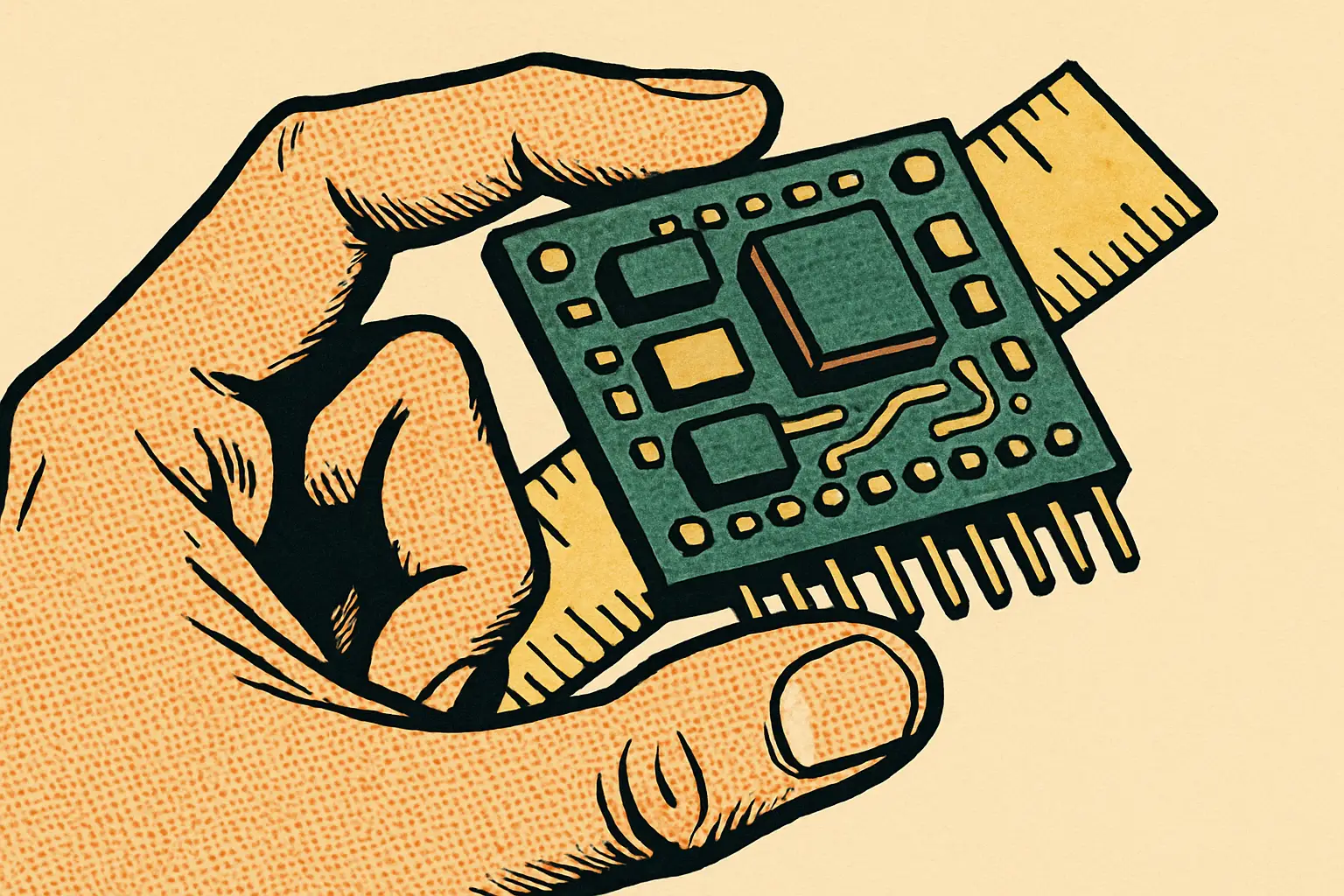
Orange Pi Zero 4 Packs 3 TOPS and 16GB Into 21 Grams
The Orange Pi Zero 4 pairs an octa-core Allwinner A733 with a 3 TOPS NPU, Wi-Fi 6 and PCIe 3.0 on a 50 x 55 mm board weighing just 21 grams.

An Octa-Core SBC That Fits Under a Coaster
Orange Pi has detailed the Zero 4, a single board computer built around the Allwinner A733 that measures 50 x 55 x 1.2 mm and weighs 21 grams. LinuxGizmos covered the specifications on August 27, 2026. The headline is not any one number but the density — this is a lot of silicon for a footprint you can cover with a bottle cap.
- Allwinner A733 SoC: two Cortex-A76 cores plus six Cortex-A55 cores at up to 2.0 GHz, with an Imagination PowerVR BXM-4-64 MC1 GPU
- 3 TOPS NPU supporting mixed-precision INT8 and FP16 inference
- Up to 16GB of memory across LPDDR5, LPDDR4X and LPDDR4 options, with eMMC from 8GB to 32GB and optional UFS from 32GB to 128GB
- Gigabit Ethernet, Wi-Fi 6 and Bluetooth 5.4, plus PCIe 3.0 and USB 3.1 on a 16-pin FPC connector
What the Big.LITTLE Split Buys You on a Board This Small
The A733's core arrangement is worth reading carefully. Two Cortex-A76 cores handle whatever needs single-thread throughput, and six Cortex-A55 cores mop up the background work at much lower power. On a board with this little surface area to dissipate heat through, that asymmetry is not a marketing bullet — it is the reason the design is thermally viable at all.
Compare it to the Orange Pi Zero 3W we covered in April, which used the same A733 in a Raspberry Pi Zero footprint. The Zero 4 is a slightly larger board and spends that extra area on I/O rather than on a faster part: Gigabit Ethernet arrives on the board itself, and there are two 22-pin MIPI CSI connectors with 4-lane support instead of a single camera path.
That second camera interface is the specification that tells you what this board is for. Two 4-lane CSI inputs plus a 3 TOPS NPU is a stereo vision configuration, and stereo vision on a 21-gram board is a drone or small-robot brain.
How Does 3 TOPS Compare to Bigger Edge AI Boards?
Modestly, and deliberately. Three TOPS is a fraction of what larger modules deliver — the Banana Pi BPI-AI2N brings 15 TOPS in a system-on-module, and dedicated edge boxes climb far higher than that. The Zero 4 is not competing there.
What 3 TOPS comfortably covers is the workload most makers actually run: object detection on a camera feed, keyword spotting, pose estimation, simple classification. Those models were tuned years ago for exactly this compute class, and running them at a few watts on a board this size is more useful than running them faster on a board that needs a fan and a barrel jack.
I/O That Punches Above the Footprint
The connectivity list is unusually complete for the size. Mini HDMI drives 4K at 60 Hz, and the USB Type-C port carries eDP or DisplayPort output as well as power, which means a display without spending the HDMI connector. There is a 26-pin GPIO header, a 13-pin expansion header, I2S digital audio, and a TWI microphone interface. PCIe 3.0 over the FPC connector is the standout — NVMe storage or a wireless card on a board this small is not a given.
Orange Pi lists Orange Pi OS, Ubuntu, Debian and Android images alongside source code, though LinuxGizmos noted the download and purchase links were still inactive at publication. Pricing has not been confirmed, and the board is expected through AliExpress and Amazon channels. Anyone budgeting a build should watch that closely given current memory pricing, a pressure that has been visible across our recent mini computer coverage.
Sources: LinuxGizmos — August 27, 2026; Tux Machines — August 28, 2026.
More Mini Computers Stories

Romu RP2354A Board: A $40 Raspberry Pi Chip in a USB Stick
Romu puts the Raspberry Pi RP2354A into a 15.5 x 12 mm USB stick for $40, running MicroPython for security keys, macro pads and MIDI controllers.

VIEWE ESP32-S31 Display: $39 Wi-Fi 6 Touch Panel for Makers
VIEWE's $38.99 4.3-inch touch display is one of the first ESP32-S31 boards, adding Wi-Fi 6, Thread, RS485 and CAN for smart home and industrial panels.

Wireless-Tag WT32P4C5-43S: A $32 ESP32-P4 Touch Display
The Wireless-Tag WT32P4C5-43S pairs an ESP32-P4 with an ESP32-C5 behind a 4.3-inch 800 x 480 touchscreen, adding dual-band Wi-Fi 6 and Thread for $32.