
OpenInfrared Point: An Open Local ESP32-S3 Remote Hub
The OpenInfrared Point pairs an ESP32-S3 with IR, NFC and audio streaming, running fully local. Kickstarter early-bird pricing starts at 149 USD.

An ESP32-S3 Remote Hub That Keeps Everything Local
The universal remote is one of those categories that never quite got solved. The good ones went cloud-only and then went away; the cheap ones need an app per device. The OpenInfrared Point, detailed by CNX Software on July 16, 2026, takes a different route: an ESP32-S3 remote hub that runs entirely on your own network with no cloud dependency, and talks to the major smart home platforms over a plain HTTP API. It is currently a crowdfunding campaign, which means shipping timelines are not guaranteed, but the hardware spec is worth a close look.
Key Takeaways
- Built on the ESP32-S3-WROOM-1 with a dual-core Tensilica LX7 at 240 MHz, 512KB SRAM plus 8MB PSRAM, and 16MB of flash.
- A multi-directional IR blaster is joined by a 3.5mm IR jack for external emitters, so cabinet-hidden gear is still reachable.
- Kickstarter early-bird pricing runs 149 USD single, 249 USD Duo, 349 USD Trio, and 1,000 USD for a 10-unit Business Pack; the campaign ends August 13, 2026.
- Operation is fully local with no cloud dependency, and the HTTP API integrates with Home Assistant, Apple Home, Alexa, Google Home, SmartThings, and IFTTT.
The Silicon
The module is an ESP32-S3-WROOM-1, which puts a dual-core Tensilica LX7 running at 240 MHz at the centre of the design. Memory is 512KB of SRAM plus 8MB of PSRAM, with 16MB of flash for firmware and stored IR codes. Wireless is WiFi 4 and Bluetooth LE 5.
That is a generous allocation for a remote hub. The PSRAM in particular is the part that makes the audio streaming feature plausible - buffering an audio stream is not something you attempt on bare SRAM. The 16MB flash gives room for a substantial local IR code database without needing to fetch codes from a server every time you add a device, which is the mechanism that quietly turns so many hubs into bricks when the server retires.
What It Actually Does
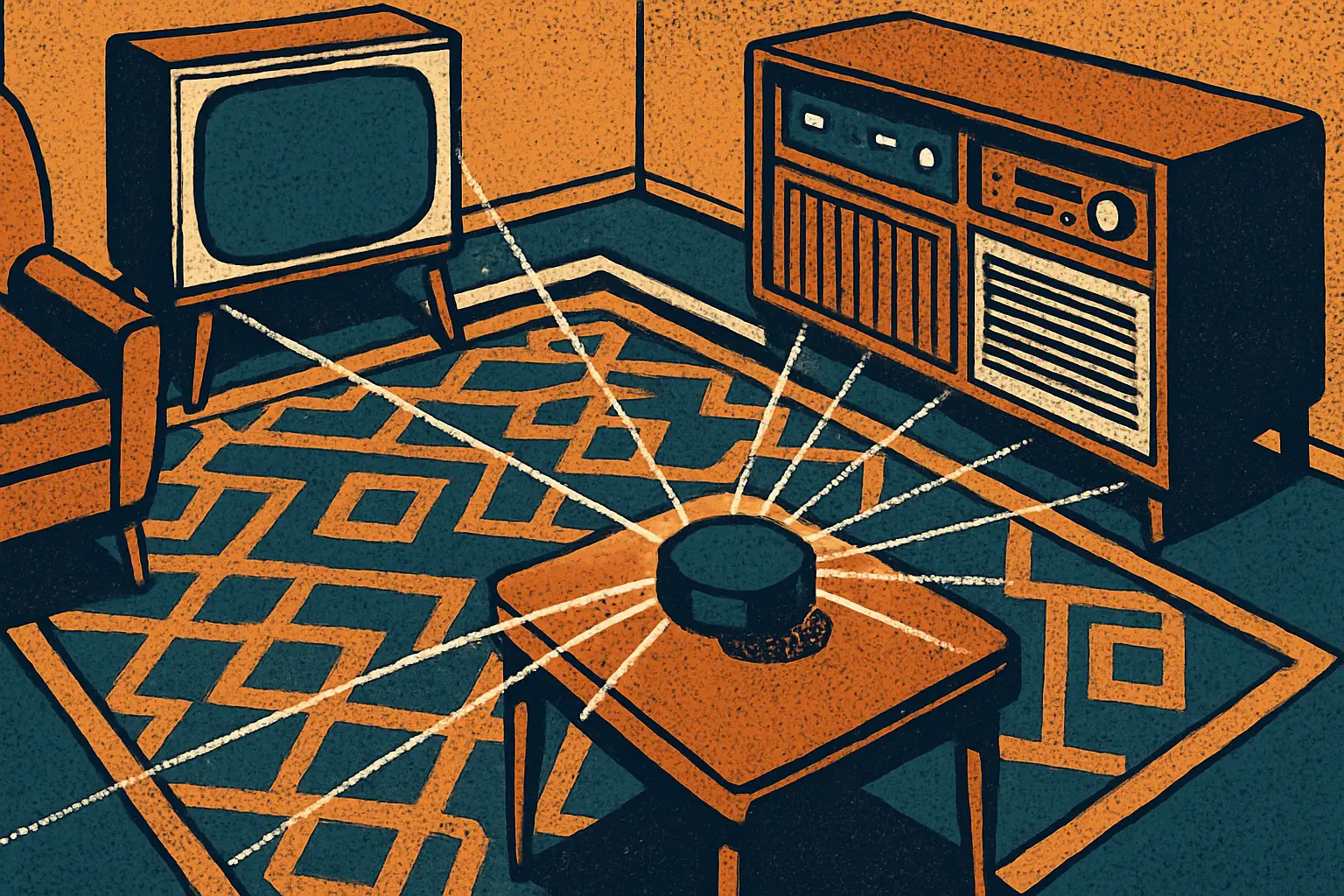
The headline function is infrared control. A multi-directional IR blaster covers a room without needing to be aimed, and a 3.5mm IR jack accepts external emitter stubs for equipment sitting inside a closed cabinet. That jack is the detail that separates a hub you can actually deploy from one that works only when every device has line of sight.
Two less obvious features round it out. A built-in NFC tag and a QR code enable tap-to-launch phone control with no app install - you tap the puck with a handset and get a control interface, which is a genuinely elegant answer to the guest-in-your-living-room problem. And a 3.5mm audio input supports private TV audio streaming, routing sound from the television to headphones or a phone rather than the room. Power is USB-C at 5V.
Home Automation Integration
Control is exposed through an HTTP API, and the listed integrations cover Home Assistant, Apple Home, Alexa, Google Home, SmartThings, and IFTTT. For homelabbers the Home Assistant path is the interesting one: a local HTTP endpoint is trivially wrapped in a REST command or a template switch, which means the hub slots into existing automations without waiting for anyone to write a custom integration. If you have been building out local-first infrastructure, this fits the same pattern as the ESP32 wM-Bus gateway for Home Assistant approach - purpose-built radio hardware exposing a clean local interface.
Is the OpenInfrared Point Open Source?
Not yet, and this is worth stating precisely. The team says hardware and software will be open-sourced when the campaign ends, along with an open IR code database, and that an RF add-on is on the roadmap. Those are stated plans from the project rather than shipped facts, and backers should treat them as such.
If the release does happen as described, it changes the calculus considerably. An open IR code database is arguably more valuable than the hardware, because IR code libraries are exactly the asset that tends to be locked up and lost. An RF add-on would extend coverage to the 433MHz gear - blinds, older sensors, some fans - that infrared cannot reach.
Pricing and the Crowdfunding Caveat
Early-bird tiers are 149 USD for a single unit, 249 USD for the Duo, 349 USD for the Trio, and 1,000 USD for a Business Pack of ten. The campaign ends August 13, 2026, and three colours are offered: Indigo, Green, and Clear. The per-unit price drops meaningfully at the multi-pack tiers, which reflects the reality that one hub covers one room.
The standard crowdfunding caveat applies without qualification: this is a campaign, not a product on a shelf, and delivery dates on campaigns are estimates rather than commitments. Back it if the local-first architecture is what you want and you are comfortable with that timeline risk.
Where It Fits
For makers, the appeal is a well-specified ESP32-S3 board with an unusually complete peripheral set aimed at a real problem, plus a stated intention to open the design. For anyone building a local-only smart home, the absence of a cloud dependency is the entire point - the hub keeps working regardless of what happens to the company behind it, which is the property that every retired hub in a drawer somewhere lacked.
More ESP32 and small-board coverage lives in our mini computers section, and the M5Stack Core2 Codex micro firmware writeup is a good companion read on what this class of silicon can do once the firmware is yours to change.
Sources: CNX Software - July 16, 2026; Kickstarter - July 16, 2026.
More Mini Computers Stories

Xerxes Pi 2026 and Nano: A $49 Raspberry Pi CM5 Homelab Kit
Xerxes Pi 2026 and Xerxes Nano bring NVMe, PoE+ and OCuLink to Raspberry Pi CM5 and Jetson modules, with Kickstarter rack kits starting at $49.

Adafruit Floppsy Rev D: An RP2350 Floppy Disk Archiver
Adafruit Floppsy Rev D uses a Raspberry Pi RP2350 with 8MB PSRAM and a 2.8-inch touchscreen to image and emulate PC and Apple II floppies without a PC.

M5Stack PaperDIY: A $25 ESP32-S3 E-Paper Kit You Assemble
M5Stack PaperDIY packs a 4.7-inch 960x540 e-paper panel, an ESP32-S3 with 8MB PSRAM and a battery into a $25 kit that you put together yourself.