
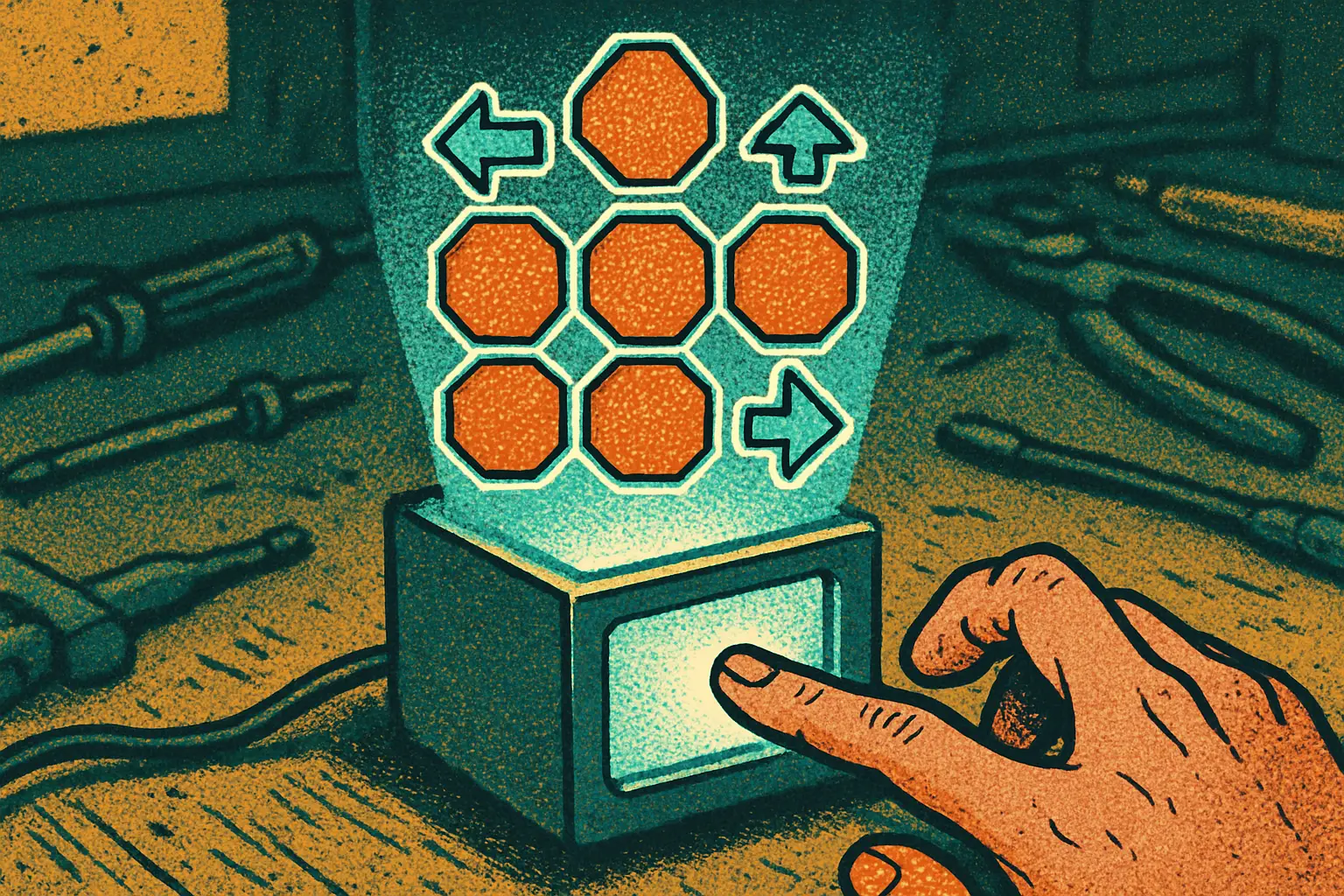
M5Stack Core2 Firmware Clones a $230 Codex Macro Pad
Open-source firmware turns a roughly $50 M5Stack Core2 into a working equivalent of OpenAI's $230 Codex Micro control pad, using its touchscreen.

A Touchscreen Cube Stands In for a Dedicated Macro Pad
OpenAI's Codex Micro — a physical control pad for driving its Codex coding agent, built by Work Louder — sells for $230 and has been hard to get, with US-only availability. On July 18, 2026, developer IAMLIUBO published open-source firmware that reproduces its functionality on an M5Stack Core2, an ESP32-based developer cube that sells for roughly $47 to $60. It is one of the cleaner examples of the maker instinct at work: the interesting part of the device was never the keycaps.
- Runs on the M5Stack Core2, an ESP32-based unit priced around $46.90–$59.90
- Presents itself over Bluetooth LE as a vendor HID device matching Codex Micro's data profile
- Uses the Core2's 2-inch touchscreen for six agent keys, six command keys, four analog-stick directions and dial actions
- Built with PlatformIO and Arduino; tested against the macOS ChatGPT desktop app
How Do You Clone a Macro Pad With No Keys?
The Core2 has no physical buttons to speak of, so the firmware moves the entire control surface onto its 2-inch touchscreen LCD. Six agent keys, six command keys, four analog-stick directions and the dial actions all become touch targets. It is a different ergonomic proposition than a real keypad — you lose the ability to hit a key without looking — but it covers the functional surface.
The clever part is the identification. The firmware presents itself over BLE as a vendor HID device matching Codex Micro's data, which means the ChatGPT desktop app treats it as the genuine article. That unlocks the features that make the pad worth having in the first place: task-status colors pushed back to the device, battery state reporting, command remapping and push-to-talk. Without that handshake you would have a macro pad; with it, you have a two-way status display.
What Are the Caveats Before You Try It?
A few, and they are worth knowing up front. The firmware has been tested against the macOS ChatGPT app. Windows compatibility is described as expected rather than verified, and Linux is a non-starter for now because there is no ChatGPT desktop app for it. This is a hobbyist project at an early stage, not a supported product.
It is also worth being clear about what this is not: it is not a complaint about the official hardware. Work Louder built a nice object, and dedicated physical keys are genuinely better for the job than a touchscreen. This is simply what happens when a capable, cheap, well-documented board is sitting on ten thousand workbenches already.
Cheap Hardware, Sharp Software
This is the same energy behind a lot of the best mini computer work — people looking at commodity boards like the RP2354-based Forgix FPGA board or the driverless Pico USB WiFi adapter and asking what else the silicon could be. The Core2 was designed as a general-purpose ESP32 development cube. It turns out that was enough.
The firmware is on GitHub under an open license, and the barrier to trying it is a board you may already own.
Sources: CNX Software — July 18, 2026; imliubo/codex-micro-4-core2 on GitHub.
More Mini Computers Stories

Sipeed MaixStation: A $3,999 128GB Box for Local LLMs
Sipeed MaixStation pairs Axera's 256 TOPS AX8860 chip with 128GB of LPDDR5X at 273 GB/s, aiming at local LLMs for an expected $3,999 after a Kickstarter.

HPMicro HPM5100: A $2.33 RISC-V MCU for Motor Control
The HPMicro HPM5100 is a 400 MHz RISC-V MCU from $2.33 with four 16-bit ADCs, four op-amps and 32 PWM channels for sensing and motor control projects.

Ryzen AI Halo 192GB: Can It Run 300B Models on Your Desk?
AMD's new Ryzen AI Halo pairs the Ryzen AI Max+ PRO 495 with 192GB of unified memory and up to 160GB as VRAM, for local 300B models at $7,299.99.