
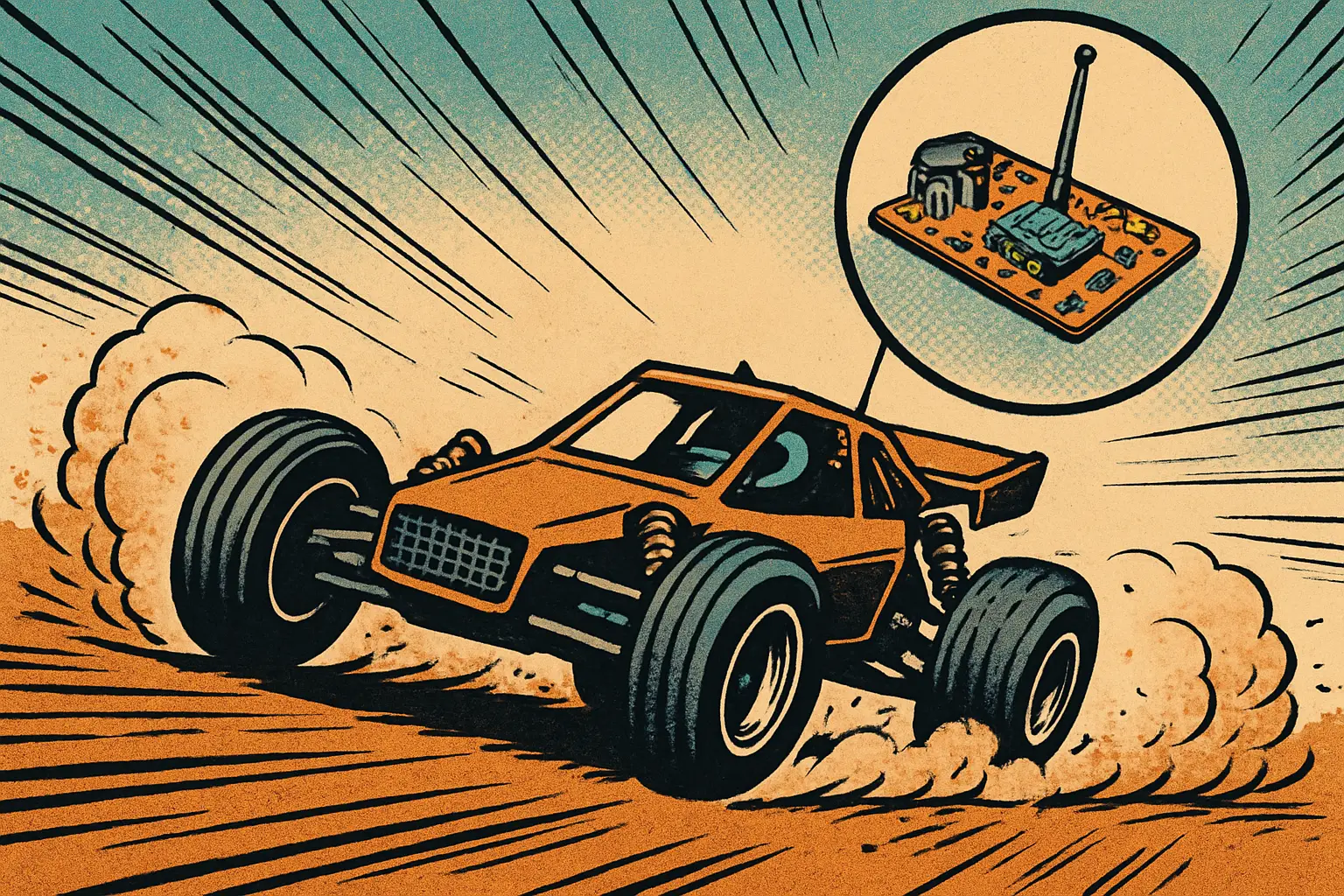
Open RC Spotter Logs RC Car Telemetry at 100 Hz on ESP32
An open-source ESP32 data logger fuses GPS and IMU with a 10-state Kalman filter, logging RC car telemetry at 100 Hz to microSD. $169 assembled.

Open RC Spotter Brings Real Motorsport Telemetry to RC Cars
CNX Software covered the Open RC Spotter on July 27, 2026, and the specification sheet is a genuine surprise. This is an open-source ESP32 telemetry board for RC cars and toys, and the sensor fusion running on it would not look out of place in a full-size motorsport data logger. A 10-state Extended Kalman Filter, 100 Hz logging, GPS and IMU fusion, and live telemetry over ESP-NOW — on a 63.6 x 38.1 mm board.
- MCU: ESP32-WROOM-32E-N4, dual-core 240 MHz, 520KB SRAM, 4MB flash
- Sensors: LSM6DS 6-axis IMU, u-blox MAX-M10S GPS, ADS1115 ADC for temperature, IRM-56384 IR receiver for lap timing
- Logging: 100 Hz to microSD; live telemetry at 20 Hz over ESP-NOW
- Price: $169 fully assembled from Energy Labs on Tindie; design files on OSHWLab, firmware on GitHub
What Does a 10-State Kalman Filter Actually Do Here?
This is the part that elevates the board above a data logger with a GPS module bolted on. GPS gives you absolute position at a low update rate with meaningful noise. An IMU gives you acceleration and angular rate at high frequency, but integrate it and the error drifts without bound. Each sensor's weakness is the other's strength.
An Extended Kalman Filter fuses them into a single state estimate that is better than either input. Ten states typically covers position, velocity, attitude, and sensor bias terms — meaning the filter is actively estimating and correcting for gyro and accelerometer drift while it runs. The practical result is that a corner exit trace stays smooth and accurate rather than dissolving into GPS jitter, which is precisely the data you need to tell whether a setup change helped.
Why 100 Hz Matters for a 1/10-Scale Car
A scale RC car goes through a corner far faster in real time than a full-size car does. Suspension events, traction breaks, and steering corrections all happen in tens of milliseconds. At 10 Hz you get a smoothed cartoon of the lap. At 100 Hz you can see the individual traction loss and correlate it against throttle and steering input — which is exactly what the board's 3-channel PWM input capture (800–2200 µs) is there for. It reads throttle, steering, and an auxiliary channel straight from the receiver, so driver input and vehicle response land on the same timeline.
The Sensor Package in Detail
| Sensor | Part | Function |
|---|---|---|
| IMU | LSM6DS | 6-axis accelerometer + gyroscope |
| GPS | u-blox MAX-M10S | Position and ground speed |
| ADC | ADS1115 | Temperature monitoring |
| IR | IRM-56384 | Lap timing beacon receiver |
The IR receiver is a thoughtful inclusion. Lap timing at RC tracks is usually done with an infrared beacon at the start-finish line, so the board integrates with infrastructure clubs already have rather than asking users to rely on GPS geofencing, which is marginal at scale-model distances.
Getting Data Off the Board
Two paths, and both are sensible. For post-session analysis, the ESP32 serves a Wi-Fi interface at 192.168.4.1 where you download CSV logs directly — no proprietary format, no desktop client, just CSV you can drop into any tool you like. For live work, ESP-NOW streams telemetry at 20 Hz to the Open RC Crew Chief web dashboard, so a pit-side laptop sees the run as it happens.
ESP-NOW is the right protocol choice here. It is a connectionless Espressif protocol that skips the Wi-Fi association handshake entirely, giving low latency and quick recovery when a car drives behind an obstacle — a much better fit than trying to hold a TCP session with a vehicle moving at scale speed.
Is $169 Reasonable?
Assembled units sell for $169 on Tindie from Energy Labs, which is not impulse-purchase territory. But look at what is on the board: a u-blox M10 GPS module, a quality IMU, a 16-bit ADC, an IR front end, microSD, and PWM capture, plus the firmware engineering to run an EKF on an ESP32 in real time. Comparable full-size motorsport loggers start well above this.
And because the design files are on OSHWLab with firmware and libraries on GitHub, the $169 is optional. You can build it yourself, or fork the firmware and port the fusion stack to a different board entirely — the genuine value of open-source hardware, and the same pattern we admired in Moonshine Puts Offline Voice AI on a Pico 2 Chip. More projects like this in our mini computers coverage.
Sources: CNX Software — July 27, 2026; Tindie — July 2026.
More Mini Computers Stories

OpenMANET Runs Video Over Wi-Fi HaLow Mesh Networks
OpenMANET pushes 1-15 Mbps over 802.11ah mesh on a Raspberry Pi 4, adding voice, RTSP video and full IP where Meshtastic sends only short text.
Renesas RZ/G3L MPUs Hit 1 mW Standby With Cortex-A55
Renesas' new RZ/G3L and RZ/G3SE run four Cortex-A55 cores at 1.2 GHz and drop to roughly 1 mW in deep standby, from $14.28 in volume pricing.
ESP32-S3 Runs Linux 6.11 With 3.7MB of RAM to Spare
Release 0.8 of the native ESP32-S3 Linux port fixes the crash that hit one boot in ten and halves the memory cost of every fork. One file to flash.