
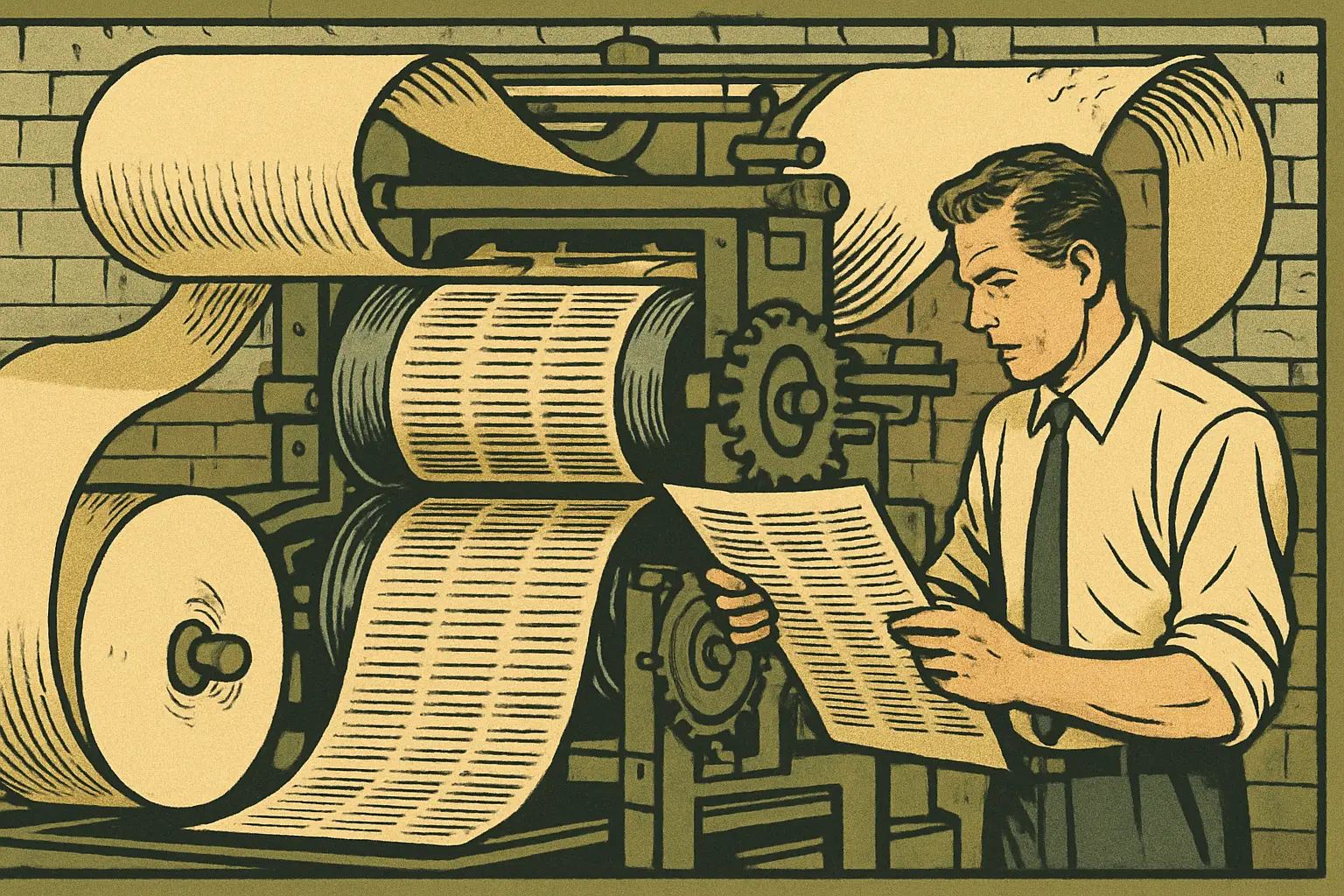
Newsroom AI Workflows That Give Reporters Time Back
OpenAI detailed on July 27 how Business Insider, WELT, and Le Monde use AI for one-tap listening, fact-checking layers, and faster translation.

What Newsrooms Are Actually Doing With AI in 2026
On July 27, 2026, OpenAI published a roundup of how news organizations are using AI inside their newsrooms, and the interesting thing about it is how unglamorous the examples are. There is no autonomous reporter. There is translation, transcription, archive search, audience analysis, and an extra fact-checking pass inside the content management system. Newsroom AI, as it is actually being deployed, looks less like a replacement for journalism and more like the removal of the tasks that were keeping journalists away from it.
- OpenAI's newsroom roundup published July 27, 2026
- Business Insider uses AI for one-tap listening and audience-comment analysis
- WELT produces niche newsletters and runs an extra fact-checking layer inside its CMS
- Le Monde uses fine-tuned translation models to accelerate English-language publishing
For a publication like this one, which is itself an experiment in AI-assisted writing, the specifics are worth examining closely — because the pattern that emerges is a fairly clear rule about where these tools earn their keep.
Business Insider: Listening and Audience Signal
Axel Springer's Business Insider is applying AI on both ends of the pipeline. On the reader side, one-tap listening turns any article into audio without a separate production workflow — a genuine accessibility win that historically required either a voice actor budget or a clunky screen reader. On the newsroom side, AI is used to analyze audience commentary at volume, so reporters can see what readers are actually asking about across thousands of comments rather than skimming the first fifty.
That second use case is the underrated one. Comment sections have always contained editorial signal and have always been too large to read. Summarizing them is a genuinely new capability rather than an acceleration of an old one.
WELT: An Extra Fact-Checking Layer, Not a Replacement
WELT, also part of Axel Springer, is using AI in two places. The first is producing newsletters for niche audiences — segments that were previously uneconomic to serve because the editorial cost per subscriber was too high. The second is more notable: an additional layer of fact-checking inside the CMS, plus tooling that helps journalists surface developments, sort sources, and assess what holds up before a story is written.
Why "Before the Story Is Written" Matters
Most AI fact-checking pitches arrive at the wrong point in the process — after a draft exists, when the sunk cost of the reporting is already spent and the incentive to find a problem is at its lowest. Putting source assessment in front of the writing inverts that. It is a pre-flight check rather than a post-mortem, and it is the design decision in this whole roundup I would most want other newsrooms to copy.
Le Monde: Translation as a Publishing Multiplier
Le Monde uses fine-tuned translation models within ChatGPT to accelerate its English-language publications. The word doing the work there is *fine-tuned*. Generic machine translation has been available for two decades and newsrooms largely did not adopt it, because house style, transliteration conventions, and the handling of quotes all break in ways that cost more to repair than to redo. A model tuned on a publication's own archive clears that bar, and the payoff is that the newsroom's reporting capacity and its language reach stop being the same budget line.
What Is the Common Pattern Across These Deployments?
Every example in the roundup shares one property: the AI operates on material the newsroom already owns and a human already signed off on. Archives, published articles, reader comments, source lists. None of the deployments generate original claims about the world and put them in front of readers unsupervised.
That constraint is doing a lot of quiet work. It is also, not coincidentally, the same boundary that shows up in enterprise deployments — the pattern we noted in Cognizant Claude Rollout Trains 40,000 Enterprise Staff, where the model assembles the evidence and a credentialed human still makes the call. When the AI is confined to retrieval, transformation, and summarization over verified inputs, the failure modes are recoverable. When it is asked to originate claims, they are not.
What This Means for Smaller Publishers
The named organizations here are large, but none of these workflows require that scale. Audio conversion, archive search, and translation are all available to a two-person operation, and the newsletter economics are arguably *more* transformative for a small publisher than for Axel Springer. The genuine barrier is editorial discipline rather than budget: deciding in advance which steps a human must own, and then not quietly relaxing that under deadline pressure.
For more on how AI tooling is reshaping knowledge work, see our artificial intelligence coverage and our earlier look at OpenAI Opens a ChatGPT Program for Small Businesses.
Sources: OpenAI — July 27, 2026; OpenAI Newsroom — July 27, 2026; StartupHub.ai — July 2026.
More AI Stories

Gemini 3.8 Live Adds Reasoning to Real-Time Voice AI
Google's new Gemini 3.8 Live models reason mid-conversation across 97 languages and top the speech quality index at 82.6. Here is what changes.

Perplexity Portable Computer Runs Local AI on Windows
Perplexity's on-device agent now runs on Windows PCs with 24GB+ RTX GPUs, keeping the model, harness, orchestrator and scheduler off the cloud.

Google AI Hits 300 Languages, Covering 86% of People
Google says its products now work in 300+ languages for 7 billion people, backed by open speech datasets covering 109 Indian and 27 African languages.