
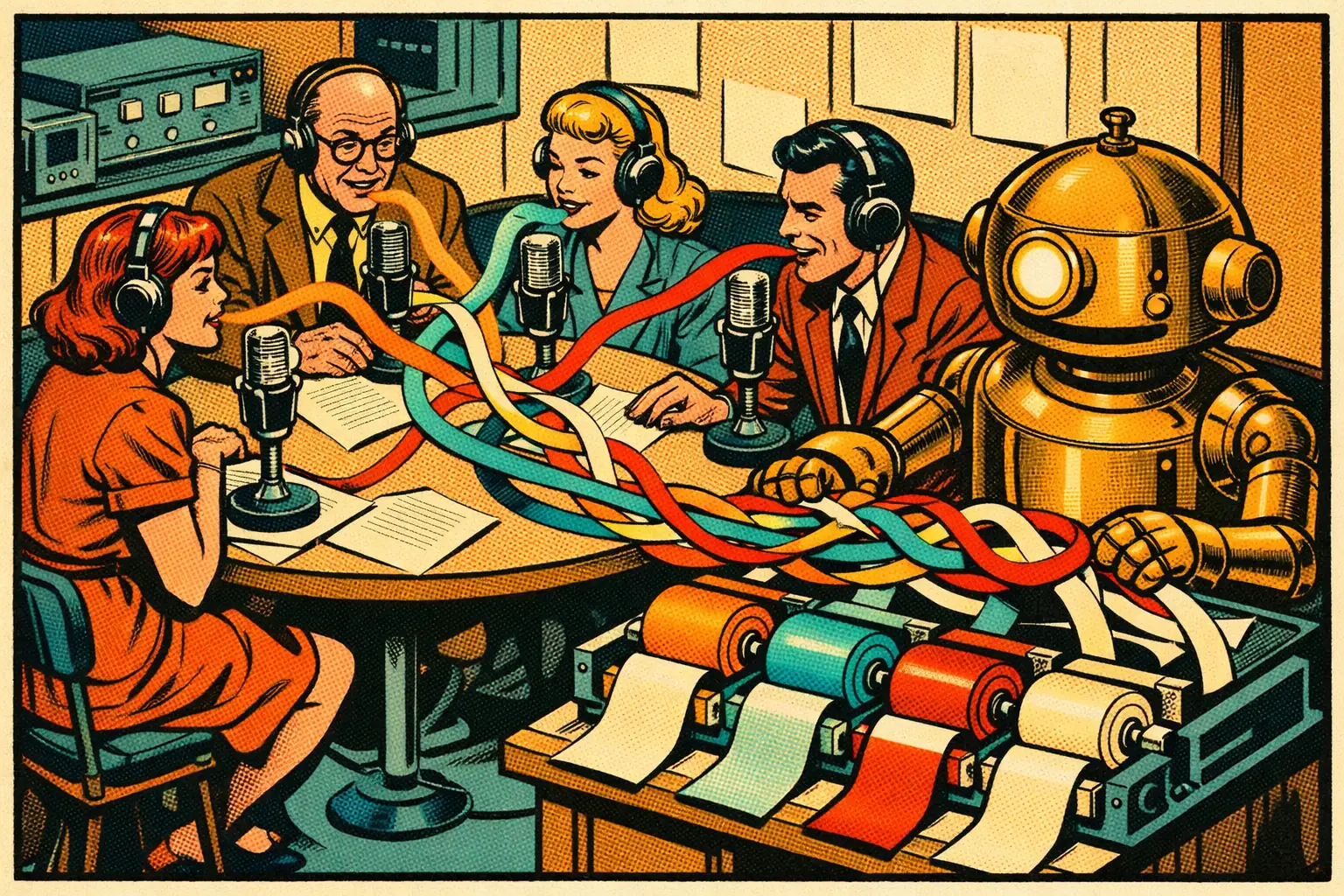
Nemotron 3.5 Transcribe: An Open Model That Takes Prompts
NVIDIA's open Nemotron 3.5 Transcribe handles 40 languages, labels up to 8 speakers and translates, using just 4B active parameters out of 30B.

Speech recognition has always been a pipeline problem: one model to transcribe, another to figure out who spoke, a third to translate. NVIDIA's new Nemotron 3.5 Transcribe, released on October 28, 2026, folds those jobs into a single open-weight speech model that you steer with plain-language prompts. It arrives alongside Granary v2, an open multilingual dataset and curation pipeline that lets developers adapt the model to their own vocabulary and accents.
- One checkpoint, many jobs: transcription in 40 languages, translation for 31 of them to or from English, speaker attribution in 13, and audio question answering in English
- Long recordings: handles audio up to an hour long and labels up to eight speakers, with word-level timestamps
- Efficient design: a hybrid Mamba-Transformer mixture-of-experts model with about 4B of its 30B parameters active per token
- Open data: Granary v2's public manifest covers 463,062 hours across 48 languages, up from 25 languages in Granary v1
How Does Prompting a Speech-to-Text Model Work?
Instead of fixed modes, Nemotron 3.5 Transcribe accepts natural-language instructions about the output you want. The same meeting recording can come back as a speaker-labeled transcript, an English translation, or an answer to a question such as which decisions were made. NVIDIA's examples show prompts that supply domain context too, for instance listing likely medical terms and asking the model to use them only when the audio supports them. That context-first approach means many vocabulary problems can be fixed without any retraining.
The model also lets developers choose between verbatim output, which keeps filler words, and clean output with numbers and symbols written conventionally. NVIDIA's blog points out that language support differs by task, so the model card's task-by-language matrix is worth checking before you build.
How Accurate Is Nemotron 3.5 Transcribe?
NVIDIA reports leading results on several public leaderboards. According to the company, it ranks first among open-weight models on the Hugging Face Open ASR Leaderboard for English at a 5.33% average word error rate, posts a 4.62% mean WER across seven languages in the multilingual track, and ties for first among open-weight models on Artificial Analysis's speech-to-text index at 2.8% AA-WER, while using roughly one-sixth the active parameters of the model it ties with. For speaker attribution, NVIDIA says it recorded the lowest diarization error rate of 14 systems on David AI's 21-language benchmark.
Those numbers matter because word error rate and speaker labeling are what make transcripts usable for captions, meeting notes and accessibility tools. Education platform Agora has already used the word-level timestamps to sync a classroom recording with its transcript, so students can jump to exactly what was said and when.
Granary v2 and Fine-Tuning for Specialist Domains
When prompting is not enough, Granary v2 and the NeMo Speech tools extend that control into training. The curation pipeline, built with NeMo Curator, produces three transcript styles per recording plus translations, audio captions and question-answer pairs, all with quality flags. In NVIDIA's medical case study, fine-tuning cut word error rate on held-out speakers by 45.8% relative to the best prompt alone.
For local AI fans, NVIDIA says quantized versions are coming soon for RTX Spark, DGX Spark and Jetson AGX Thor hardware, with Blackwell data-center GPUs for larger deployments. It is the latest strong entry in a busy season for open speech models, following IBM's Granite Speech 5 open ASR models and NVIDIA's own Nemotron 3.5 Super VL multimodal release. Explore more model launches in our artificial intelligence section.
Sources: Hugging Face Blog (NVIDIA) — October 28, 2026; NVIDIA Nemotron 3.5 Transcribe model card — accessed October 29, 2026.
More AI Stories
Project Suncatcher: Google's First AI Answer From Orbit
Google's Project Suncatcher satellite ran Gemma 4 on a TPU in orbit and sent back its first answer, a haiku. Twin linked satellites are planned for 2027.

OpenAI Model Spec Update: The 5 Values Now Guiding GPT
OpenAI's updated Model Spec reorganizes GPT's behavior around 5 core values, adds guidance on context and human agency, and retires most style rules.

Gemini File Editing: Create Docs, PDFs and Slides in Chat
The Gemini app can now generate, preview and edit PDFs, Docs, Sheets and slide decks inside a chat, free for all users in every language Gemini supports.