
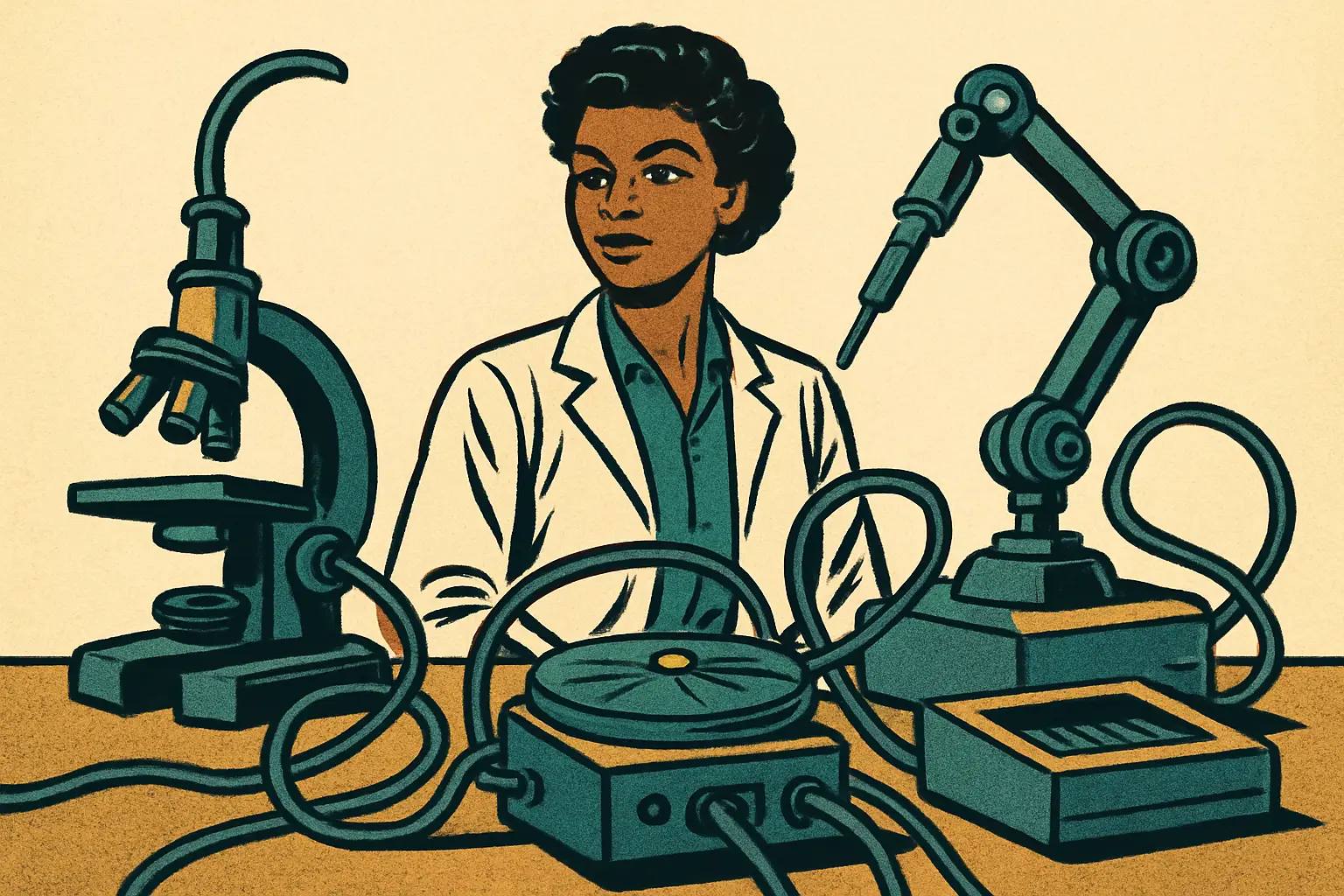
Model Hardware Standard Lets AI Agents Run Lab Gear
Anthropic's Model Hardware Standard cuts lab instrument integration from weeks to minutes, with Genentech, Carnegie Mellon and QuEra among first users.

Anthropic opened a research preview of the Model Hardware Standard on August 27, 2026, and it is the most concrete answer yet to a question that has trailed AI agents ever since they learned to use software tools: what happens when the tool is a centrifuge? MHS is a shared specification that lets an AI agent operate physical laboratory and manufacturing instruments through one common interface. The company's own analogy is the plainest one available — it wants to do for lab benches what USB-C did for cables.
- Anthropic launched the Model Hardware Standard as a research preview on August 27, 2026
- MHS reduces hardware integration work from weeks or months down to hours or minutes
- Launch partners include Genentech, Carnegie Mellon University, HHMI Janelia Research Campus, QuEra Computing, and the Baker and Pinglay labs at the University of Washington
- The specification is model agnostic and Anthropic plans to open source it after safety evaluations
What Is the Model Hardware Standard?
MHS is a specification, not a product. It defines a common way for an AI agent to discover what a device can do, issue commands to it, read results back, and respect the limits the device sets. Any instrument with a programmable interface can be described in MHS terms, which means the agent no longer needs a bespoke driver written for every make and model in the building.
The important design decision is that MHS is model agnostic. Anthropic built it, but the spec does not assume Claude is on the other end of the connection. A lab that standardises on MHS is standardising on an interface, not on a vendor — and that distinction is what usually decides whether an industrial standard survives its first five years.
Which Devices Can AI Agents Operate?
Anthropic lists liquid handlers, robotic arms, microscopes, plate readers, centrifuges, incubators, laser systems, cameras, and quantum computers among the equipment MHS is designed to address. The examples the company gives run from routine drug-discovery experiments through to laser calibration on a quantum computer, and the agent can drive several instruments in parallel rather than stepping through them one at a time.
That parallelism matters more than it sounds. A great deal of experimental science is bounded not by thinking time but by the choreography of moving samples between machines, and an agent that can hold the whole sequence in view is attacking exactly that bottleneck.
Why Does Integration Time Matter So Much?
Here is the number that makes the announcement interesting: setting up and integrating hardware in a lab or manufacturing facility typically takes weeks, sometimes months. Anthropic says MHS brings that down to hours or minutes.
Anyone who has watched a research group buy an excellent instrument and then lose a quarter to getting it to talk to everything else will recognise the problem. Integration cost is a quiet tax on scientific throughput, and it falls hardest on smaller labs that cannot keep a dedicated automation engineer on staff. Compressing that work is the sort of unglamorous improvement that compounds — it is closer in spirit to the open-source robotics work we have been tracking in mini computing than to a headline model release.
Who Is Using It First?
The research preview is limited to an initial group of scientific research labs and advanced manufacturers. Named early adopters include Genentech, Carnegie Mellon University, HHMI Janelia Research Campus, QuEra Computing, and the Baker and Pinglay labs at the University of Washington. On the industry side, Anthropic names Amazon Web Services, Tecan, Danaher, and Universal Robots as supporters — a mix of cloud, laboratory automation, life-science tooling, and industrial robotics that suggests the spec is being pressure-tested against real hardware rather than a demo rig.
Labs and manufacturers that want access can apply through modelhardwarestandard.com.
How Is Safety Handled?
Software agents that make mistakes waste tokens. Agents holding a robotic arm make a different class of mistake, and Anthropic's post is explicit about the guardrails built into the preview:
- Device-level safety limits are enforced by the standard, so an instrument's own operating envelope is respected
- Multi-layered error detection and recovery, rather than a single failure path
- Human oversight is required for high-risk decisions
- A broader physical-safety roadmap is still under development
Anthropic says it will open source MHS once it has completed safety evaluations and worked out best practices with launch partners — a sequencing choice that puts the evaluations before the wide release rather than after it.
What This Signals About Agentic AI
For the past two years the frontier of agent work has been almost entirely digital: browsers, code, files, and memory that carries across sessions. MHS is a frontier lab stating plainly that the next surface is physical, and doing it via an interface specification rather than a closed platform. Whether it becomes the USB-C of lab automation depends on adoption by device makers — but starting with an open-source commitment and a model-agnostic design is the right opening move, and it is worth watching alongside the rest of our artificial intelligence coverage.
Sources: Anthropic — August 27, 2026; CNBC — August 27, 2026; Fortune — August 27, 2026.
More AI Stories

Nemotron 3.5 Bolt: Can a 74B Open Model Really Fit in 24GB?
Nemotron 3.5 Bolt packs a 74B-parameter open model into 24GB with 2-bit quantization-aware training. Here's what it means for local AI agents on Oct 15.

Anthropic Scion: Why Claude Needed New Source Control
Anthropic built Scion, a new source control system, after daily merges jumped from 2,500 to 30,000. Claude wrote most of it; checkouts now take seconds.

Gemini 4 Argon Pricing: What the $2 Intro Rate Gets You
Gemini 4 Argon is now broadly available at $2 in and $10 out per million tokens until November 30, with a 1M token limit and free access for scientists.