
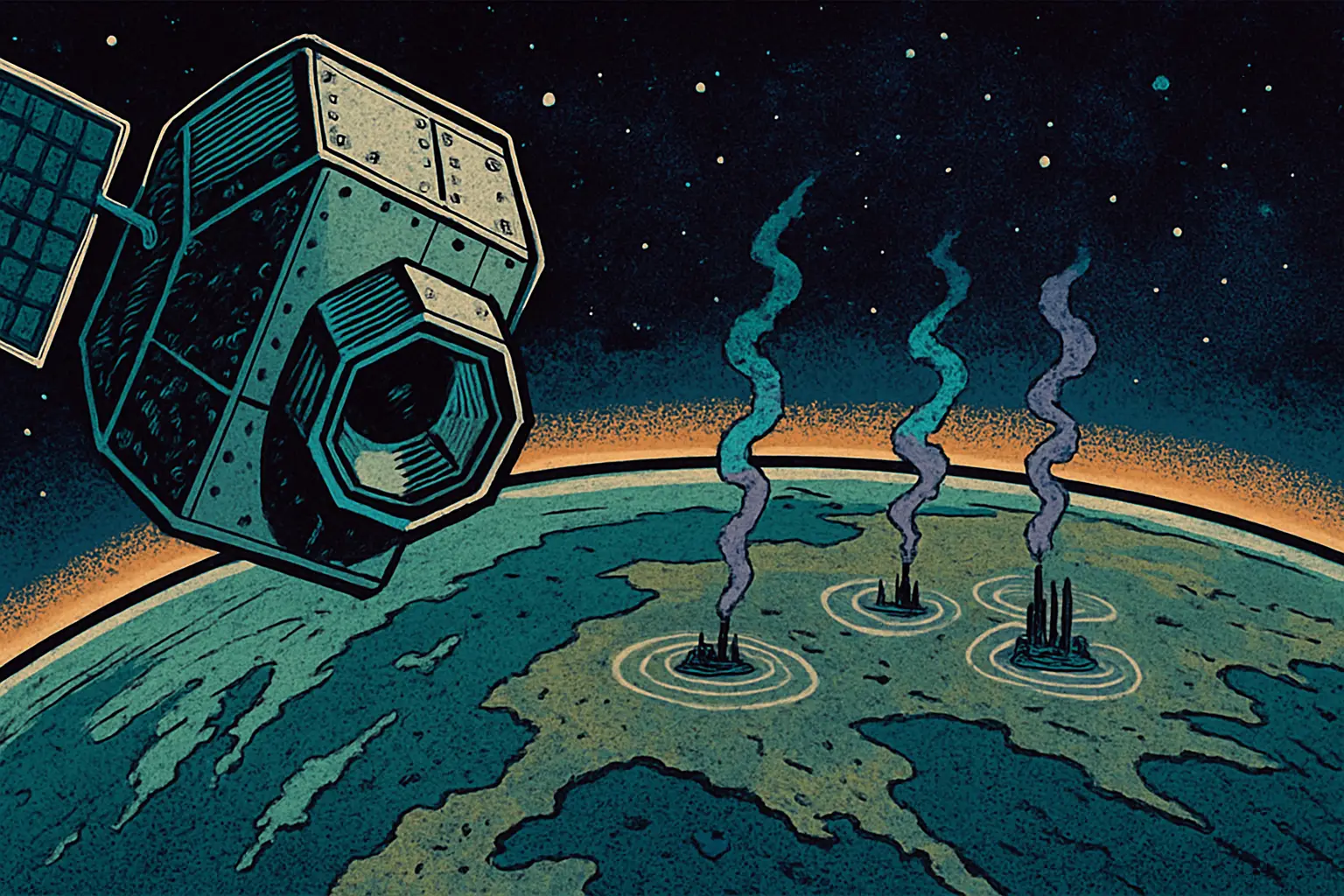
Methane-Mapping AI Spots 50% More Plumes From Space
Google and NASA JPL released MAPL-EMIT, a vision transformer that found 23,000 extra methane plumes and detects 50% more than human analysts.

A Deep Learning Model That Reads Methane Straight From Raw Light
Google Research and NASA's Jet Propulsion Laboratory have released MAPL-EMIT, a deep learning model that detects and measures methane plumes from orbit — and the headline number is that it finds roughly 50% more plumes than expert human analysts working the same imagery. The work was published in PNAS and announced on Google's research blog on September 9, 2026, alongside a global plume database, the trained weights, and an inference library.
- Detection gain: identifies about 50% more methane plumes than human experts reviewing the same data
- New plumes found: more than 23,000 additional plumes worldwide, including 24 of the 25 largest-emitting landfills
- Training data: 3.6 million physics-simulated methane plumes rather than hand-labeled examples
- Released openly: plume database and enhancement rasters on Google Earth Engine, model and synthetic dataset on Kaggle, inference code on GitHub
How Does MAPL-EMIT Differ From Older Methane Detection?
The conventional pipeline for satellite methane detection runs in stages. A physics-based retrieval step converts raw radiance into an estimated methane concentration for each pixel, and then a human analyst — or a simpler classifier — looks at the resulting map and decides which blobs are real plumes and which are artifacts from bright roofs, water, or mineral surfaces that happen to absorb light in similar bands.
MAPL-EMIT collapses that into one model. It is an end-to-end vision transformer that takes the complete radiance spectrum from NASA's EMIT imaging spectrometer aboard the International Space Station and does three jobs at once: it quantifies the methane enhancement in every pixel, draws the boundary of each plume, and localizes the emission source. Doing all three jointly is what buys the accuracy. A model that has to explain where a plume starts is much less likely to call a shiny parking lot a methane cloud, because the shape and the source point have to be consistent with the spectral signal.
The training approach is the other notable choice. Hand-labeling methane plumes is slow and scarce, so the team trained on 3.6 million synthetic plumes generated by physics simulation. That is a familiar pattern in AI for science work — when real labels are expensive but the underlying physics is well understood, you can manufacture as much supervision as you need. It only works if the simulator is faithful enough that the model does not learn artifacts of the simulation, and the published detection gains suggest it held up here.
What Does Finding 23,000 More Plumes Actually Buy?
Methane is a short-lived but potent greenhouse gas, and most of the emissions that matter at a facility scale come from a relatively small number of concentrated sources: gas infrastructure, coal operations, large landfills. The practical problem has never been knowing that these sources exist — it is knowing precisely which vent, which cell of which landfill, on which day. That is the gap between a general estimate and an actionable work order.
Detecting 24 of the world's 25 largest-emitting landfills is a useful illustration. Landfill emissions are diffuse, uneven, and shift with weather and cover material, which makes them exactly the kind of source that a fixed-frame analysis tends to miss. A model that can sweep the full EMIT archive and surface candidates at scale turns a research exercise into monitoring infrastructure.
Why the Open Release Matters More Than the Benchmark
The part of this release most likely to compound is not the accuracy figure — it is that Google put the artifacts where practitioners already work. The global plume database and methane enhancement rasters ship as Earth Engine collections, so anyone already running geospatial analysis there can query them without re-deriving anything. The trained model and the synthetic plume dataset are on Kaggle, and an inference library is on GitHub, which means a research group with its own spectrometer data can run the same pipeline instead of rebuilding it.
That is a meaningfully different posture from publishing a paper with a results table. It also makes the claims checkable, which is the standard any detection model should want to be held to. For readers following how machine learning is being pointed at scientific datasets rather than chat interfaces, this sits alongside DeepMind's AlphaGenome Atlas variant map and IBM's Granite time-series foundation model as part of the same shift: domain-specific models, released open, aimed at a dataset nobody could exhaust by hand.
Sources: Google Research — September 9, 2026; The Keyword (Google) — September 9, 2026; Unite.AI — September 2026.
More AI Stories

Gemini 3.8 Live Adds Reasoning to Real-Time Voice AI
Google's new Gemini 3.8 Live models reason mid-conversation across 97 languages and top the speech quality index at 82.6. Here is what changes.

Perplexity Portable Computer Runs Local AI on Windows
Perplexity's on-device agent now runs on Windows PCs with 24GB+ RTX GPUs, keeping the model, harness, orchestrator and scheduler off the cloud.
Google AI Hits 300 Languages, Covering 86% of People
Google says its products now work in 300+ languages for 7 billion people, backed by open speech datasets covering 109 Indian and 27 African languages.