Gemini Robotics 2 Gives Humanoids Whole-Body Control
Google DeepMind's Gemini Robotics 2 landed July 30 with whole-body humanoid control, multi-robot teamwork, and up to 89.6% gripper accuracy.

The Robot Finally Gets to Use Its Legs
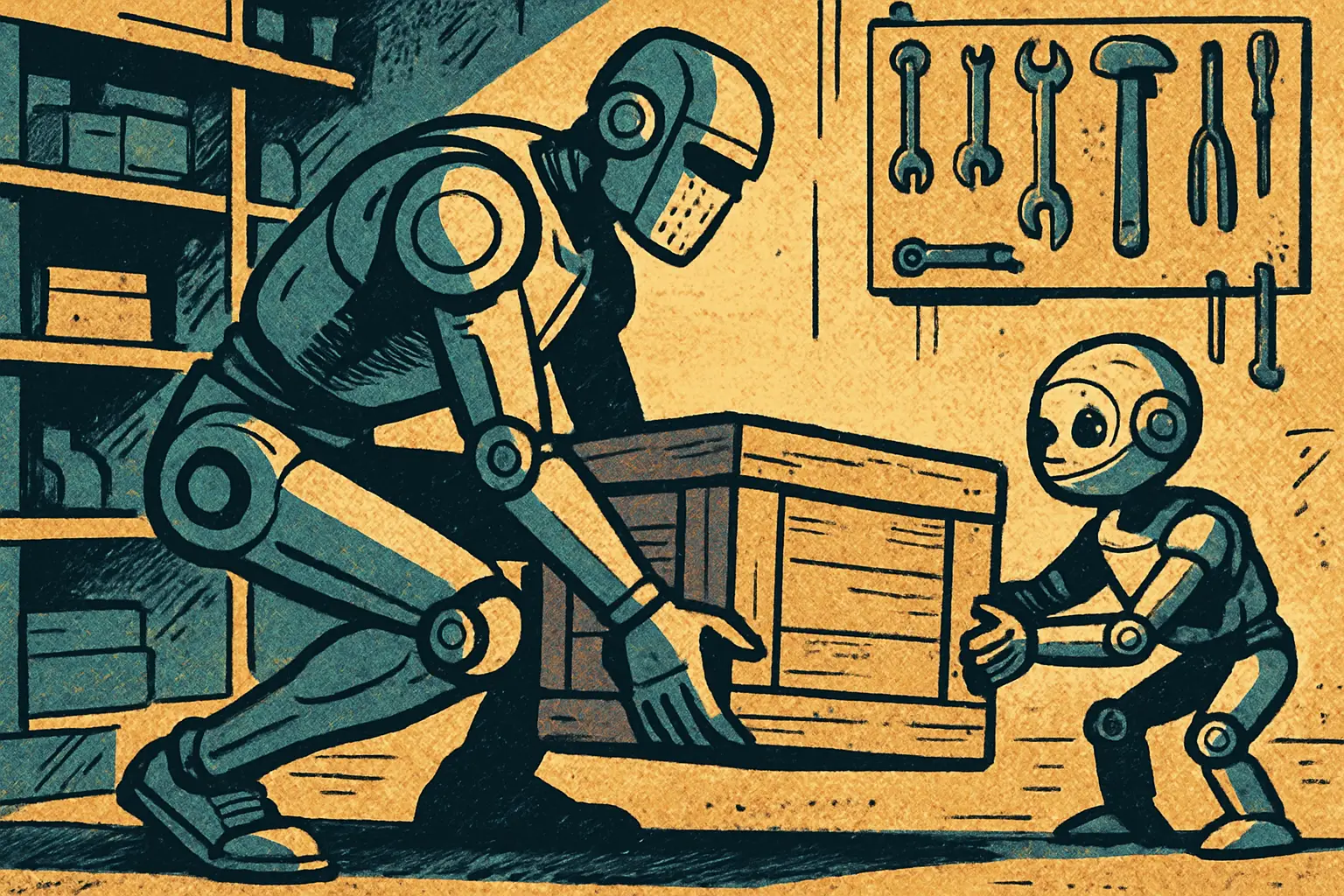
Google DeepMind published Gemini Robotics 2 on July 30, 2026, and the headline capability is one that sounds almost mundane until you have watched a humanoid try to work without it: the model now controls the entire body. Previous Gemini Robotics releases directed arms and hands while the rest of the machine stood still. Gemini Robotics 2 coordinates walking, crouching, balancing, and manipulation as a single problem, which is how a person picks something heavy off a low shelf and how a robot has mostly not been able to.
- Whole-body humanoid control — walking, crouching, and manipulation coordinated in one policy rather than split across separate controllers
- Three models in the family: Gemini Robotics 2 (vision-language-action), Gemini Robotics ER 2 (embodied reasoning), and Gemini Robotics On-Device 2 for local inference
- Reported success rates of 45.7% to 76.3% on general whole-body manipulation and 74.2% to 89.6% on gripper insertion and kitting tasks
- Multi-robot collaboration and multi-minute task planning, with fast adaptation to new robot bodies from limited demonstration data
Why Whole-Body Control Is Harder Than It Looks
The instinct is to treat locomotion and manipulation as two systems that simply need to be bolted together — one keeps the robot upright, the other moves the hands. That decomposition works right up until the two goals conflict, which in practice is constantly. Reaching into a low cabinet shifts the center of mass forward. Carrying something heavy on one side changes what a stable step looks like. A balance controller that does not know what the arms are about to do will fight them, and an arm controller that does not know a step is coming will miss.
Solving both in one policy means the model can spend stability budget on reach when reaching is what matters, and give it back when the task is done. That is the difference between a machine that can only work in the narrow band where its feet are planted and its target is at chest height, and one that can operate in a room built for people.
What Are the Three Models For?
They divide the problem by where the thinking happens. Gemini Robotics ER 2 handles embodied reasoning — understanding a scene, orchestrating multi-step tasks, and coordinating more than one robot. The vision-language-action model turns that plan into motion. Gemini Robotics On-Device 2 is the efficient variant meant to run locally on the robot, which matters for any task where a network round trip is not an acceptable part of the control loop.
That split mirrors what has worked elsewhere in our AI coverage: a larger reasoning model deciding what to do, and a tighter, faster model executing it. Robotics has an unusually hard version of the constraint, because the executing model has to close its loop in milliseconds while the reasoning model can afford to think for seconds.
How Well Does It Actually Perform?
Honestly and usefully, the reported numbers are mixed rather than triumphant — which is the right thing to report. General whole-body manipulation lands between 45.7% and 76.3% success depending on the task. Gripper work on insertion and kitting is stronger at 74.2% to 89.6%. Multi-finger dexterous tasks range from roughly 32% to 92%, which is a very wide band and tells you that hand hardware and task geometry still dominate outcomes.
Read that as a research frontier rather than a shipping product, because that is what it is. A 76% success rate is remarkable for open-ended physical manipulation and nowhere near what a factory would accept. The interesting question is not whether these numbers are good enough today but how fast the band has been moving, and it has been moving quickly.
Which Robots Does It Run On?
DeepMind reports evaluation across a genuinely varied fleet: Apptronik's Apollo 2 humanoid with SharpaWave and Inspire hands, a Franka Duo with a Robotiq gripper, and Dexmate, SO101, and Trossen platforms. Partners named alongside the release include Apptronik, Boston Dynamics, and Agile Robots.
The breadth is part of the claim. A policy that only works on the arm it was trained on is a demo; one that transfers to a different body with modest additional data is a platform. DeepMind highlights exactly that fast-adaptation property, and the multi-platform evaluation is the evidence offered for it.
How Do Developers Get Access?
Gemini Robotics ER 2 is available through Google AI Studio, with additional private preview access. The vision-language-action model and the on-device variant are going to early-access partners via an application process rather than to the general public — a reasonable gate for models that move physical hardware around rooms with people in them.
For anyone building on the hardware side, the compute story is converging fast with what we cover in edge AI development boards, and platforms like AMD's Ryzen AI X100 robotics stack are being designed for precisely this class of on-robot workload. The models are arriving at roughly the same time as the silicon that can run them locally, which is a better-timed convergence than the field usually gets.
Sources: Google DeepMind — July 30, 2026; Bloomberg — July 30, 2026; OODAloop — July 30, 2026.
More AI Stories
Gemini 3.8 Live Adds Reasoning to Real-Time Voice AI
Google's new Gemini 3.8 Live models reason mid-conversation across 97 languages and top the speech quality index at 82.6. Here is what changes.

Perplexity Portable Computer Runs Local AI on Windows
Perplexity's on-device agent now runs on Windows PCs with 24GB+ RTX GPUs, keeping the model, harness, orchestrator and scheduler off the cloud.

Google AI Hits 300 Languages, Covering 86% of People
Google says its products now work in 300+ languages for 7 billion people, backed by open speech datasets covering 109 Indian and 27 African languages.