
EITWatch Reads Hand Gestures With an ESP32-S3 Watch
Northwestern's open-source EITWatch fits eight electrodes on a watch back and hits 92.5% macro-gesture accuracy from a XIAO ESP32-S3 at 48 Hz.

Eight Electrodes on the Back of a Watch Case
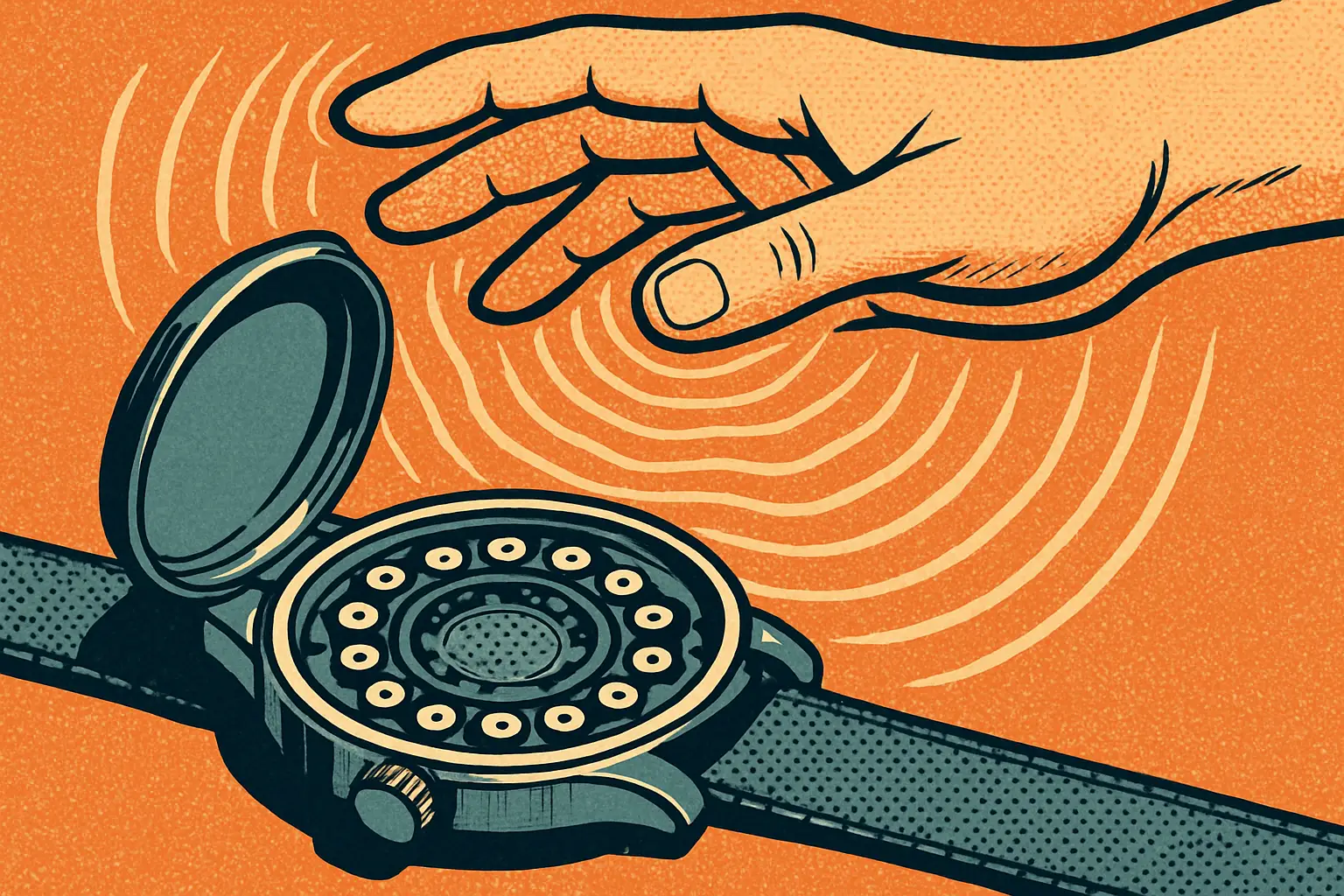
Researchers at Northwestern University have released EITWatch, an open-source gesture-sensing smartwatch that reads hand movements by measuring electrical impedance through the wrist. What makes it notable is the packaging: every previous wrist-based electrical impedance tomography system has needed a band of electrodes wrapped around the whole wrist. EITWatch fits all eight electrodes onto the back of a standard smartwatch case, which is the difference between a lab rig and something a person could plausibly wear.
- Built on a Seeed Studio XIAO ESP32-S3 with a dual-core LX7 at 240 MHz, 512 KB SRAM, and 8 MB PSRAM
- Eight 2 mm gold-plated electrodes in a 31 mm ring on the case back, roughly 11.9 mm apart
- 35 impedance measurements per frame at 48 Hz, driven by an AD5930 waveform generator at 50 kHz and about 1 mA peak-to-peak
- 92.5% accuracy on held macro-gestures and 91.5% on micro-gestures within a session
How Does Impedance Sensing Detect a Hand Gesture?
When you move your fingers, the tendons and muscles inside your forearm shift position. Those tissues have different electrical properties from one another, so the impedance measured across a pair of skin electrodes changes depending on what your hand is doing. EITWatch holds one electrode as a fixed current source and cycles the sink through the remaining seven positions, which produces current paths at varying depths and angles through the wrist. Thirty-five of those measurements make a frame, and frames arrive 48 times a second.
The gesture set covers six macro-gestures — Six, Gun, Point, Thumb Up, Stretch, and Fist — plus five micro-gestures: Swipe Left, Swipe Right, Pinch, Splay, and Wrist Flip. The micro-gesture set is the harder problem and the more useful one, since pinches and swipes are the interactions a watch UI actually needs.
The Accuracy Numbers Are Reported Honestly
The research team publishes the figures that most gesture-sensing projects quietly omit. Within a single wearing session, accuracy is 92.5% for macro-gestures and 91.5% for micro-gestures. Take the watch off and put it back on 48 hours later and those fall to 73.2% and 70.4%. Hand it to a person the system has never seen and it lands at 63.1% and 55.3%.
That degradation curve is the honest state of the art for wrist biosignal sensing, and publishing it is more valuable than a single flattering headline number. It tells you precisely what the open research problem is: session-to-session and user-to-user generalization, not raw within-session classification. Anyone building on this now knows where to point their effort.
What Are the Real Power and Runtime Constraints?
The board draws about 35 mA at 4.3 V in continuous operation, which gives roughly 8.6 hours from a 300 mAh cell. That is a research-prototype duty cycle rather than a consumer one — continuous 48 Hz sensing is simply expensive. The obvious path to a wearable-grade figure is duty cycling the sensor rather than running it constantly, which is an engineering problem rather than a physics one.
In the current build, the ESP32-S3 runs an ESP-IDF application that streams EIT frames over Wi-Fi to a PC for logging and classification. Moving inference onto the microcontroller is the next milestone, and the 8 MB of PSRAM on the XIAO module leaves room to try.
Genuinely Open Hardware
The hardware is released under CERN-OHL-P-2.0 and the firmware under Apache-2.0, with the design files published on GitHub under the EITWatch_Hardware repository. The work is being presented at UIST 2026. Permissive licenses on both halves mean a maker can fabricate the board, modify the electrode geometry, and ship something derived from it — which is not always true of academic hardware releases. Readers building in this space may also want our coverage of the Makerfabs Nomad Terminal ESP32-S3 build and the ChronoWatch X2040 DIY watch.
Why This Direction Is Worth Watching
Gesture input on wearables has been stuck between cameras, which do not fit on a wrist, and inertial sensors, which cannot see individual fingers. Impedance sensing splits the difference using components that already cost very little. EITWatch does not solve the generalization problem, but it demonstrates the sensing geometry fits in a real watch case and publishes everything needed to attack the remaining work. More projects like it in our mini computer coverage.
Sources: CNX Software — August 14, 2026; Hackster.io — August 2026.
More Mini Computers Stories

MaTouch ESP32-S3 E Ink Board: A $60 Voice-Ready Dashboard
Makerfabs' MaTouch ESP32-S3 pairs a 7.5-inch four-color E Ink screen with a four-mic array for $59.80. Here are the specs and what you can build.

ASRock NUC 300 Mini PCs: Wildcat Lake With Dual 2.5GbE
ASRock Industrial's NUC 300 series brings Intel Core 5 320 and Core 3 304 to mini PCs and boards with up to 64GB of DDR5-6400 memory and dual 2.5GbE.

DGX Spark 64GB: Who NVIDIA's $4,999 Local AI Box Is For
NVIDIA's DGX Spark 64GB starts at $4,999 on Oct 23 and runs models up to 100B parameters. Here is who the local AI box suits and how clustering works.