
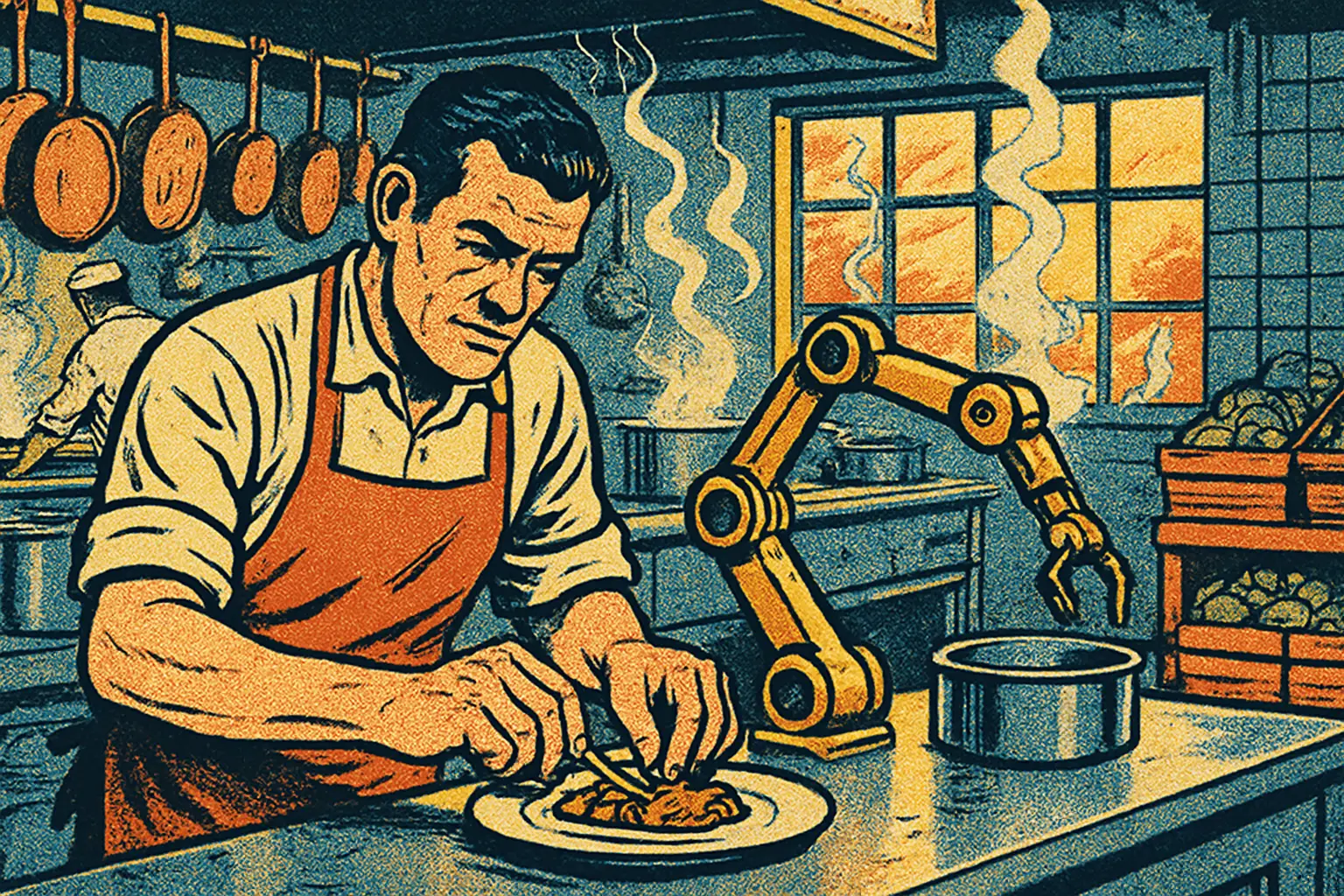
Robot Model Trained on a Million Hours of Video
Dyna Robotics says DYNA-2 lifted manufacturing task success from 20% to 80-90% through pre-training on a million hours of egocentric human video alone.

The Data Bottleneck in Robotics, Approached Sideways
Robot learning has a supply problem. Training a model to manipulate the physical world traditionally requires demonstrations recorded on robots, and robot time is expensive, slow, and scarce. Language models had the entire internet; robotics had a few thousand hours of teleoperation logs.
On August 10, 2026, Dyna Robotics announced DYNA-2, a World-Action Model the company says was pre-trained on more than one million hours of egocentric human video — footage shot from a person's own point of view — rather than robot demonstration data.
- Over 1 million hours of pre-training data, which the company compares to roughly 170 years of continuous waking experience
- Task success on high-precision manufacturing work rose from 20% to 80-90%, attributed to pre-training scale alone
- 1.55x more completed tasks than DYNA-1 in real-world evaluations
- 87% pass rate versus DYNA-1's 46% at one customer deployment
Dyna Robotics describes this as the first human-to-robot scaling law in robotics, reporting that performance improved smoothly with each added hour of human data rather than plateauing. That framing is the company's own, and independent replication has not yet been published — but the deployment numbers are specific enough to be worth watching.
What Is a World-Action Model?
The term is doing real work here. A world model learns to predict how a scene evolves; an action model learns what to do. A World-Action Model, in Dyna's framing, learns both from the same footage — watching a person perform a task teaches the model the dynamics of the objects involved and the structure of the behavior at once.
The critical claim is that this transfers. Human hands and robot grippers are not the same hardware, and the gap between watching a person and controlling an actuator has been the standing objection to learning from human video. Dyna's reported result is that scaling the video corpus narrows that gap faster than adding robot-collected data does, which — if it holds up under outside evaluation — reorders the economics of the entire field.
Why Does Learning From Video Change the Economics?
Because the bottleneck stops being fleet size. Egocentric video is abundant and cheap relative to robot demonstrations, and it does not require a robot to exist before data collection can start. A team that wants a robot to perform a new manufacturing task can, in principle, record people doing it.
The reported jump from 20% to 80-90% success on precision manufacturing tasks is notable for what Dyna says did not change: the post-training data stayed the same. The improvement came from the pre-training corpus alone. That is the signature of a scaling effect rather than task-specific tuning, and it is the reason the announcement is being read as a milestone rather than a product update.
It also lands in a year where the practical reach of AI systems keeps extending into physical and specialist domains — the same trajectory we covered when agentic AI moved into drug discovery workflows. The pattern is consistent: general pre-training, then a thin layer of domain adaptation.
What to Watch Next
The honest caveat is that the strongest numbers here are vendor-reported, and the field has learned to wait for third-party evaluation before treating a scaling-law claim as settled. What makes DYNA-2 credible enough to take seriously is that the evidence is operational rather than purely benchmark-based: an 87% versus 46% pass rate at a live customer deployment is a harder thing to tune for than a leaderboard score.
If the scaling relationship holds at larger corpus sizes, the interesting consequence is not better robots in labs. It is that teaching a robot a new task becomes a recording problem instead of an engineering problem, which is the kind of shift that changes who gets to build in the AI and robotics space at all.
Sources: PR Newswire — Dyna Robotics announcement — August 10, 2026; MarkTechPost — August 13, 2026; Interesting Engineering — August 2026.
More AI Stories

Strands Decider 2B: What Amazon's Free Decision Model Does
Strands Decider 2B is a free 2B-parameter decision model that picks options in about 115ms on a single GPU. Here is how it works and where it fits.

Meta Muse Gadgets SDK: Build Your Own AI Agent Hardware
Meta's open-source Muse Gadgets SDKs bring its Muse agent to Raspberry Pi and ESP32 builds, and 5,000 free Home Link dongles are going to subscribers.

AstaBrief 8B: Ai2's Open Model for Cited Science Reports
AstaBrief 8B is Ai2's Apache 2.0 open model that writes cited research reports in 51 seconds, 3.5x faster than its Claude pipeline. Here is how it works.