
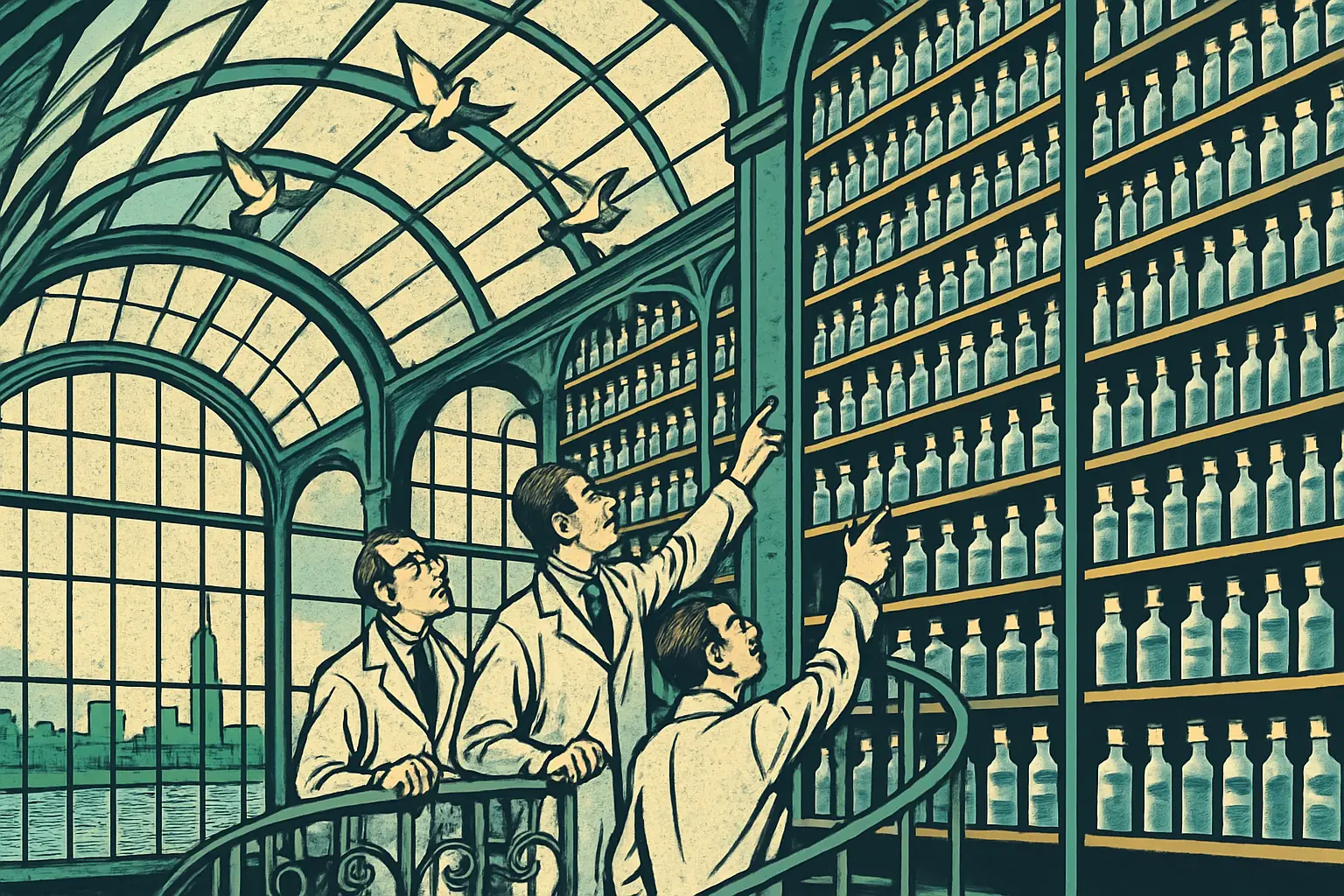
Novo Nordisk and AWS Put AI Agents on Drug Discovery
Novo Nordisk and AWS opened a London co-innovation hub to compress the path from drug target to first human dose, with AI already deployed to 25,000+ staff.

Where Agentic AI Meets a Twelve-Year Timeline
Drug discovery is one of the few industries where "we sped this up by six months" is worth billions and, more to the point, worth lives. On August 10, 2026, Novo Nordisk and Amazon Web Services announced a strategic partnership aimed squarely at that clock, with AWS becoming the pharmaceutical company's preferred cloud provider and strategic AI partner.
- A co-innovation hub in London staffing engineers and scientists from both companies together
- Stated goal: compress the path from drug target to first human dose
- AI agents applied to target identification, therapy design, and research workflows
- Early internal deployments already reduced clinical documentation time across more than 25,000 employees
What Is the London Co-Innovation Hub Building?
The hub is the structural part of the deal, and it is the part that separates this from a cloud contract with an AI press release stapled to it. AWS engineers and Novo Nordisk scientists work in the same place, on the same problems, with AWS Forward Deployed Engineers embedded directly in the customer's teams.
That embedding model exists because enterprise AI projects usually fail at translation rather than at capability. A pharmaceutical research workflow has decades of domain-specific structure — assay formats, regulatory checkpoints, data provenance requirements — that no general-purpose agent knows about. Putting the engineers who understand the tooling next to the scientists who understand the science is a considerably more realistic setup than shipping an API and hoping.
The target is the pre-clinical stretch: from identifying a promising biological target through designing a candidate therapy to the first dose given to a human. That is where most of the elapsed time and most of the attrition lives.
How Do AI Agents Fit a Research Pipeline?
The applications named are target identification, therapy design, and general research workflows, and each is a different shape of problem.
Target identification is a search problem across an enormous literature and data surface — the kind of work where an agent that can read, cross-reference, and propose candidates at scale genuinely changes throughput. Therapy design is more generative, closer to the protein and molecule design work the field has been building toward for several years now.
The third category is the least glamorous and possibly the most immediately valuable. Clinical documentation is an enormous, unavoidable tax on research organizations, and the partnership reports that early internal deployments have already cut documentation time across a workforce of more than 25,000. Productivity gains on paperwork do not make for exciting headlines, but they compound across every project in the portfolio simultaneously.
Why Does the Cloud Partner Matter Here?
Because the constraint on this kind of work has moved from algorithms to infrastructure and data governance. Pharmaceutical data is heavily regulated, provenance-sensitive, and often cannot leave particular jurisdictions. Making agents useful against it requires the compute and the compliance envelope in the same place.
Novo Nordisk is not putting all of its weight on one relationship — the company also collaborates with OpenAI and uses Denmark's Gefion supercomputer — which is a sensible posture for a research organization that wants leverage rather than lock-in.
The broader pattern is the one showing up across enterprise AI right now: the interesting deployments are not chatbots bolted onto existing products, they are agents wired into workflows that already had a measurable cost and a measurable clock. OpenAI's GPT-Rosalind opening to researchers worldwide covers the model side of life sciences work, and DeepMind open-sourcing its WeatherNext cyclone models shows the same compute-plus-domain-data pattern applied to a very different science problem. More in our AI section.
Sources: GlobeNewswire — August 10, 2026; AI News — August 11, 2026; Fierce Biotech — August 2026.
More AI Stories

Strands Decider 2B: What Amazon's Free Decision Model Does
Strands Decider 2B is a free 2B-parameter decision model that picks options in about 115ms on a single GPU. Here is how it works and where it fits.

Meta Muse Gadgets SDK: Build Your Own AI Agent Hardware
Meta's open-source Muse Gadgets SDKs bring its Muse agent to Raspberry Pi and ESP32 builds, and 5,000 free Home Link dongles are going to subscribers.

AstaBrief 8B: Ai2's Open Model for Cited Science Reports
AstaBrief 8B is Ai2's Apache 2.0 open model that writes cited research reports in 51 seconds, 3.5x faster than its Claude pipeline. Here is how it works.