
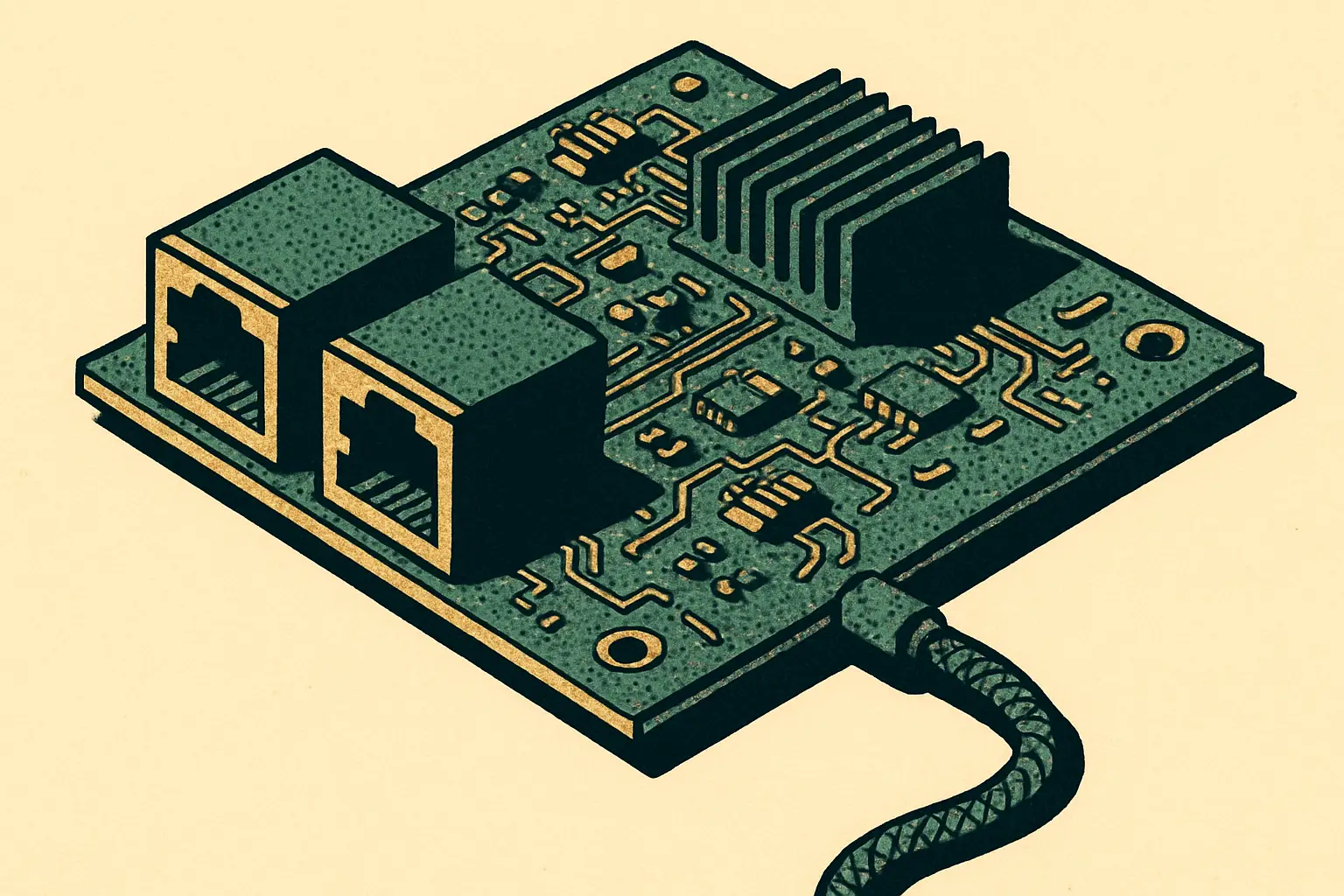
Antmicro Open-Sources a Thunderbolt Dual 10GbE Card
Antmicro released the full KiCad files for a Thunderbolt 3 to dual 10GbE adapter under Apache 2.0, measured at 9.4 Gbps while drawing under 9 watts.

Antmicro published the complete design for a Thunderbolt 3 to dual 10 Gigabit Ethernet adapter on August 6, 2026, releasing the KiCad project files and documentation on GitHub under the Apache License 2.0. Open hardware at this speed grade is rare — high-speed networking designs usually stay locked inside vendor NDAs — so a fully documented reference design with measured thermal and throughput numbers is a genuinely useful artifact.
- Intel X710-AT2 dual 10GbE controller paired with an Intel JHL6340 Thunderbolt 3 controller over PCIe Gen3 x4
- Measured 9.4 Gbps full-duplex on a single port, or 2x 5.5 Gbps with both ports active
- Power draw stays under 9W, with passive heatsink cooling stabilizing around 65C at typical ambient
- Board measures 110 x 70 mm, released under Apache 2.0 with KiCad sources on GitHub
Reading the Throughput Numbers Honestly
The single-port result is the impressive one: 9.4 Gbps full-duplex is about as close to line rate as a 10GbE link realistically gets once you account for framing overhead. That number tells you the Thunderbolt path and the X710 are both doing their jobs.
The dual-port figure needs context. Running both ports simultaneously yields roughly 5.5 Gbps each, or about 11 Gbps aggregate — which is what you would expect from a PCIe Gen3 x4 link feeding two 10GbE MACs. Gen3 x4 gives you roughly 32 Gbps of theoretical bandwidth, but Thunderbolt 3 tunneling, protocol overhead, and host controller behavior take their cut. Aggregate throughput above 10 Gbps from a bus-powered dongle is a solid result; expecting 20 is not how the arithmetic works.
Power is the underrated spec here. Under 9W total, cooled passively, holding 65C at typical room temperature — that is a design you can leave running in a closet without a fan, and the 4-pin PWM header is there if your enclosure runs hotter.
Why Does an Open Reference Design Matter?
Antmicro is not mass-producing this board, and it is not for sale. The company positions these releases as reference designs that showcase its hardware customization work, which is a perfectly transparent business model — and it means the design is genuinely intended to be forked rather than merely admired.
That changes what the release is worth. If you are building a smart terminal, a point-of-sale device, a multi-camera capture rig, or an IoT gateway that needs real network throughput over a single cable, you now have a validated starting point with a known-good component pairing and published thermal behavior. The gap between a schematic and a board that actually hits 9.4 Gbps is where most projects die; having someone else close it under a permissive license is a real head start.
For homelab builders browsing our mini computers coverage, the more immediate appeal is a compact way to give a Thunderbolt-equipped mini PC or laptop two 10GbE ports without a PCIe slot. Pair that with a virtualization host — Proxmox VE 9.2's official Arm64 support opened up a lot of small-form-factor options this month — and a fanless box starts looking like a credible network appliance.
The Open Hardware Momentum
This lands in a good week for open designs. Espressif's ESP RainMaker Neo release opened up a full device-to-cloud IoT stack a day earlier, and the pattern across both is the same: companies publishing the hard, expensive, already-validated part and competing on the services around it. For anyone building hardware in 2026, that is a considerably friendlier landscape than the one we had five years ago.
Sources: CNX Software — August 6, 2026; Antmicro on GitHub — August 2026.
More Mini Computers Stories

MaTouch ESP32-S3 E Ink Board: A $60 Voice-Ready Dashboard
Makerfabs' MaTouch ESP32-S3 pairs a 7.5-inch four-color E Ink screen with a four-mic array for $59.80. Here are the specs and what you can build.

ASRock NUC 300 Mini PCs: Wildcat Lake With Dual 2.5GbE
ASRock Industrial's NUC 300 series brings Intel Core 5 320 and Core 3 304 to mini PCs and boards with up to 64GB of DDR5-6400 memory and dual 2.5GbE.

DGX Spark 64GB: Who NVIDIA's $4,999 Local AI Box Is For
NVIDIA's DGX Spark 64GB starts at $4,999 on Oct 23 and runs models up to 100B parameters. Here is who the local AI box suits and how clustering works.