
Ai2 ToyBlocks: An Open Sim World for Testing Robot AI
Ai2's ToyBlocks is an open robot-learning simulator that generates training demos automatically, up to 24x real time on one GPU, to show why robots fail.

Robot demos are getting impressive, but they rarely explain why a robot succeeds on one try and fails on the next. The Allen Institute for AI (Ai2) wants to fix that with ToyBlocks, an open robot-learning simulator released on November 6. The idea is simple: build a small, fully controlled world where researchers can change one thing at a time and trace exactly where a robot policy breaks.
- ToyBlocks is an open simulation framework built on NVIDIA's IsaacSim and Isaac Lab
- It automatically generates robot demonstrations, with no human teleoperation needed
- Data generation runs hundreds of plans in parallel on one GPU, at up to 24 times real time
- Datasets use the LeRobot format, and code, data and models are all public
What Is a FoundationWorld?
Ai2 calls ToyBlocks the first of its "FoundationWorlds." Each one pairs a simulated environment with tools that create tasks and training demonstrations automatically, plus metrics that track a robot's behavior over time. Ai2 compares it to a petri dish: a deliberately simple setting where you can vary conditions and watch the effects.
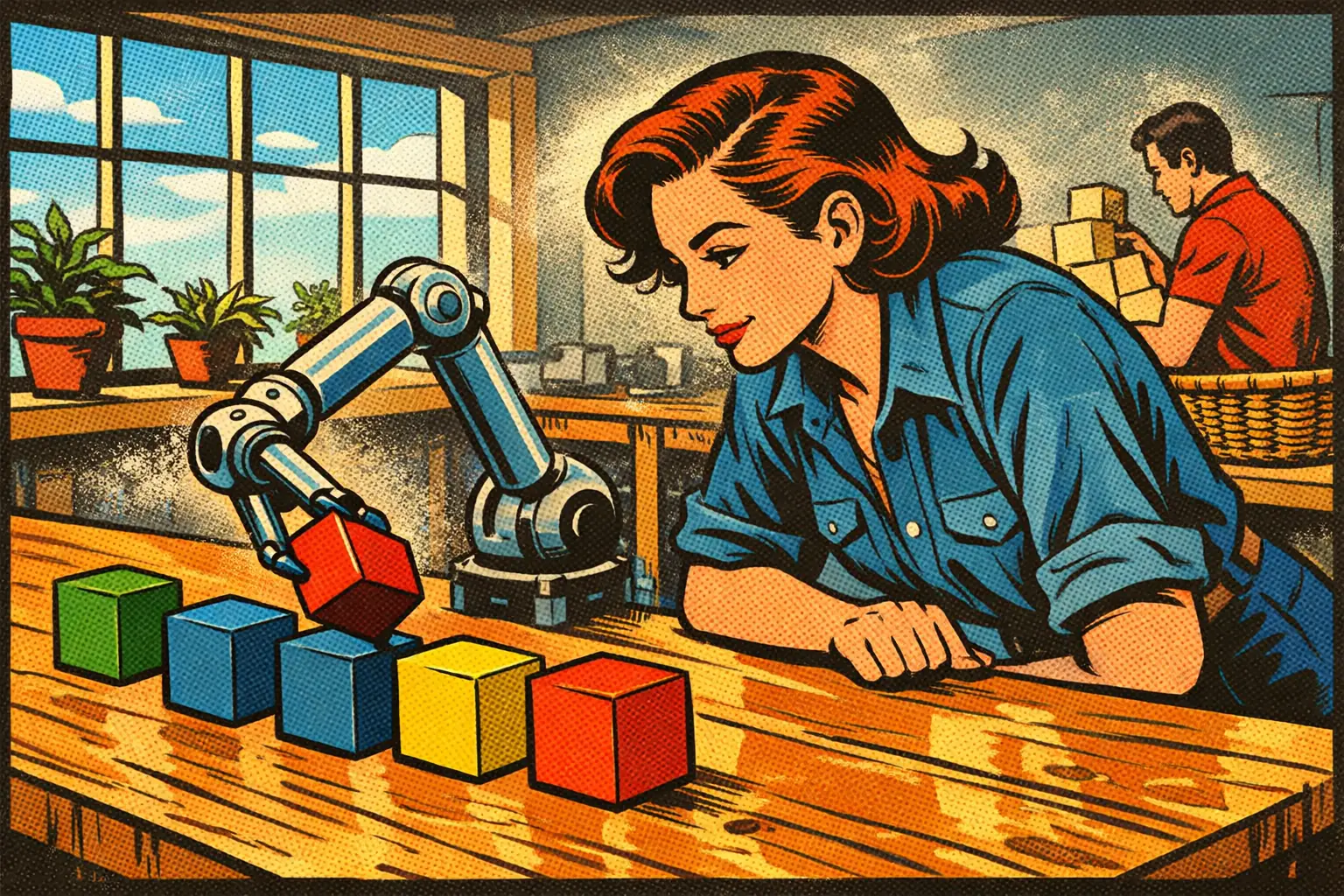
ToyBlocks is a robot arm and a set of blocks on a tabletop. That sounds basic, yet the tasks still need real reasoning. The robot must push, flip and stack blocks, and the block faces carry pictures and letters, so it may need to turn a block over to see a hidden face before sorting it. Domain randomization changes block size, table height and other physical details from scene to scene, which tests how well a model copes when geometry shifts.
How Does ToyBlocks Generate Training Data?
Short skills, such as pushing a block or flipping it onto another face without picking it up, are learned with reinforcement learning and motion planning in Isaac Lab. During skill training the simulator can hand the policy exact block positions, information a real robot would have to estimate from cameras. That lets ToyBlocks produce skills that would otherwise need slow human demonstrations.
A task-and-motion planner then chains those skills together to solve longer tasks. Each plan runs in simulation and becomes a labeled demonstration. Because every task goal is written in the PDDL planning language, ToyBlocks scores success and partial progress automatically, with no custom metric code.
Why Hierarchical Robot Policies Benefit
ToyBlocks ships with training tools for ManiFlow, a low-level policy that moves the arm, and it can run that policy under a high-level model that decides what to do next. The README lists Molmo 2, Astra and Claude as examples. Either level can be swapped for a perfect "oracle," so researchers can tell whether a failure came from planning or from motor control. Failed states can even be fed back into data generation to create recovery demonstrations.
It builds on Ai2's earlier open robotics work, including MolmoAct 2, MolmoBot and MolmoSpaces, and follows the lab's habit of releasing everything openly, as it did with AstaBrief 8B for cited science reports. For hobbyists, the open approach pairs well with projects like the Microduck open-source robot. Ai2 says a technical report is coming soon. Follow more research like this in our AI coverage.
Sources: Ai2 on Hugging Face — November 6, 2026; ToyBlocks on GitHub — accessed November 6, 2026.
More AI Stories

Google TPU 8i Max and 8tx: What Two New AI Chips Change
Google's TPU 8i Max doubles compute, SRAM and HBM bandwidth for million-token contexts, while TPU 8tx brings confidential computing to AI inference.

Counterfactual World Models Help Robots Learn From Surprises
A new counterfactual world model method lets robots ask what would have happened, lifting retry success to as high as 97 percent in simulated tests.
OpenAI Pierre Deal: What It Means for Codex and Code Review
OpenAI will acquire Pierre, maker of Code Storage plus Diffs and Trees, days after revealing Pando, a Git backend with nearly 5x faster pushes.