
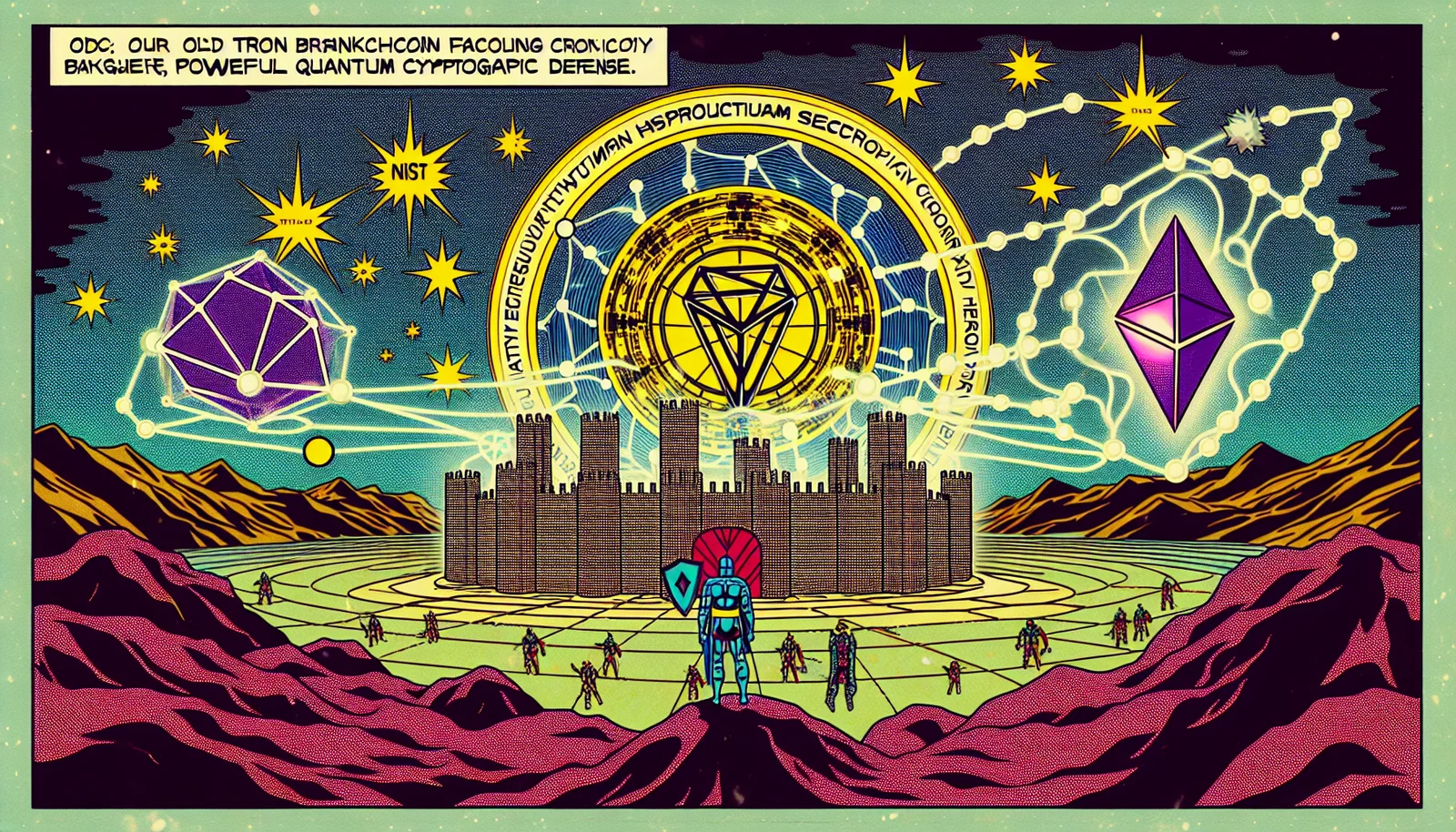
TRON Targets First Major Blockchain Post-Quantum Cryptography Upgrade With NIST Standards
Justin Sun announced TRON will deploy NIST-standardized post-quantum signatures on mainnet — making TRON the first major public blockchain to future-proof user assets against quantum computing.

TRON Makes Its Move on Post-Quantum Security
On April 14, 2026, Justin Sun announced that TRON will become the first major public blockchain to deploy NIST-standardized post-quantum cryptographic signatures on its mainnet. The announcement positions TRON ahead of competing networks in addressing what the cryptography community has increasingly identified as the long-horizon existential risk to all current blockchain security models: the eventual arrival of sufficiently powerful quantum computers capable of breaking elliptic curve cryptography.
The urgency is not immediate — current quantum computers are nowhere near the scale required to break ECDSA. But the security community operates on timelines measured in years for cryptographic migration, and the blockchains that begin that migration earliest will be best positioned when quantum capability eventually crosses the relevant threshold.
The Cryptographic Foundation TRON Is Replacing
Every major public blockchain today — Bitcoin, Ethereum, Solana, and TRON among them — relies on elliptic curve cryptography (specifically ECDSA, the Elliptic Curve Digital Signature Algorithm) to secure transactions and wallet ownership. ECDSA's security derives from the computational difficulty of solving the discrete logarithm problem on elliptic curves, a problem that is effectively impossible for classical computers at the key lengths currently in use.
Quantum computers, operating under Shor's algorithm, can in principle solve the discrete logarithm problem exponentially faster than classical hardware. A sufficiently large quantum computer — estimated to require millions of stable logical qubits, a threshold still years away — would be capable of deriving private keys from public keys, breaking the cryptographic guarantees that underpin all current blockchain transaction security.
The NIST Standards TRON Will Deploy
TRON's implementation is expected to use NIST's recently standardized post-quantum algorithms: ML-DSA (FIPS 204) as the primary signature standard, with SLH-DSA (FIPS 205) as a secondary option. These algorithms were standardized by NIST in 2024 after an eight-year evaluation process, and represent the current consensus on cryptographic approaches resistant to quantum attacks.
The transition architecture will use a hybrid signing approach in its early phase — transactions will carry both the current ECDSA signature and the new post-quantum signature, verified by network nodes simultaneously. This hybrid period provides security continuity during the migration and allows the network to validate that post-quantum signature verification operates correctly at scale before removing the legacy ECDSA dependency.
The Technical Challenges of Post-Quantum Migration
Post-quantum signatures are meaningfully larger than ECDSA signatures. ML-DSA signatures run 10 to 30 times the size of their ECDSA equivalents, while SLH-DSA signatures can be up to 121 times larger. On a high-volume chain like TRON — which processed 200 million transactions in Q1 2026 alone — these larger signatures have direct implications for storage requirements, bandwidth consumption, and transaction throughput.
Sun has indicated that a technical roadmap detailing the specific NIST algorithm selection, hybrid transition architecture, and block size and gas schedule adjustments is forthcoming.
Why This Matters Beyond TRON
TRON's move is a signal to the broader blockchain ecosystem. The network's willingness to accept the engineering complexity and performance trade-offs of post-quantum migration — rather than deferring it — sets a precedent.
The cryptographic threat from quantum computing will not announce its arrival with a clear deadline. Networks that wait for urgency before beginning migration will be executing a complex, high-stakes upgrade under time pressure. Networks that migrate proactively will have worked through the technical challenges years in advance. TRON is betting on being in the second group.
Sources: Unchained Crypto (April 2026), CoinGabbar (April 2026), CryptoNews.net (April 2026), Bitcoin.com News (April 2026), The Merkle News (April 2026)
More Crypto Stories
SEC Crypto Custody Proposal: What It Means for Advisers
The SEC proposed crypto custody rules on Oct 1 letting advisers and funds use state trust companies and self-custody. Public comments run for 60 days.

Evernorth XRPN Nasdaq Debut: Inside the 473M XRP Treasury
Evernorth won its SPAC vote and plans to list on Nasdaq as XRPN on October 8, holding about 473 million XRP backed by over $1 billion in funding.

Roughrider Coin: How 90+ North Dakota Banks Settle on Solana
Fiserv's digital asset platform is live with Roughrider Coin: a dollar-backed stablecoin linking 90+ North Dakota banks on Solana. Here is how it works.