
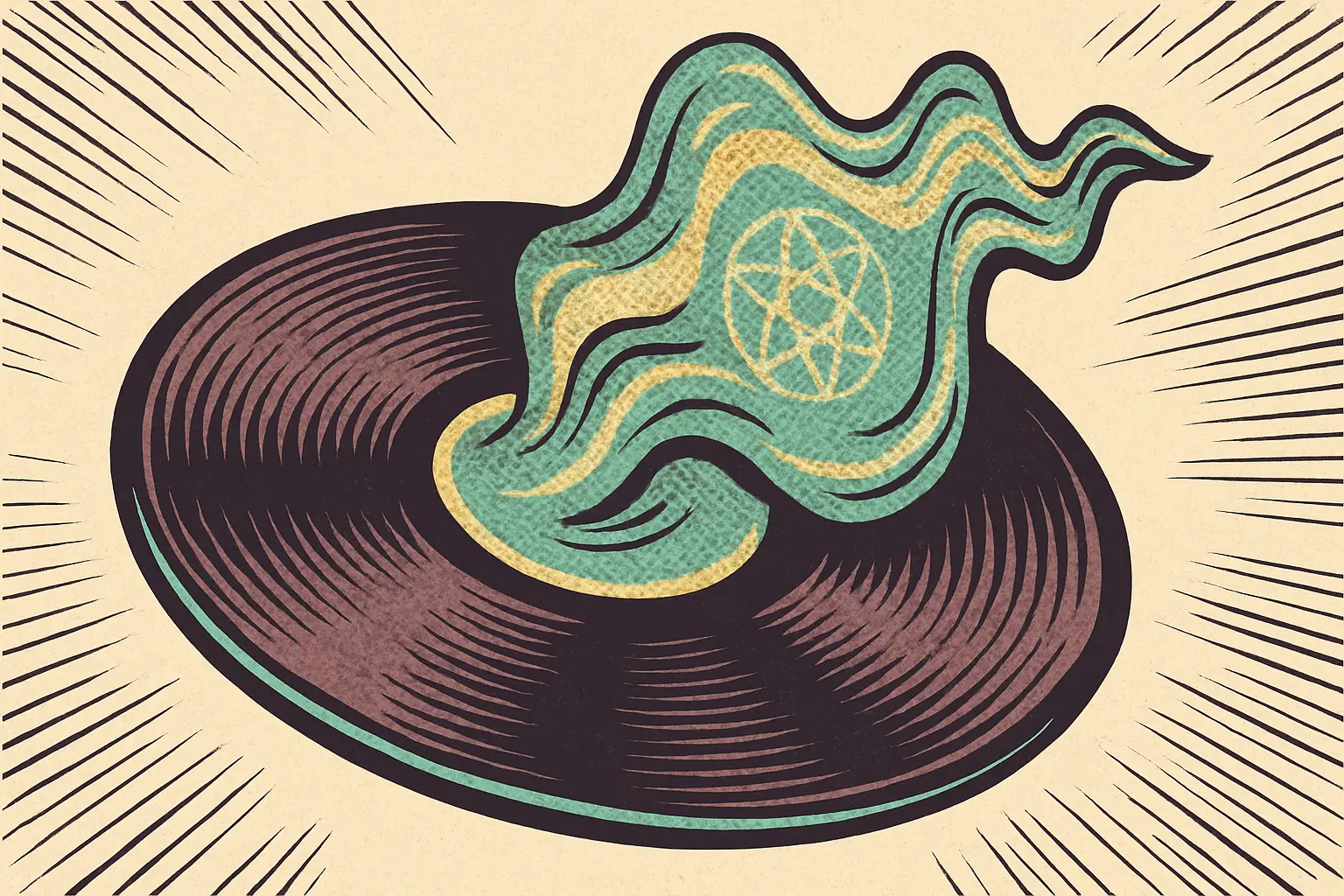
Suno Watermarks AI Songs to Make Origins Verifiable
Suno will embed an inaudible signature in every track it generates, giving streaming platforms a way to identify AI-made music automatically.

Suno announced on August 6, 2026 that every song generated on its platform will soon carry an inaudible watermark in the waveform, paired with acoustic fingerprinting that partner platforms can use to recognize a Suno-made track wherever it surfaces. It is a provenance move, and provenance has quietly become one of the more important unsolved problems in generative media.
- Announced August 6, 2026, with rollout described as arriving in the coming weeks
- Every generated track receives an inaudible watermark embedded in the audio waveform itself
- Acoustic fingerprinting lets partner platforms identify tracks even after re-encoding
- Labelling tools will show listeners when a song originated on Suno, and download limits will curb bulk redistribution
Why Audio Watermarking Is Harder Than Image Watermarking
Visual watermarking has had a comparatively easy run. An image is a fixed grid of pixels, and a signature distributed across that grid survives most ordinary handling. Audio is a different problem. A song gets transcoded to a lossy codec, normalized for loudness, trimmed, pitch-shifted, and re-uploaded — often several times before it reaches a listener. A watermark has to survive all of that while remaining genuinely inaudible to a careful ear on good headphones.
That is why the pairing with fingerprinting matters. A watermark is an embedded signal; a fingerprint is a derived one, computed from the acoustic characteristics of the recording itself. Watermarks are precise but can be degraded. Fingerprints are more robust to re-encoding but require a reference database. Running both gives you two independent chances to identify a track, and the failure modes do not overlap much.
What Does Watermarking Actually Solve for Listeners?
The practical target is automated bulk uploading — schemes where thousands of generated tracks get pushed onto streaming services and then farmed for play counts. A platform that can detect provenance at ingest can apply its own policy at ingest, rather than trying to unwind the mess months later. The download limits Suno described work on the same principle: throttling volume at the source is cheaper than filtering it downstream.
For everyday listeners, the more interesting outcome is labelling. Knowing that a track was machine-generated is not a judgment about whether it is good — plenty of people are making genuinely enjoyable music with these tools. It is simply information, and information about origin is the thing that lets an audience calibrate its own expectations. Disclosure tends to build more trust than it costs.
The Broader Provenance Trend
Suno is not moving in isolation. Content credentials, signed model outputs, and origin metadata have been converging across the industry through 2026, and the pattern is consistent: the labs producing generative output are increasingly shipping the identification layer alongside the generation layer rather than waiting for someone else to build it. That is a healthier default, and it echoes the governance-by-design thinking we covered in our AI coverage and in pieces like NVIDIA's agent skill scanner, where the safety tooling shipped as part of the platform rather than bolted on afterward.
Suno has not yet named the technical provider or standard behind the watermark, nor detailed how tracks generated before the rollout will be handled. Those details will determine how interoperable the system is — a watermark that only Suno's own partners can read is far less useful than one built on an open specification. That is the thing worth watching as the rollout lands.
What Creators Should Expect
If you make music with these tools, the near-term change is modest: your tracks will carry an origin signature, and distributing them at industrial volume will be harder. For anyone releasing a handful of songs, the practical impact is close to zero. The longer-term effect is a music ecosystem where the question of where a recording came from has a technical answer instead of an argument — and that benefits human and AI-assisted artists alike.
Sources: Engadget — August 7, 2026; Dataconomy — August 7, 2026; TNW — August 2026.
More AI Stories
Strands Decider 2B: What Amazon's Free Decision Model Does
Strands Decider 2B is a free 2B-parameter decision model that picks options in about 115ms on a single GPU. Here is how it works and where it fits.

Meta Muse Gadgets SDK: Build Your Own AI Agent Hardware
Meta's open-source Muse Gadgets SDKs bring its Muse agent to Raspberry Pi and ESP32 builds, and 5,000 free Home Link dongles are going to subscribers.
AstaBrief 8B: Ai2's Open Model for Cited Science Reports
AstaBrief 8B is Ai2's Apache 2.0 open model that writes cited research reports in 51 seconds, 3.5x faster than its Claude pipeline. Here is how it works.