
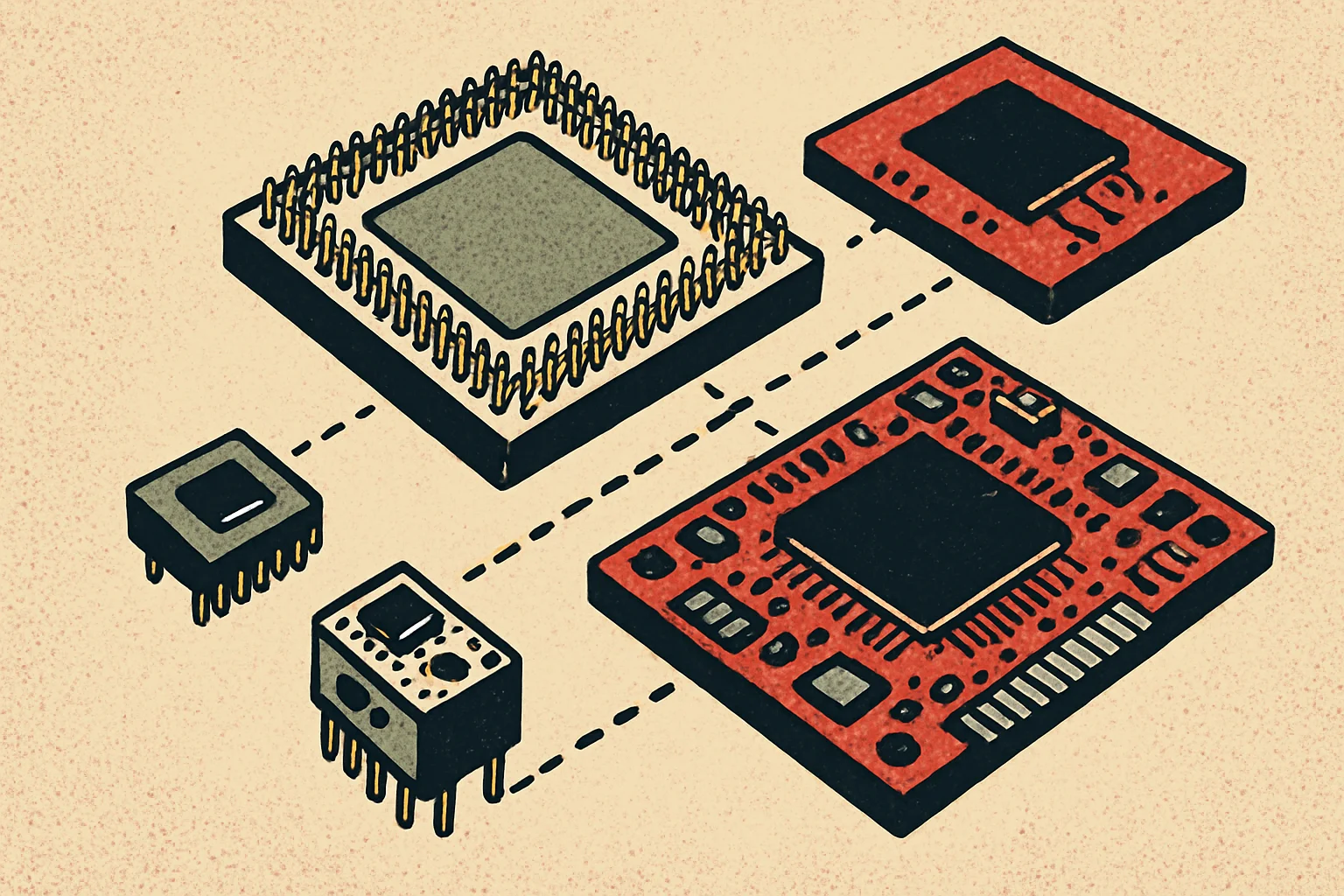
sprite_tm Builds a Retro PC From Scratch With FPGA Glue Logic
At Hackaday Europe 2026, sprite_tm built a working i486 retro PC from parts, using a Lattice ECP5 FPGA for glue logic. It became the Vapourdeck handheld.

Building an x86 PC From Individual Parts, on Purpose
Some projects are useful, and some are pure engineering joy. The retro PC that Jeroen Domburg — better known as sprite_tm — presented at Hackaday Europe 2026, written up on June 29, 2026, is firmly the second kind, and it is the more instructive for it. He built a functional retro PC from individual parts, and in doing so produced one of the best hands-on tours of how a classic x86 machine actually fits together.
The core is period-correct: an Intel i486 DX4-100, with an AMD Am486DX5-133 as the alternate CPU. These are the chips that defined early-90s DOS computing, and getting one to boot from scratch means recreating the supporting cast of logic that a real motherboard used to provide.
FPGA Glue Logic Fills the Gaps
Here is the clever part. A vintage 486 does not just need a CPU and RAM — it needs a chipset full of "glue" logic to tie the processor to memory, buses, and peripherals. Sourcing every original support chip is impractical today. So sprite_tm used a Lattice ECP5 FPGA to fill in the missing chipset glue logic.
That is a beautiful blend of eras. The FPGA lets him implement the address decoding, bus timing, and control signals that a stack of dedicated 90s chips would have handled, all reconfigurable in HDL rather than fixed in silicon. It means the design can be debugged and iterated in a way the original hardware never could, and it is a genuinely modern technique applied to a vintage target.
The ESP32-S3 as Peripheral Manager
Rounding out the system, an ESP32-S3 handles peripheral management. Using a capable modern microcontroller to emulate or manage the peripherals — the housekeeping a retro PC expects — is a pragmatic move. It offloads a whole category of glue duties to firmware that is far easier to write and update than dedicated logic, and it keeps the parts count sane.
The payoff is that the machine actually works. It boots MS-DOS, runs benchmarks, and plays games including Commander Keen. That is the proof any retro-build wants: not a static museum piece, but a system that runs real period software at speed.
From Bench Build to the Vapourdeck
What elevates this from a great demo to an inspiring project is where it went next. The build evolved into a portable handheld that sprite_tm calls the "Vapourdeck." Taking a from-scratch 486 and shrinking it into something handheld is a serious integration challenge — power, packaging, display, and input all have to come together — and it turns an educational exercise into a device you could genuinely carry around and play DOS games on.
Why This Matters for Makers
For anyone learning how computers work at the bus level, this project is a goldmine. It shows how a CPU, a VGA chipset like the Chips & Technologies F65545, glue logic, and peripherals interlock — and it demonstrates that modern tools like FPGAs and capable microcontrollers can stand in for parts that are otherwise hard to find. That approach is directly transferable: the same techniques let you revive plenty of vintage hardware that would otherwise be stuck for missing chips.
Projects like this are why I love the maker scene. It is deep, it is hands-on, and it leaves you understanding the machine better than any datasheet could. If sprite_tm publishes more on the Vapourdeck, it will be well worth following.
Sources: Hackaday (June 29, 2026).
More Mini Computers Stories

MaTouch ESP32-S3 E Ink Board: A $60 Voice-Ready Dashboard
Makerfabs' MaTouch ESP32-S3 pairs a 7.5-inch four-color E Ink screen with a four-mic array for $59.80. Here are the specs and what you can build.

ASRock NUC 300 Mini PCs: Wildcat Lake With Dual 2.5GbE
ASRock Industrial's NUC 300 series brings Intel Core 5 320 and Core 3 304 to mini PCs and boards with up to 64GB of DDR5-6400 memory and dual 2.5GbE.

DGX Spark 64GB: Who NVIDIA's $4,999 Local AI Box Is For
NVIDIA's DGX Spark 64GB starts at $4,999 on Oct 23 and runs models up to 100B parameters. Here is who the local AI box suits and how clustering works.