
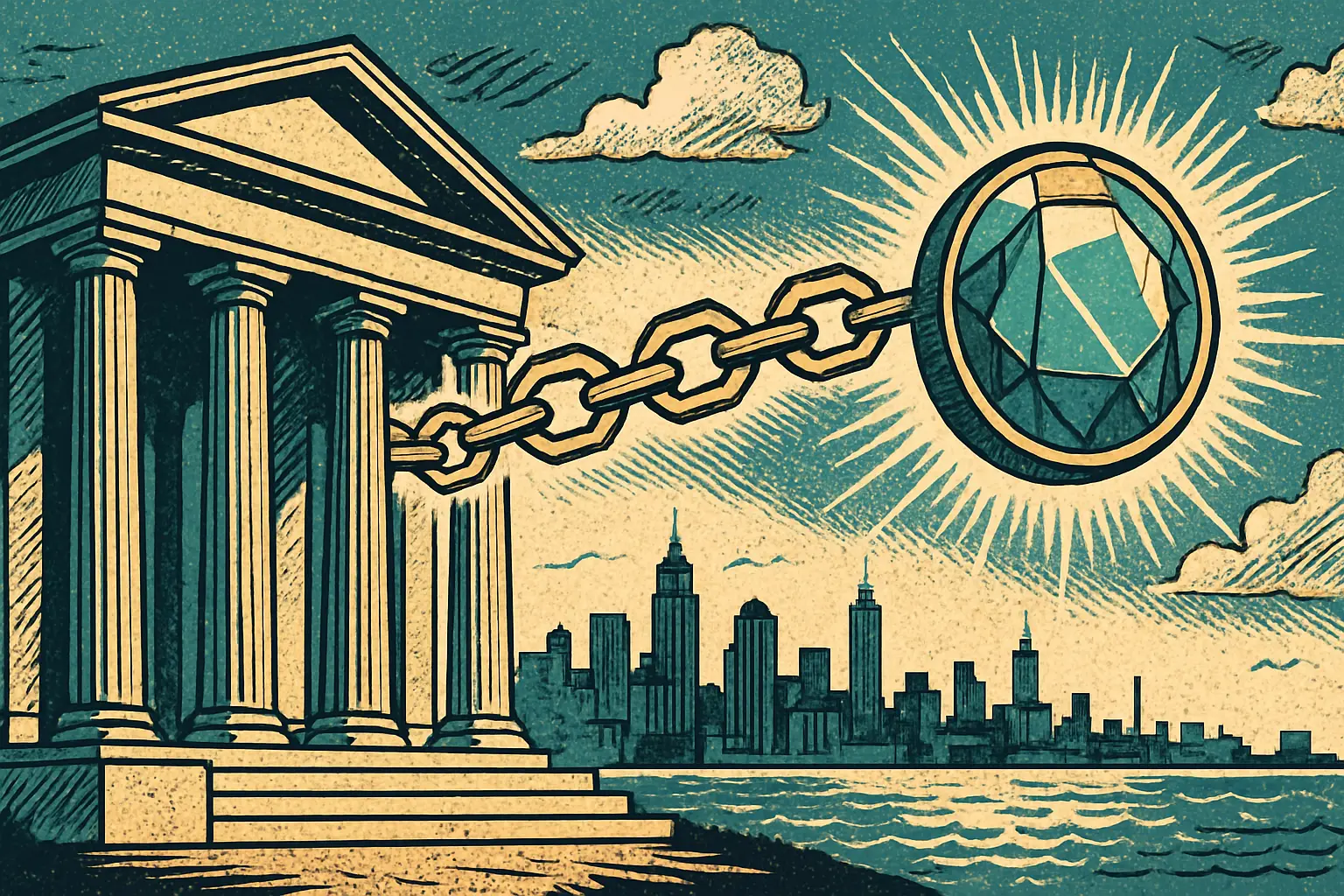
Shinhan Tests a Won-Denominated Tokenized Fund on Solana
Shinhan Asset Management, which oversees $96.6B, signed a four-way pact with the Solana Foundation, Etherfuse, and Orca to pilot a tokenized won fund.

Almost every tokenized money-market product launched so far has been denominated in dollars. On August 21, 2026, Shinhan Asset Management signed a four-party memorandum of understanding with the Solana Foundation, tokenization platform Etherfuse, and on-chain liquidity provider Orca to test something different: a Korean won-denominated tokenized fund aimed at overseas institutional investors.
- Shinhan Asset Management oversees roughly $96.6 billion in assets under management
- The proof of concept covers the full issuance and distribution process for a won-denominated ultra-short bond fund issued in tokenized form
- Shinhan says it modeled the structure on BlackRock's tokenized fund BUIDL
- The tokenized real-world-asset market excluding stablecoins has reached about $36.27 billion, up roughly 2,200% since 2020
Why a Won-Denominated Fund Is the Interesting Part
Tokenized treasuries and money-market funds have been the breakout real-world-asset category, and they have been overwhelmingly dollar-based. That makes sense — dollar liquidity is deepest and the regulatory path was clearest — but it also means on-chain capital has essentially one currency exposure available in this product class.
A won-denominated ultra-short bond fund gives an overseas institution a way to hold short-duration Korean exposure in a token rather than through a traditional custody chain. The structure Shinhan describes assumes overseas institutional investors buy into the fund and receive tokens representing their holding, with Shinhan managing the underlying portfolio. Cointelegraph has also reported Shinhan working with tokenization network Plume on a KRW-denominated pilot, which suggests the firm is evaluating more than one venue.
What the Proof of Concept Will Actually Test
The four partners have set out an unglamorous but essential checklist: know-your-customer and anti-money-laundering procedures, blockchain operations, foreign-exchange requirements, security audits, regulatory compliance, and the design of on-chain liquidity. Orca's involvement points directly at that last item — a tokenized fund without a liquidity venue is a certificate, not an instrument.
Two limits are worth stating plainly. The memorandum does not commit the parties to launching an actual product, and the proof of concept is limited to an offshore market structure. This is a capability-building exercise, not a launch announcement.
How Does the Regulatory Timeline Fit?
The timing tracks South Korea's security token offering framework. The National Assembly passed STO framework amendments in January 2026, and the new regulations are scheduled to take effect in February 2027. That gives institutions roughly eighteen months to build and test infrastructure before the rules land.
Shinhan CEO Lee Seok-won framed the effort in exactly those terms: "Our goal is to proactively secure capabilities that can be activated immediately upon the system's implementation, and to lead the market for managing KRW-based digital financial products."
Korea Keeps Showing Up in This Story
South Korea has become one of the most active jurisdictions in institutional crypto infrastructure. We have covered Toss Bank and the Solana Foundation partnering on cross-border payments, Solana Pay targeting 330,000 Korean merchants, and Ripple Payments reaching Jeonbuk Bank — all within the past two months.
The through-line is that Korean financial institutions are treating tokenization as plumbing to be built before the regulation arrives rather than a product to be launched after it. For a market sizing question, the $36.27 billion in non-stablecoin tokenized assets is still small against traditional fund flows, but the 2,200% growth since 2020 explains why a $96.6 billion asset manager is running pilots rather than waiting.
More institutional tokenization coverage lives in our crypto section.
Sources: The Block — August 21, 2026; Seoul Economic Daily — August 21, 2026; Cointelegraph — August 2026.
More Crypto Stories
OKXICE Tokenized Stocks: How 24/7 Trading Would Work
OKXICE filed to offer 24/7 trading of 60+ tokenized US stocks on X Layer under the SEC exemption, with soulbound-token wallets. Here is the design.
SEC Crypto Custody Proposal: What It Means for Advisers
The SEC proposed crypto custody rules on Oct 1 letting advisers and funds use state trust companies and self-custody. Public comments run for 60 days.

Evernorth XRPN Nasdaq Debut: Inside the 473M XRP Treasury
Evernorth won its SPAC vote and plans to list on Nasdaq as XRPN on October 8, holding about 473 million XRP backed by over $1 billion in funding.