
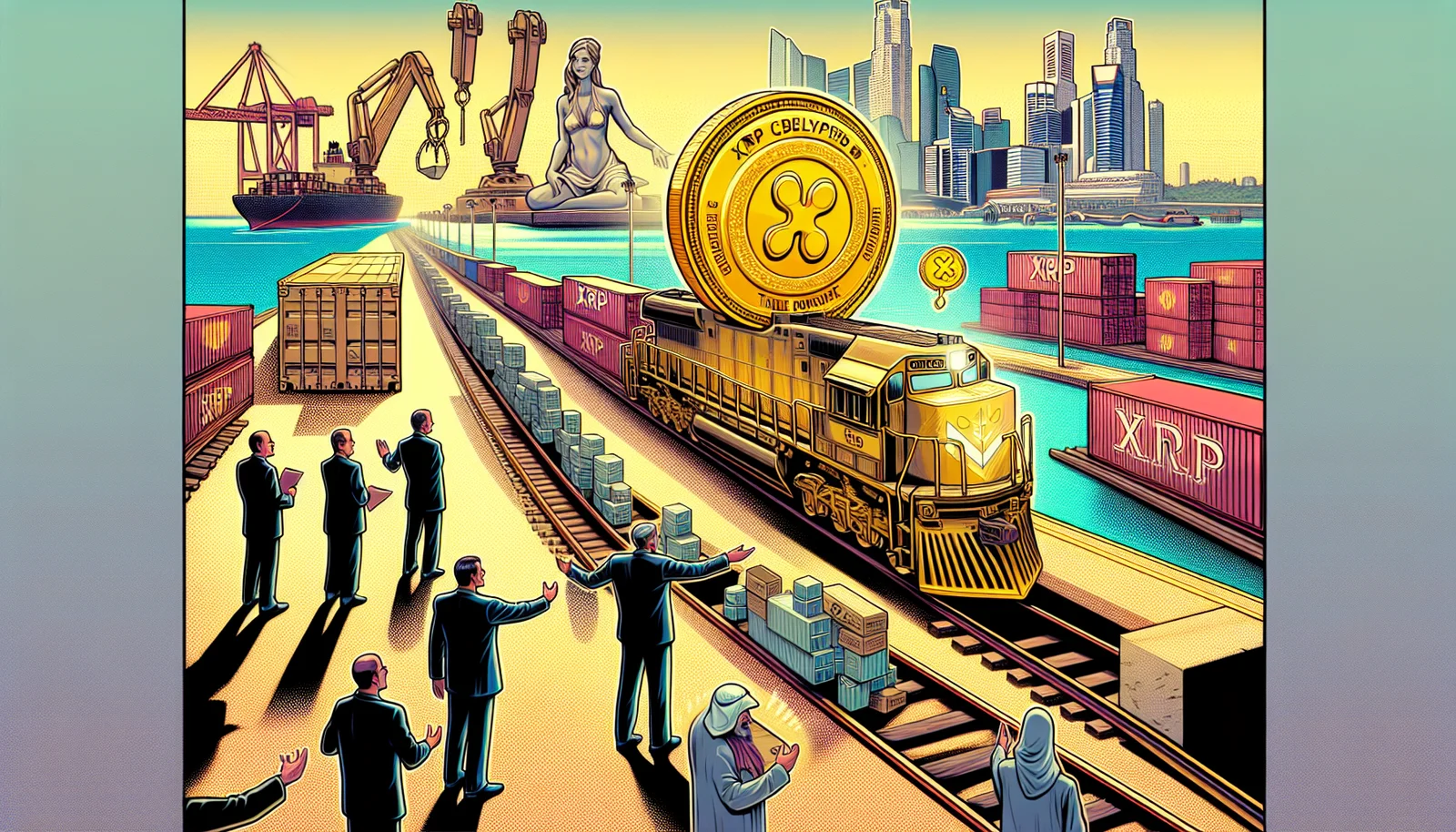
Ripple's RLUSD Enters Singapore's Central Bank Sandbox for Cross-Border Trade Finance
Ripple has joined Singapore's MAS BLOOM sandbox with RLUSD on XRP Ledger, targeting automated cross-border trade payment settlements alongside JP Morgan and DBS.

MAS Acceptance Puts RLUSD in Elite Institutional Company
Ripple's RLUSD stablecoin has cleared a significant institutional credibility threshold. On March 25, 2026, Ripple confirmed participation in the Monetary Authority of Singapore's BLOOM (Borderless, Liquid, Open, Online, Multi-currency) sandbox program — placing RLUSD alongside payment solutions from JP Morgan, DBS, Circle, and Coinbase in a live regulatory testing environment operated by one of the world's most respected financial regulators.
The MAS BLOOM sandbox is not an introductory program. Participants are selected based on the maturity of their technology and the specificity of their use case. Ripple's acceptance — and its specific deployment within a trade finance automation pilot with supply chain platform Unloq — signals that RLUSD has reached the institutional grade required to operate in Singapore's tightly regulated financial ecosystem.
The Use Case: Automated Trade Payment Settlement
The specific application Ripple is piloting in the BLOOM sandbox illustrates why blockchain-based stablecoins offer genuine advantages over traditional correspondent banking rails in trade finance contexts.
The pilot uses RLUSD on XRP Ledger to settle cross-border trade payments automatically: payment triggers execute when predefined conditions are met — typically verification of shipment milestones or customs clearance events confirmed via Unloq's supply chain platform. This programmable payment model compresses what is traditionally a manual, multi-party reconciliation process into an automated, near-instant settlement sequence.
The quantitative case is straightforward. Traditional cross-border trade payments involve multiple correspondent banks, take two to five business days to settle, carry fees of 2-3% of transaction value, and require manual reconciliation at each step. An RLUSD-on-XRP-Ledger settlement completes in seconds, costs a fraction of a cent, and requires no reconciliation because the payment record and the settlement are the same on-chain transaction.
The Partners Signal Institutional Seriousness
JP Morgan's co-participation alongside Ripple in the BLOOM sandbox is the detail that institutional analysts are noting most carefully. JP Morgan's blockchain and digital asset division runs Onyx — one of the most sophisticated institutional blockchain platforms in the banking sector. Its presence alongside Ripple in a MAS-supervised sandbox suggests the two organizations' approaches to blockchain payment rails are being evaluated as complementary rather than competing.
DBS, Singapore's largest bank and consistently ranked among the most forward-looking financial institutions in Asia in digital asset infrastructure, similarly brings institutional credibility. A pilot that includes DBS, JP Morgan, and MAS supervision is operational preparation — not an exploratory exercise.
RLUSD's Market Positioning
RLUSD's positioning as an institutional-first, regulation-friendly stablecoin is increasingly differentiated from the broader stablecoin market. Where USDT and USDC compete primarily on liquidity and crypto-native platform integration, RLUSD is building its install base from the top down: MAS-supervised pilots, correspondent banking relationships, and ISO 20022-compatible messaging on XRP Ledger.
For the XRP ecosystem broadly, the BLOOM sandbox participation represents concrete evidence that the regulatory strategy Ripple has pursued through years of legal challenge is producing the institutional access that was always the thesis behind XRP Ledger's design as a payments rail.
Sources: CoinDesk (March 25, 2026), BanklessTimes (March 25, 2026), The Block (March 25, 2026)
More Crypto Stories

Ethereum Glamsterdam on Sepolia: What 200M Gas Means Next
Ethereum's Glamsterdam upgrade is live on Sepolia with in-protocol PBS, parallel validation and a near-200M gas limit, over 3x mainnet's current 60M.

Samsung Wallet USDC: How 82M Galaxy Phones Will Send Money
Samsung Wallet will let US users send USDC across borders over Solana from late October 2026, reaching about 82 million Galaxy devices at launch.

How Stablecoins Work: Reserves, Redemption and Sending Money
How do stablecoins work? Our guide explains the 4 types, how USDC reserves and 1:1 redemption work, and how to send a stablecoin transfer abroad safely.