
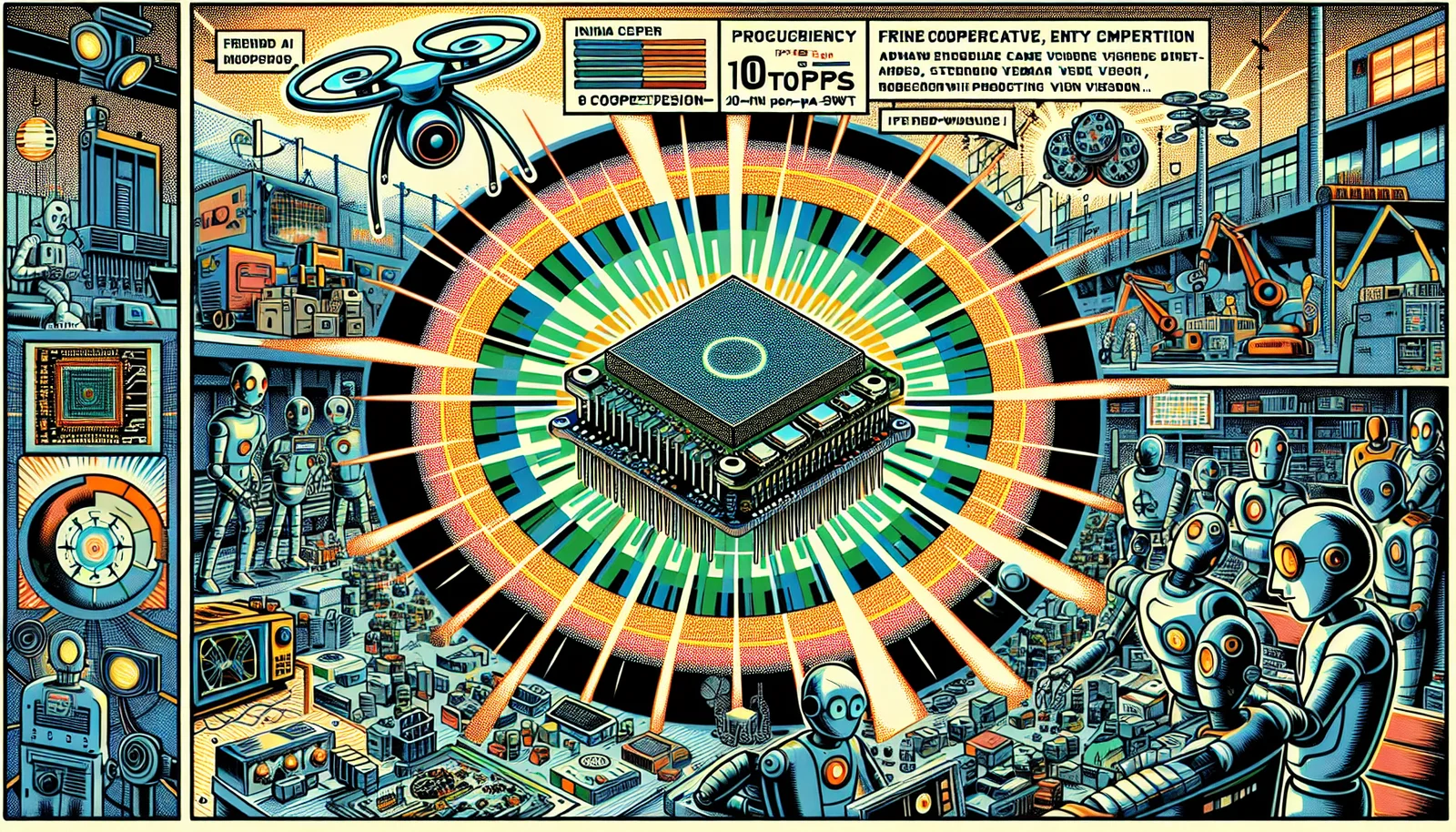
Renesas RZ/V2H Robotics Dev Kit Packs 80 TOPS of Edge AI on a Single Pi-Style Board
Renesas launched its RZ/V2H Robotics Development Kit on May 5, 2026 — combining quad Cortex-A55 cores, dual real-time R8 cores, and an 80 TOPS DRP-AI3 accelerator on a single Raspberry Pi-style board for autonomous robotics.

A Single-Board Robotics Platform With Real Compute Headroom
Renesas dropped its RZ/V2H Robotics Development Kit on May 5, 2026, and the spec sheet is the kind of thing that makes embedded engineers nod approvingly. The single board computer pairs a heterogeneous compute layout — four Arm Cortex-A55 application cores at 1.8 GHz, dual Cortex-R8 real-time cores at 800 MHz, and a Cortex-M33 microcontroller for low-level housekeeping — with the third-generation Dynamically Reconfigurable Processor AI accelerator (DRP-AI3) capable of pushing up to 80 TOPS of inference throughput. That is a serious amount of edge AI horsepower on a single SBC with a Raspberry Pi-compatible 40-pin GPIO header.
The release is aimed squarely at autonomous robotics, drones, factory automation, and machine vision builds — applications where the historical pain has been juggling a separate vision SoC, a real-time motor controller, and a power management subsystem on three different boards. The RZ/V2H pulls all of that onto one substrate, which is the kind of integration story that makes BOM costs and chassis volumes shrink in interesting ways.
What the RZ/V2H Spec Sheet Actually Looks Like
Under the heatsink, the RZ/V2H is a heterogeneous MPU built for the whole robotics control loop. The Cortex-A55 cluster handles Linux-side application logic and high-level perception. The Cortex-R8 dual core runs hard real-time control for motors or flight surfaces. The Cortex-M33 handles secure boot and power management. And the DRP-AI3 accelerator sits next to the cluster as a dedicated dataflow engine for vision inference, with pruning-based compute optimization that Renesas claims delivers 10 TOPS per watt — a roughly 10× efficiency bump over the previous-generation DRP-AI part.
Memory and storage are similarly serious for an edge AI single board computer. The dev kit ships with 16 GB of LPDDR4 system memory, 64 MB of QSPI flash for the secure-boot image, and a 64 GB microSD card pre-loaded with the Renesas Linux BSP. Connectivity is the part that will matter most for builders: a 16-pin PCIe Gen3 FFC connector for high-bandwidth peripherals, dual MIPI CSI camera interfaces for stereo or multi-camera vision rigs, USB 3.2 for fast peripheral I/O, Gigabit Ethernet for the data plane, and a micro HDMI output for headed configurations.
The Raspberry Pi GPIO Header Decision Is the Smart Play
The most interesting design choice on the RZ/V2H Robotics Development Kit is the Raspberry Pi-compatible 40-pin GPIO header. That single decision means the SBC inherits the entire ecosystem of HATs, sensor breakout boards, robotics shields, and reference designs that have grown up around the Raspberry Pi platform over the past decade. For an industrial customer evaluating whether to commit to the RZ/V2H for a production robotics build, the pin-compatible header dramatically lowers the prototype-to-production curve.
The 80 TOPS DRP-AI3 figure is the headline number, but the more practical one for most robotics workloads is the 10 TOPS-per-watt efficiency rating. Edge robotics platforms live or die by their power envelope, and being able to push real-time vision inference at single-digit watts is the difference between a battery-powered autonomous mobile robot that runs a full shift and one that needs a tether. The pruning techniques baked into DRP-AI3 are a meaningful step up from the brute-force TOPS-rating game that has dominated the edge AI accelerator market.
Where the RZ/V2H Slots Into the Edge AI Landscape
The RZ/V2H Robotics Development Kit sits in an interesting middle band of the edge AI single board computer market. It is more capable than a Raspberry Pi 5 paired with an AI HAT, less power-hungry than an NVIDIA Jetson Orin, and far more integrated than a generic ARM SBC paired with a discrete NPU. For builders who need a single-board platform for autonomous machine vision, motor-controlled robotics, or drone flight stacks, the RZ/V2H is now one of the cleanest options on the market.
The release also lands at a moment when the edge AI hardware landscape has been getting a lot more interesting. Renesas, Allwinner, Rockchip, and Spacemit are all shipping increasingly capable AI MPUs with on-die accelerators, and the era of "the GPU box has to be in the cloud" is rapidly giving way to "your robot can run a full vision pipeline on its own controller." The RZ/V2H Robotics Development Kit is one of the cleaner expressions of that trend — a single board, eighty TOPS of inference, and a Pi-compatible header. That is a genuinely useful addition to the edge AI hardware shelf.
Sources: CNX Software Coverage of Renesas RZ/V2H Robotics Development Kit (May 5, 2026), Renesas Product Page for RZ/V2H Vision AI MPU, Renesas Newsroom Announcement of RZ/V2H Single-Chip MPU
More Mini Computers Stories

Radxa Dragon Q8B Review: Twice the Pi 5 Speed for $209?
Jeff Geerling's Radxa Dragon Q8B review finds the $209 Snapdragon 8cx Gen 3 board more than doubles Raspberry Pi 5 multi-core speed, with dual 2.5GbE.

ESP32-C3 Ad Blocker: Pi-hole-Style DNS Filtering for $2
The open-source esp32-c3-adblock firmware turns a $2 ESP32-C3 board into a network-wide DNS ad blocker that handles up to 537,000 domains without PSRAM.

Raspberry Pi Net Zero: How Pi Towers Swapped Gas for Pis
Raspberry Pi replaced a £150,000 building system with a £7,800 Pi-based one at Pi Towers, cut gas entirely in June 2026, and targets net zero in 2027.