
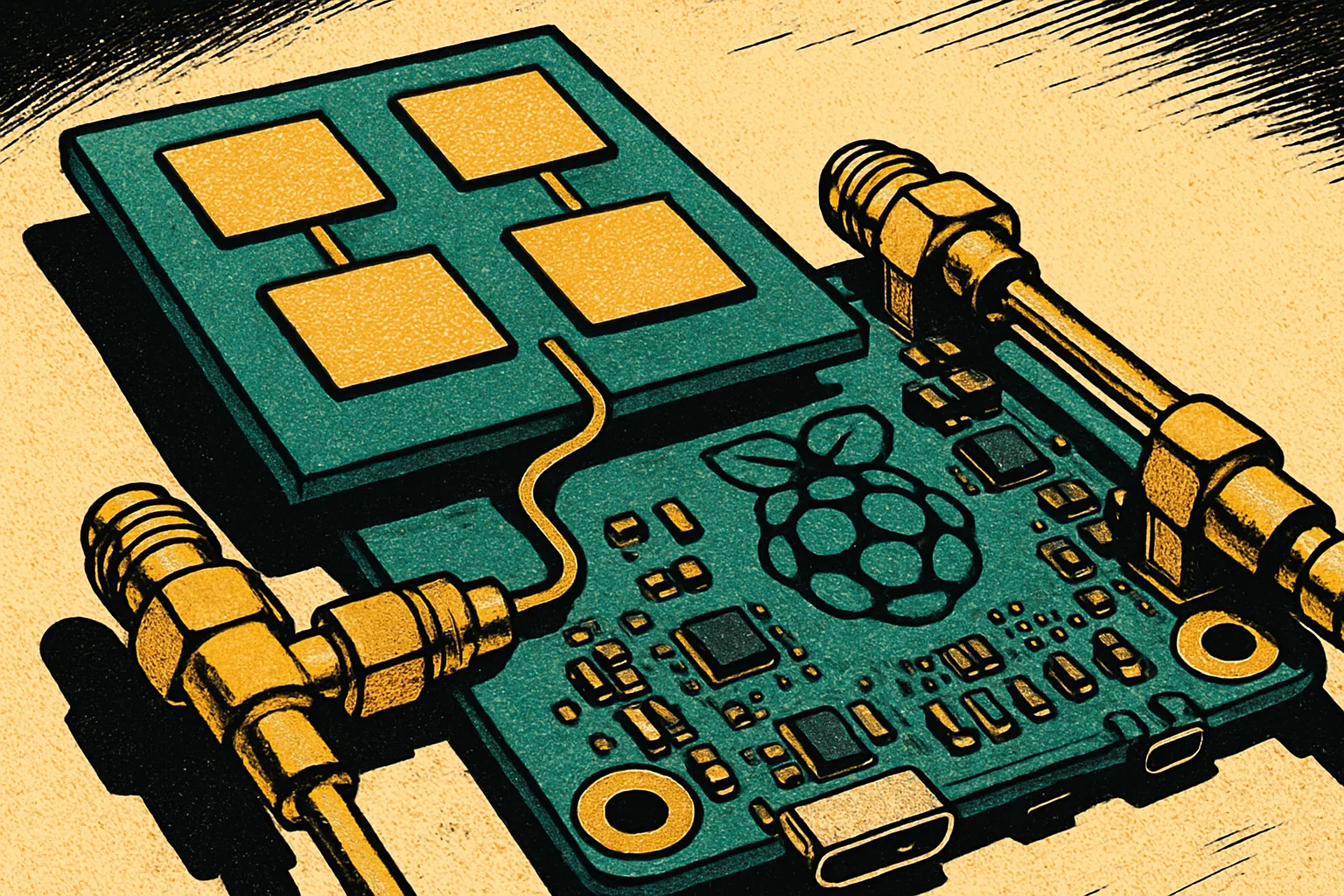
QuadRF: A Raspberry Pi 5 4x4 MIMO SDR RF Camera Hits Crowd Supply
QuadRF is a Raspberry Pi 5 4x4 MIMO software-defined radio tile that renders a live 30fps RF overlay. Open-source SDR beamforming from $499.

QuadRF Turns a Raspberry Pi 5 Into an RF Camera
Every so often a board lands that reframes what a hobbyist bench can actually do. QuadRF, a Raspberry Pi 5-based 4x4 MIMO software-defined radio tile from Scale RF, is one of those. It launched its crowdfunding campaign on Crowd Supply on June 24, 2026, and the pitch is refreshingly concrete: four coherent antennas, a live 30fps RF overlay on your phone or laptop, and a fully open-source stack. If you have ever wanted to *see* the radio spectrum around you rather than just plot it, this is the SDR to watch.
The headline spec is the 4x4 MIMO front end. Four receive channels sampled coherently is what separates QuadRF from the single-channel dongles most makers start with. Coherence is the whole game here — it is what lets the tile do direction-finding and phased-array style processing rather than just tuning one frequency at a time.
Beamforming and Phased-Array, Made Approachable
What makes QuadRF genuinely interesting from a hardware standpoint is that Scale RF built it as a scalable phased-array and beamforming architecture. The four coherent channels on a single tile are the entry point, and the design is meant to scale up from there. That is the same core idea behind serious radar and 5G base-station arrays, packaged onto a tile that a researcher or advanced tinkerer can actually afford and program.
The integrated Raspberry Pi 5 is a smart call. Rather than shipping a raw radio that needs a host PC babysitting it, the Pi 5 handles compute on-board, and the RF visualization streams out to a phone or laptop at 30fps. That live overlay is the feature that will pull people in — turning invisible signals into something you can point at and reason about in real time.
Software That Plays Nicely
On the software side, QuadRF speaks the languages makers already use. It is compatible with GNU Radio, SoapySDR, and ZeroMQ, so you are not locked into a proprietary toolchain. GNU Radio gives you the flowgraph environment, SoapySDR abstracts the hardware so your code stays portable, and ZeroMQ makes it straightforward to pipe samples between processes or across a network. That combination means the learning curve is mostly about RF concepts, not about fighting a closed SDK.
Open Source, and the Price/Performance Case
The entire project is open-source under GPLv2. For a device doing coherent MIMO capture and beamforming, that openness is a big deal — you can inspect the design, adapt it, and build on it without reverse-engineering a black box. It is exactly the kind of transparency that makes a platform durable in the maker and research communities.
Kits start at $499. For four coherent channels with an integrated Pi 5 and a live 30fps visualization pipeline, that lands in genuinely accessible territory for this class of hardware; coherent multi-channel SDRs have historically cost considerably more. Scale RF is targeting shipping for late September 2026, so backers should plan around that window.
If you are into direction-finding, spectrum monitoring, or just want a hands-on way to learn phased-array concepts, QuadRF is one of the most compelling open SDR platforms to appear on Crowd Supply this year. I will be keen to run it through its paces once units ship.
Sources: CNX Software (June 24, 2026); LinuxGizmos (June 2026).
More Mini Computers Stories

MaTouch ESP32-S3 E Ink Board: A $60 Voice-Ready Dashboard
Makerfabs' MaTouch ESP32-S3 pairs a 7.5-inch four-color E Ink screen with a four-mic array for $59.80. Here are the specs and what you can build.

ASRock NUC 300 Mini PCs: Wildcat Lake With Dual 2.5GbE
ASRock Industrial's NUC 300 series brings Intel Core 5 320 and Core 3 304 to mini PCs and boards with up to 64GB of DDR5-6400 memory and dual 2.5GbE.

DGX Spark 64GB: Who NVIDIA's $4,999 Local AI Box Is For
NVIDIA's DGX Spark 64GB starts at $4,999 on Oct 23 and runs models up to 100B parameters. Here is who the local AI box suits and how clustering works.