
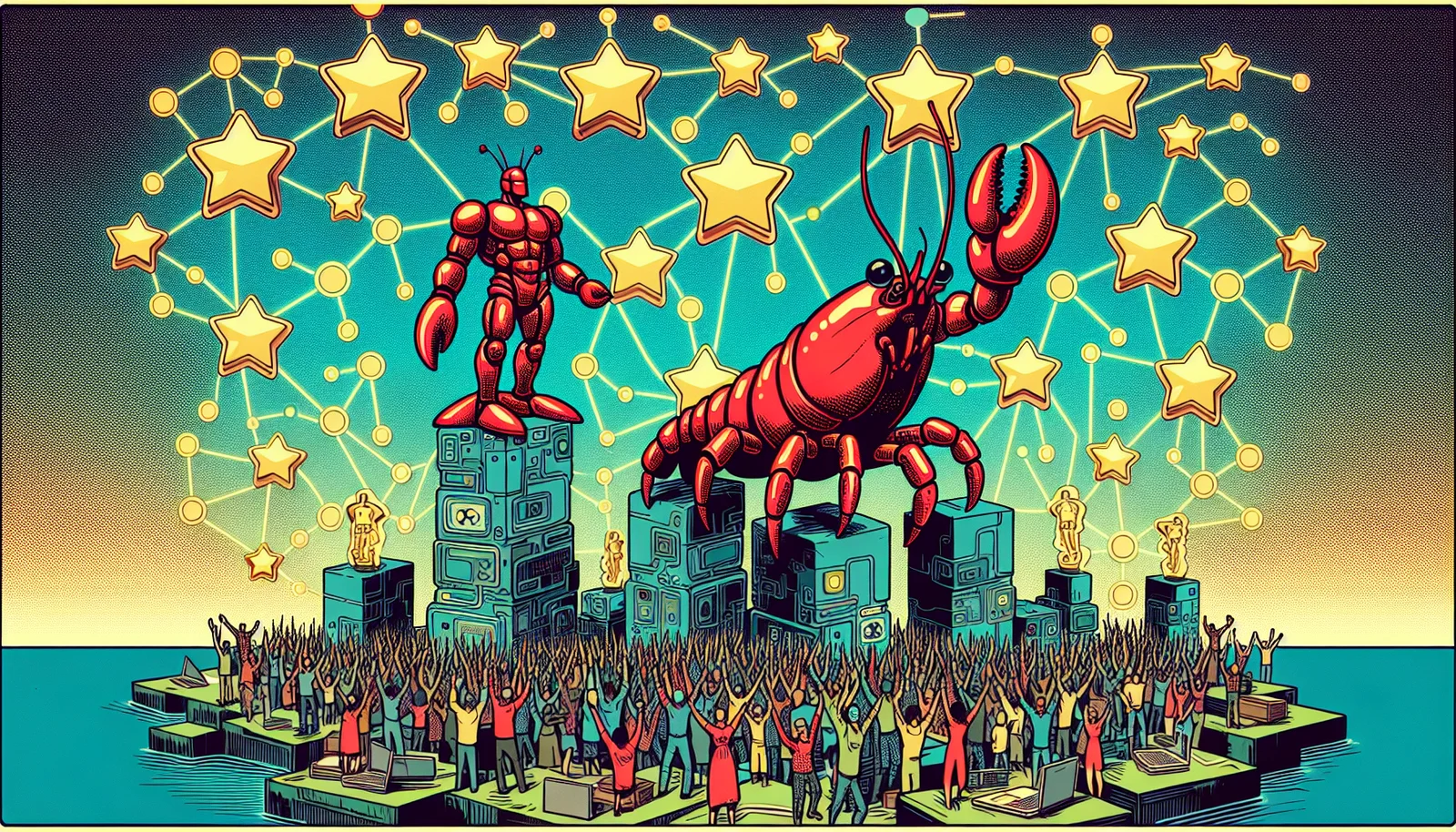
OpenClaw Becomes GitHub's Most-Starred Project as the Open-Source AI Agent Wave Crests
The open-source AI agent framework OpenClaw has surpassed 250,000 GitHub stars, overtaking React — marking a pivotal shift in how developers worldwide build and ship autonomous AI agents.

The Fastest-Growing Open Source Project in GitHub History
There are moments in software development when a project's adoption curve stops looking like normal growth and starts looking like something else entirely. OpenClaw is one of those projects. In the first 72 hours after its public release, it accumulated 60,000 GitHub stars. By mid-March 2026, it had crossed 250,000 — overtaking React to become the most-starred software project in GitHub's history. That number continues to climb.
OpenClaw is an open-source AI agent framework originally created by Austrian developer Peter Steinberger. The project began as Clawdbot, passed through a version called Moltbot, and arrived at its current name and identity as a full-featured framework for building, deploying, and managing autonomous AI agents. Its design philosophy emphasizes accessibility: structured to allow non-experts to deploy capable agents with minimal infrastructure overhead, while giving experienced engineers the flexibility to customize every layer of the stack.
What Makes OpenClaw Different
The AI agent framework space has grown crowded quickly. What sets OpenClaw apart is not a single technical breakthrough — it is the combination of architecture decisions that make the framework accessible without sacrificing depth.
OpenClaw's core contribution is a modular agent-task pipeline with clean separation between planning, execution, memory, and tool use components. Each layer is independently extensible: developers can swap in different LLM backends, use built-in tools or define custom ones, and configure memory retrieval strategies without touching unrelated code. The framework ships with a minimal working agent out of the box, so the path from installation to first working agent is measured in minutes rather than hours.
That approachability drove the initial viral growth. Once the framework gained traction, the community contributed rapidly: plugins, integrations, documentation, and specialized agents accumulated in the public repository at a rate reflecting genuine developer enthusiasm.
The Developer Ecosystem Response
The response from major technology platforms has been striking. Several prominent tech companies have moved quickly to build on OpenClaw's foundation, releasing integration tools and application wrappers that extend the framework's reach into consumer-facing contexts. Open-source projects building on OpenClaw have multiplied across categories: code review agents, research agents, workflow automation tools, and domain-specific applications for industries from logistics to content creation.
For developers evaluating AI agent frameworks, the community signal matters enormously. Documentation improves when contributors maintain it. Integrations expand when the ecosystem is active. Issues get resolved faster when more engineers are watching the repository. OpenClaw's star trajectory reflects real engagement rather than speculative interest, which translates to a healthier long-term development environment for projects built on it.
Three Production Releases in a Single Day
On March 25, 2026, the OpenClaw team shipped three signed production-ready releases in a single day: versions openclaw 2026.3.24-beta.1, openclaw 2026.3.24-beta.2, and the more stable openclaw 2026.3.24. Three releases in one day signals a development team operating with real momentum and a commitment to rapid iteration.
That shipping cadence, combined with the scale of community contribution visible in the repository, suggests an active and maturing project — not a viral attention flash that will cool without infrastructure behind it.
What the 250K Stars Milestone Actually Means
It is worth being precise about what a milestone like 250,000 GitHub stars represents. Stars are a weak signal of actual deployment on their own — many represent interest or bookmarking rather than active use. But the rate of star accumulation, combined with the volume of pull requests, plugin contributions, and downstream framework adoption visible in the ecosystem, indicates that OpenClaw's engagement is broadly real.
For AI practitioners evaluating agent frameworks in 2026, OpenClaw's trajectory makes it a project worth serious attention. The star count is the headline; the development velocity and ecosystem depth are the substance.
Sources: KDnuggets (March 2026), SimilarLabs (March 2026), The Wire China (March 29, 2026), Fortune (March 14, 2026), Labla.org (March 25, 2026)
More AI Stories

Google AMIE Lancet Study: What 98 Clinic Patients Showed
Google's AMIE diagnostic AI talked with 98 real clinic patients before their visits, and its diagnosis lists matched doctors' final calls 90% of the time.

Microsoft-Decision-1: A $0.042 Decision Model on Foundry
Microsoft-Decision-1 scores yes/no and multiple-choice decisions in a single pass on Foundry for $0.042 per million input tokens, with free output tokens.

Gemini Agent for Work: What Google's Universal Agent Does
Google's new Gemini agent runs multi-day jobs in the cloud, routes work across Gemini and Claude models, and adds hard spend caps for business teams.