
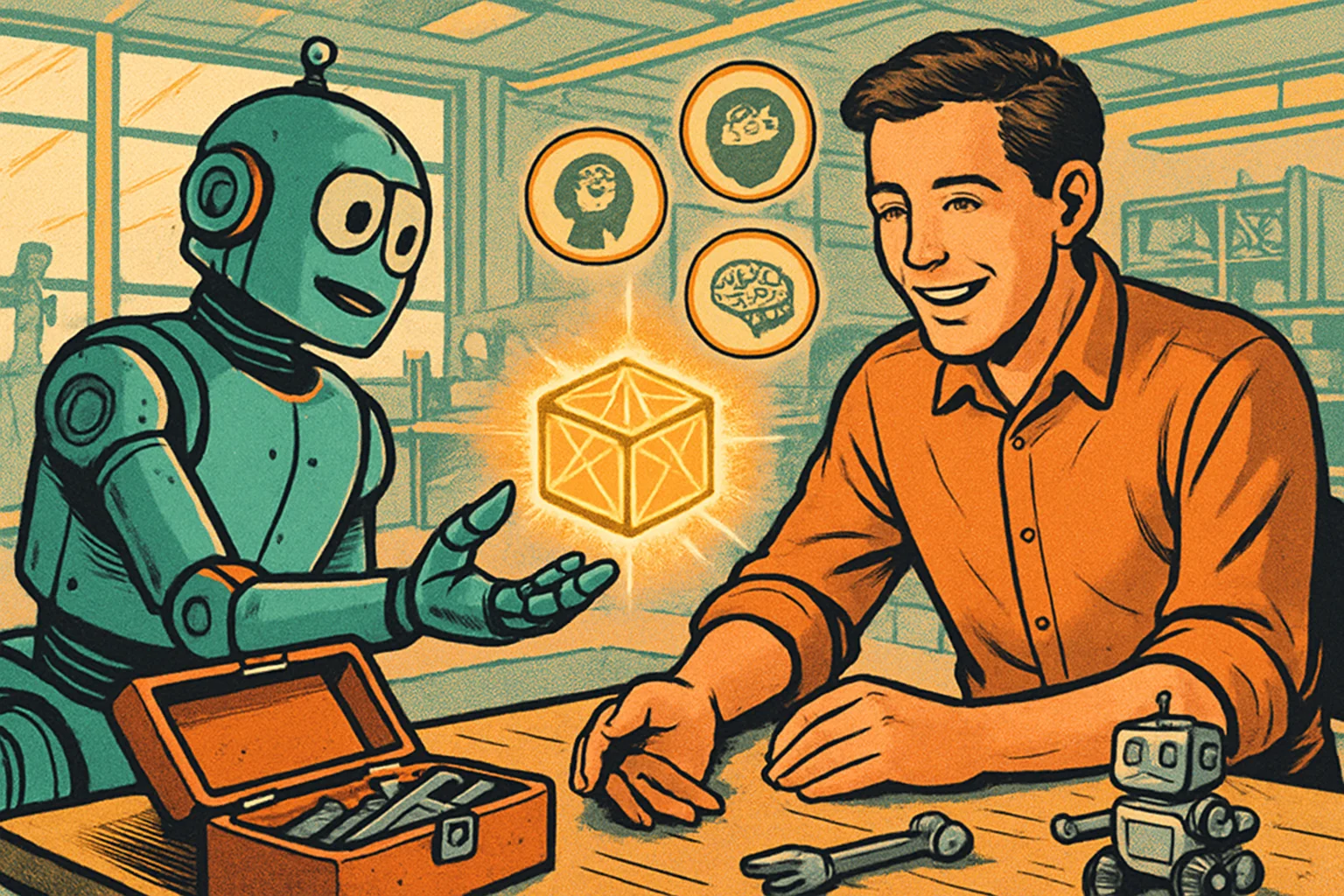
Open-Source Robotics Leaps Forward: NVIDIA and Hugging Face Join LeRobot
NVIDIA and Hugging Face bring open humanoid models and data tools to the LeRobot library, opening vision-language-action robotics to every lab.

A Milestone for Open-Source Robotics
Something genuinely exciting happened this week for anyone who dreams of building intelligent machines. NVIDIA and Hugging Face announced that they are bringing new models and frameworks into LeRobot, Hugging Face's open-source robotics library. In practical terms, this means that state-of-the-art tooling for teaching robots to see, reason, and act is now freely downloadable by anyone with curiosity and a laptop.
What makes this such a notable moment is the scale of the community it stitches together. The collaboration connects roughly 3 million robotics developers with Hugging Face's 16 million AI builders. When two ecosystems of that size begin sharing a common home, the pace of progress tends to accelerate in ways that are hard to overstate.
Inside the New LeRobot Tools
Two pieces anchor this release. The first is NVIDIA Isaac Teleop, an open-source framework for robot data collection. Gathering clean, real-world demonstration data has long been one of the quiet bottlenecks in robotics, so an open tool for capturing it removes friction at exactly the right point in the pipeline.
The second, and arguably the headline, is Isaac GR00T N1.7, an open reasoning vision-language-action model built for humanoid robots. A vision-language-action model is precisely what it sounds like: a single system that takes in what a robot sees, interprets instructions in natural language, and produces the physical actions that follow. GR00T N1.7 was pretrained on an enormous 20,000 hours of EgoScale human video data, giving it a rich grounding in how people actually move and manipulate objects.
Why Apache-2.0 Matters
Here is the detail I find most encouraging. GR00T N1.7 ships under the Apache-2.0 license, meaning it is commercially licensable. A startup can build a product on it. A university lab can fine-tune it for a research paper. Neither has to ask permission or negotiate a contract first. That permissive licensing is what turns a powerful model into genuinely shared infrastructure. NVIDIA has also signaled that its Cosmos 3 world foundation model is planned as a next step, hinting that the toolkit will keep growing.
Data That Levels the Playing Field
Models are only as capable as the data behind them, and this release leans on a substantial physical-AI dataset containing more than 350,000 real and simulated trajectories along with 57 million grasps. Assembling a corpus of that size independently would be far beyond the reach of most teams. By opening it up, the collaboration hands smaller players a resource that until recently only the best-funded giants could assemble.
That is the heart of the positive story here. Freely downloadable humanoid models, open data-collection tooling, and vast shared datasets lower the barrier to entry for the people who often drive the most creative work: graduate students, independent researchers, and early-stage startups. Open-source robotics has always promised to democratize the field, and this LeRobot expansion is a concrete, meaningful step toward that promise.
Looking Ahead
The most rewarding thing about open ecosystems is that their value compounds. Every lab that builds on GR00T N1.7, every dataset contributed back, every improvement to Isaac Teleop makes the next project easier for everyone. If you have ever wanted to experiment with humanoid robots or vision-language-action models, there has never been a better moment to clone the repository and begin. The tools are open, the community is enormous, and the road ahead looks bright.
Sources: NVIDIA Blog — "NVIDIA and Hugging Face Bring New Models and Frameworks to LeRobot" — July 7, 2026; The AI Insider — coverage — July 7, 2026; Hugging Face — "NVIDIA Isaac GR00T N1.7" model blog — July 2026.
More AI Stories

Mistral Large 4: What a 1T Open-Weight Model Means for You
Mistral Large 4 packs 1 trillion parameters with 49B active, costs $1.36 per million input tokens, and its open weights are due by the end of October.

EmbeddingGemma 2: On-Device Search for Text, Images, Audio
EmbeddingGemma 2 is a 740M open embedding model that searches text, images, audio and video on a phone using as little as 191MB of RAM. See how it works.
What Claude Code Mods Can Change, and What to Check First
Claude Code mods are TypeScript functions that rewrite prompts, add UI and replace built-in features. Here is how they install and what to check first.