
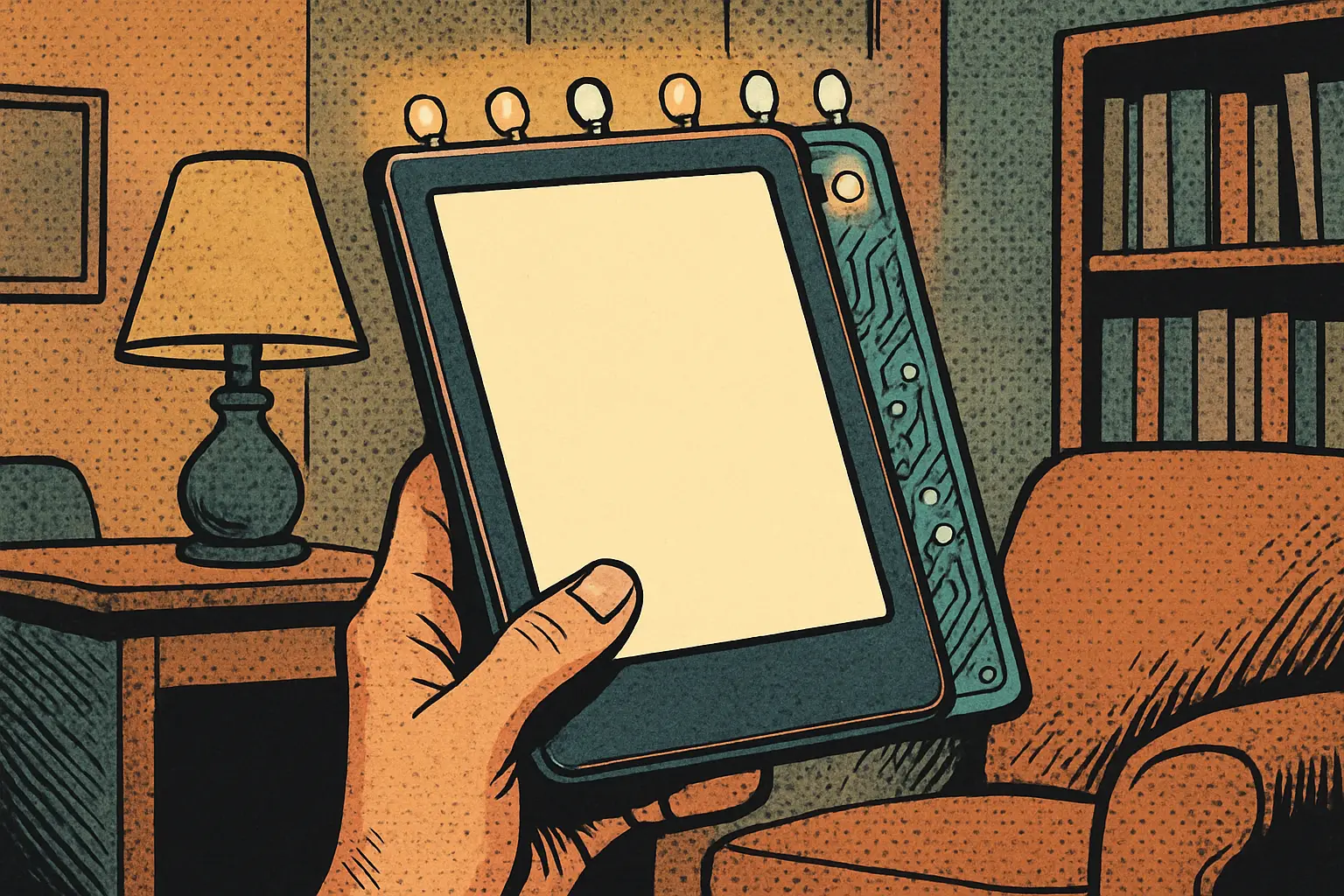
Open Book Touch Is a Hackable Open-Source E-Reader
The Open Book Touch is a DRM-free ESP32-S3 e-reader with a 4.26-inch touch e-paper screen, open firmware, and a replaceable battery, from \$149.

An E-Reader You Are Actually Allowed to Tinker With
Most e-readers are sealed black boxes tied to one store's ecosystem. The Open Book Touch, which opened for crowdfunding on July 10, 2026, is the opposite: a DRM-free, fully open-source hardware e-reader built around the familiar ESP32-S3 microcontroller. It is aimed squarely at readers and makers who want a device they can repair, reflash, and genuinely own — a philosophy that fits right in with the open-source hardware projects we love to cover.
- 4.26-inch front-lit e-paper touchscreen at 480×800 resolution, with no front buttons
- Powered by an ESP32-S3 dual-core MCU with Wi-Fi and Bluetooth LE, 16 MB flash, and 8 MB PSRAM
- User-replaceable 1,800 mAh LiPo battery charging over USB-C, good for weeks of reading
- Firmware built on ESP-IDF and FreeRTOS with SQLite for the library — hardware and software both open
What Makes the Hardware Interesting?
At just 78 × 120 × 10 mm and 85 grams, the Open Book Touch is pocketable and genuinely thin. The front lighting is a nice touch of engineering: ten LEDs — five warm and five cool — let you dial in both brightness and color temperature, so late-night reading can skew warm without an app subscription telling you when. It reads EPUB and plain text with proper hyphenation, justification, and inline images.
The choice of the ESP32-S3 is what makes this a mini-computer story rather than a gadget story. It is the same accessible, well-documented single-board silicon powering a wave of maker devices, including the PocketMage E-Paper PDA and an E-Ink Game Boy emulator handheld. Anyone comfortable with ESP-IDF can extend this reader, not just theme it.
Why Does an Open E-Reader Matter?
The appeal is durability and control. A user-replaceable battery alone sets it apart from mainstream readers that become e-waste the moment their sealed cell wears out. Because the firmware is open and metadata lives in a plain SQLite database, your library is yours to back up, script, and sync however you like — no account required, no format lock-in.
The device is on Crowd Supply starting at \$149 with a battery and microSD card, with a \$249 "Author's Edition" that adds a premium enclosure. That is a step above budget commercial readers, but you are paying for openness, repairability, and a platform you can build on — a fair trade for the maker crowd.
A Small Win for Repairable Computing
The Open Book Touch will not out-spec a big-brand reader on paper, and it does not try to. Its pitch is quieter and, honestly, more hopeful: a well-made reading device that respects your ownership, invites modification, and can be kept alive for years with a fresh battery and a firmware pull. In a season packed with clever ESP32-S3 builds, this is one of the most genuinely useful — a reminder that open hardware can be practical, not just a proof of concept.
Sources: CNX Software — July 10, 2026; Liliputing — July 10, 2026.
More Mini Computers Stories

Raspberry Pi Net Zero: How Pi Towers Swapped Gas for Pis
Raspberry Pi replaced a £150,000 building system with a £7,800 Pi-based one at Pi Towers, cut gas entirely in June 2026, and targets net zero in 2027.

Q8botOne Robot Dog: A Palm-Sized Open ESP32-C3 Quadruped
Q8botOne is a palm-sized open-source robot dog with an ESP32-C3 brain and 8 DYNAMIXEL actuators, from $199 as a kit or $599 assembled on Crowd Supply.

Surface RTX Spark Dev Box: Is a $5,999 AI Box Worth It?
Microsoft opened Surface RTX Spark Dev Box pre-orders at $5,999: 128GB unified memory, up to 1 petaflop FP4, and support for 120B-plus parameter models.