
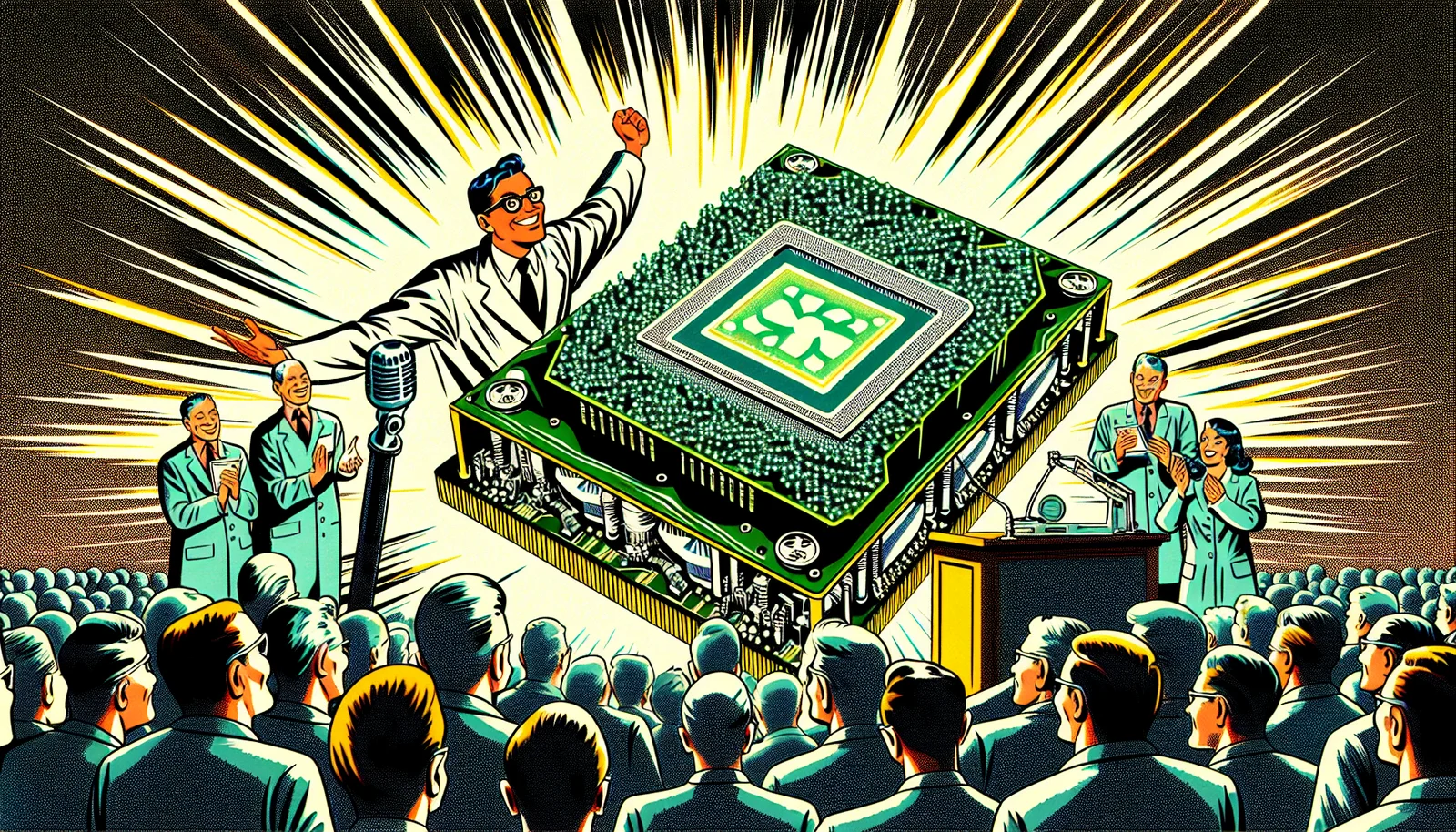
NVIDIA Unveils Vera Rubin GPU Architecture and Open AI Agent Platform at GTC 2026
NVIDIA's GTC 2026 brings the Vera Rubin GPU with 3-4x Blackwell AI compute density, the Nemotron 3 Super 120B coding model, and an open-source platform for safe autonomous AI agents.

GTC 2026: The Agentic AI Era Gets Its Hardware Foundation
NVIDIA's GPU Technology Conference 2026, held in San Jose in late March, made one architectural message unmistakably clear: the transition from conversational AI to autonomous agentic AI is now hardware-accelerated. Jensen Huang and the NVIDIA team unveiled the Vera Rubin GPU architecture, the Nemotron 3 Super enterprise coding model, and a new open-source platform for deploying safe, self-evolving AI agents — a set of announcements that collectively define what AI infrastructure will look like for the next two to three years.
Vera Rubin: 3-4x the Compute Density of Blackwell
The GPU architecture headliner is Vera Rubin — NVIDIA's next major datacenter compute platform and the successor to the Blackwell architecture that has been in high demand since its introduction. Vera Rubin delivers approximately three to four times the AI compute density of Blackwell at comparable power envelopes — an improvement that tracks with the exponential growth in AI model complexity that has characterized the past several years.
For AI labs and enterprises training frontier models, the Vera Rubin generation means that the same datacenter footprint can accommodate substantially larger training runs, or that existing training budgets can be stretched to cover more experimental work. For inference at scale, the density improvement translates directly to cost per token — a metric that has become one of the most important competitive dimensions for AI deployment.
Nemotron 3 Super: NVIDIA's Coding Model Challenge
Alongside the hardware announcement, NVIDIA dropped Nemotron 3 Super — a 120B-parameter enterprise coding model that scored 60.47% on SWE-Bench Verified, one of the most rigorous benchmarks for evaluating real-world software engineering capability. Scores in this range place Nemotron 3 Super in the competitive upper tier of coding-focused large language models.
The model is built for enterprise deployment, optimized for private data environments where organizations need coding intelligence without routing sensitive code through third-party APIs. Its availability through NVIDIA's enterprise AI stack positions it as a direct competitor to coding-specialized models from OpenAI, Anthropic, and Google for enterprise software development automation.
An Open-Source Platform for Autonomous Agents
The third major announcement at GTC 2026 was arguably the most strategically significant: NVIDIA unveiled an open-source software platform for building autonomous, self-improving AI agents with a focus on safety and security. The platform provides a structured framework for deploying agents that can operate independently within enterprise systems — coordinating tasks, adapting to new information, and improving their own workflows over time.
Critically, the platform's open-source nature means the enterprise AI community can inspect, audit, and contribute to the safety and security primitives that govern how autonomous agents operate. This addresses one of the most significant barriers to enterprise adoption of agentic AI: the difficulty of auditing and governing systems that operate with a degree of autonomy.
GTC 2026 was widely described by industry analysts as a landmark moment — the conference where the architectural foundations of the agentic AI era moved from theoretical to imminent.
Sources: NVIDIA Newsroom (March 23-24, 2026), CNBC (March 2026), FuturumGroup (March 2026)
More AI Stories

Nemotron 3.5 Bolt: Can a 74B Open Model Really Fit in 24GB?
Nemotron 3.5 Bolt packs a 74B-parameter open model into 24GB with 2-bit quantization-aware training. Here's what it means for local AI agents on Oct 15.

Anthropic Scion: Why Claude Needed New Source Control
Anthropic built Scion, a new source control system, after daily merges jumped from 2,500 to 30,000. Claude wrote most of it; checkouts now take seconds.

Gemini 4 Argon Pricing: What the $2 Intro Rate Gets You
Gemini 4 Argon is now broadly available at $2 in and $10 out per million tokens until November 30, with a 1M token limit and free access for scientists.