
NVIDIA Isaac GR00T N1.7 Opens Humanoid Robot AI to Everyone With Apache 2.0 License
NVIDIA releases Isaac GR00T N1.7 — a 3B-parameter open VLA model for humanoid robots, commercially licensed under Apache 2.0 and available on Hugging Face.

NVIDIA Opens Physical AI to Builders With Isaac GR00T N1.7
NVIDIA's National Robotics Week announcement this April included one of the most significant open releases in the physical AI space: Isaac GR00T N1.7, a 3-billion-parameter Vision-Language-Action model for humanoid robots, now available in early access under a full Apache 2.0 commercial license.
The model is hosted on Hugging Face and GitHub, which means any team building a humanoid robot platform can pull it down today, modify it, deploy it, and build commercial products on top of it without royalty obligations. That level of openness is relatively rare in robotics AI, where most serious foundation models remain proprietary.
What Isaac GR00T N1.7 Actually Does
GR00T N1.7 maps two inputs — visual observations and natural language instructions — directly to robot motor actions. Feed it a camera view and tell it "pick up the red cup and place it on the shelf," and the model generates the continuous motor control signals a humanoid arm needs to execute that command.
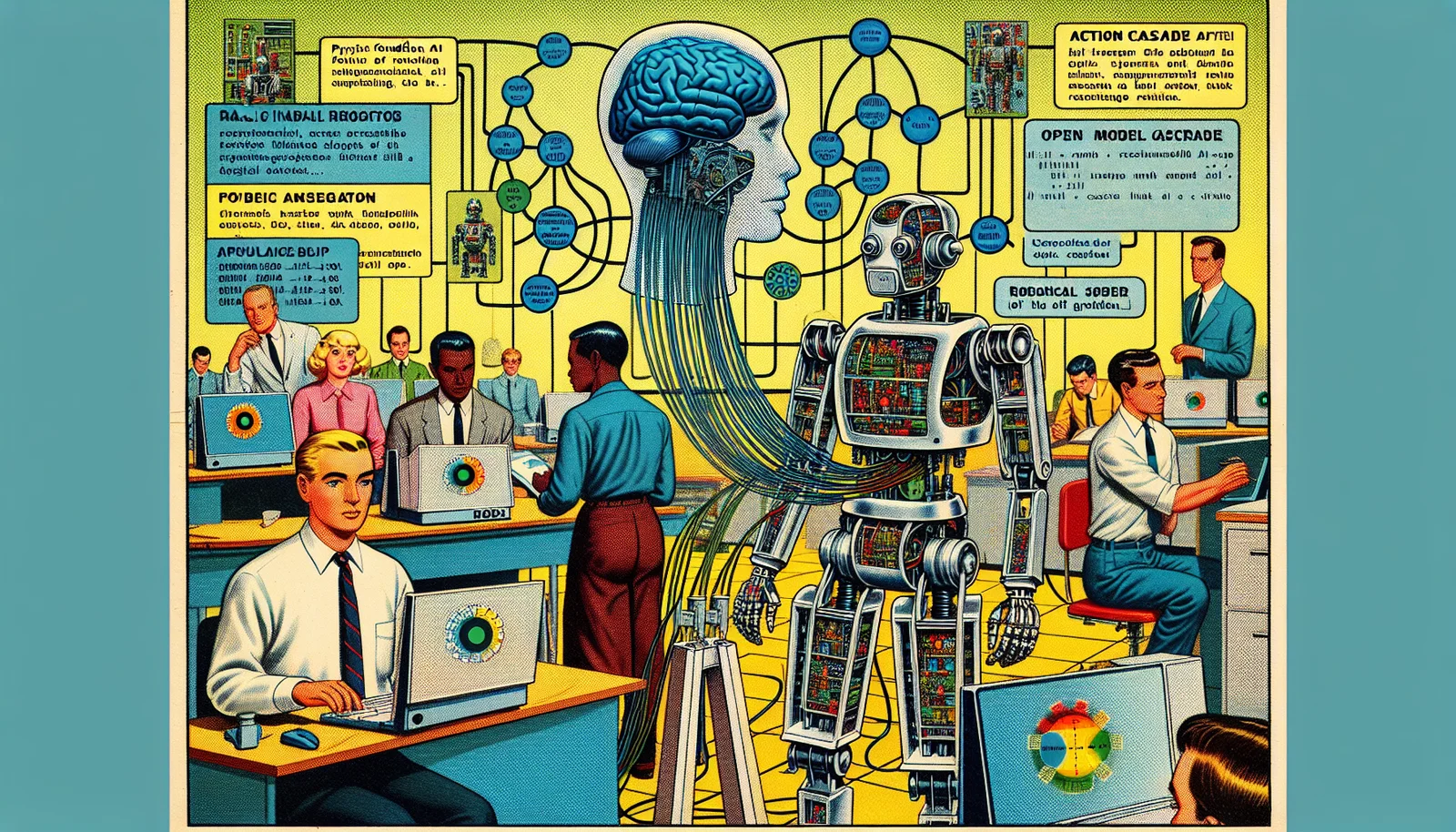
The architecture NVIDIA calls "Action Cascade" separates the reasoning side (high-level planning, instruction parsing) from the motor execution side (the precise joint commands that move the robot). This dual-system design lets the model handle ambiguous language and novel situations at the reasoning layer while maintaining the responsiveness and precision real robot hardware requires at the control layer.
A Step Up From N1.6
GR00T N1.7 builds on N1.6's simulation-to-real workflow. The key advance is the reasoning layer's ability to handle multi-step tasks with more coherent planning across longer action sequences — the model maintains its goal understanding through complex manipulation challenges where earlier versions would drift.
NVIDIA trained N1.7 using a human-data-first strategy, emphasizing that human demonstration data scales better for teaching dexterous manipulation than simulated data alone.
Open Weights and the Robotics Ecosystem
NVIDIA timed this release alongside global partners unveiling next-generation humanoid platforms. The Apache 2.0 license is a deliberate move to accelerate the ecosystem — the more robotics teams that use GR00T as a foundation, the more demonstration data and fine-tuned checkpoints flow back into the community.
For university labs, hardware startups, and enterprise robotics teams that have been building custom robot arms or mobile manipulators, GR00T N1.7 offers a strong general-purpose starting point that can be fine-tuned on their specific hardware and task domain rather than training from scratch.
The global robotics market is projected to reach $124 billion in 2026. Open foundation models like GR00T are one of the key accelerants — they compress the time between "hardware prototype" and "task-capable system" from years to months.
How to Get Started
The model is available via NVIDIA's Hugging Face page and the Isaac-GR00T GitHub repository. NVIDIA's Isaac Sim simulation environment provides the workflow for sim-to-real transfer for teams without immediate access to physical hardware.
The "early access" designation means NVIDIA is still refining documentation and deployment tooling, but the weights and architecture are stable for research and commercial pilot work.
Why This Matters
Physical AI — models that directly control robot bodies in the real world — is one of the most technically demanding frontiers in machine learning. GR00T N1.7 being commercially open means the competitive gap between teams with NVIDIA research partnerships and the broader developer community just narrowed significantly.
For researchers, makers, and robotics engineers who have been waiting for a credible open foundation model to build on: this is that model.
Sources: NVIDIA Newsroom (April 2026), Hugging Face Blog — NVIDIA Isaac GR00T N1.7 (April 2026), RoboticsTomorrow (April 23, 2026), CVPR 2026 Robotics Preview (April 23, 2026)
More AI Stories

Strands Decider 2B: What Amazon's Free Decision Model Does
Strands Decider 2B is a free 2B-parameter decision model that picks options in about 115ms on a single GPU. Here is how it works and where it fits.

Meta Muse Gadgets SDK: Build Your Own AI Agent Hardware
Meta's open-source Muse Gadgets SDKs bring its Muse agent to Raspberry Pi and ESP32 builds, and 5,000 free Home Link dongles are going to subscribers.

AstaBrief 8B: Ai2's Open Model for Cited Science Reports
AstaBrief 8B is Ai2's Apache 2.0 open model that writes cited research reports in 51 seconds, 3.5x faster than its Claude pipeline. Here is how it works.