
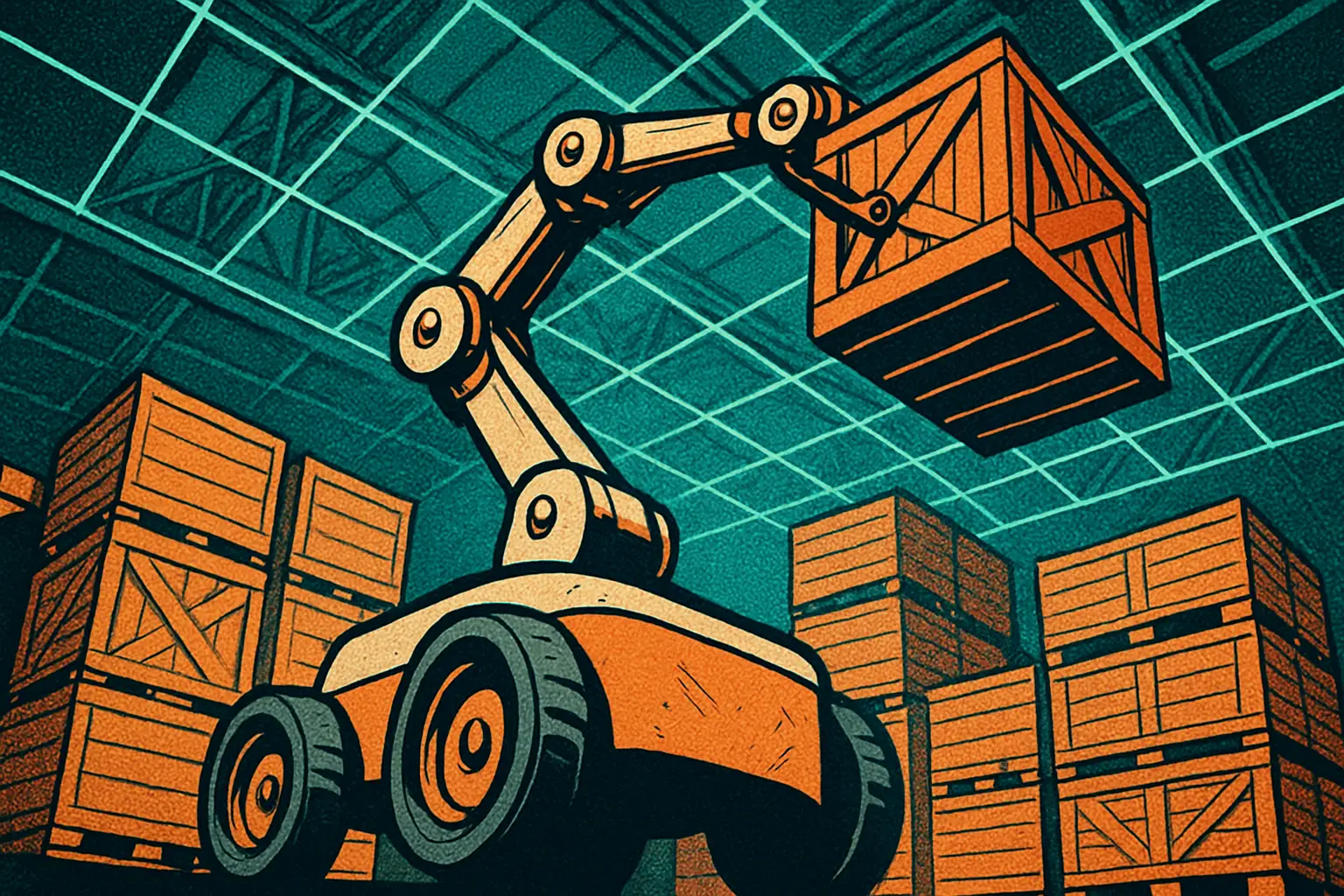
NVIDIA Cosmos 3 Edge Puts World Models Inside Robots
NVIDIA Cosmos 3 Edge is a 4-billion-parameter world model doing spatial reasoning on Jetson and RTX hardware, adaptable to a robot in about a day.

A World Model Small Enough to Live on the Robot
NVIDIA Cosmos 3 Edge is a 4-billion-parameter world model built on the Nemotron family, and its most interesting property is not its size but its address: it runs on the machine itself. Introduced on July 15, 2026, the model lets robots and vision-AI systems perform spatial reasoning and generate robot action policies on-device rather than shipping frames to a data center. After a decade in which edge AI mostly meant classification - person or forklift, defect or no defect - that is a change of category rather than a bump in accuracy.
- A 4-billion-parameter world model built on NVIDIA's Nemotron model family, announced July 15, 2026
- Runs on NVIDIA Jetson modules including the new Jetson T2000 and T3000, plus RTX GPUs and DGX systems
- NVIDIA says developers can adapt it to a specific robot, vehicle, sensor rig, or environment in roughly one day
- More than 20 Japanese organizations intend to join a new Cosmos Coalition, among them FANUC, Yaskawa Electric, Fujitsu, Hitachi, Sony Group, and Kawasaki Heavy Industries
What Does a World Model Actually Do?
A classifier answers a question about a single frame. A world model maintains an internal representation of a scene as it evolves: which objects are present, where they sit relative to one another, how they are likely to move, and what changes if the machine reaches into that space. That representation is the bridge between perception and action, which is why the output of Cosmos 3 Edge is not only a label but a robot action policy.
The practical consequence is that the reasoning loop closes locally. A mobile robot in a warehouse aisle or a camera rig watching a construction site no longer depends on a network link for the part of the job that has to happen in milliseconds. That is the core argument for putting a world model at the edge, and the same one that made purpose-built inference silicon compelling in our look at NVIDIA's Jetson T3000 and T2000 edge AI modules.
Why Does the One-Day Adaptation Claim Matter?
Physical AI has a customization problem. Every deployment brings its own robot geometry, camera placement, lighting, and floor surface. Historically that meant a bespoke data collection and training effort per site, and that cost is a large part of why promising pilots have been slow to become fleets.
NVIDIA's position is that Cosmos 3 Edge can be adapted to a particular robot, vehicle, sensor rig, or environment in roughly a day. Paired with new Metropolis libraries the company says let teams assemble vision-AI pipelines at least 6x faster, the pitch is about iteration speed: if retargeting takes a day instead of a quarter, a team can afford to try the awkward third idea - usually where the useful behavior turns up.
Which Hardware Runs It?
The model targets three tiers of NVIDIA silicon. Jetson modules, including the new T2000 and T3000, cover embedded deployment inside the robot or camera. RTX GPUs handle workstation-class development and on-premises inference. DGX systems take the heavier adaptation work. The continuity matters more than any single tier: a team can develop on a desktop and deploy the same model family onto a module. Compact on-device intelligence has been trending this way for a while, as with the reCamera Pro on-device AI camera.
The Cosmos Coalition and Japan's Industrial Pull
Cosmos 3 Edge arrived alongside a two-day visit to Japan by NVIDIA chief executive Jensen Huang, focused on robotics, manufacturing, healthcare, and industrial AI. More than 20 Japanese organizations have signaled they intend to join a new Cosmos Coalition, a roster spanning industrial robotics, electronics, and IT: FANUC, Yaskawa Electric, Fujitsu, Hitachi, Sony Group, and Kawasaki Heavy Industries among them.
A world model is only as good as the machines it gets to move. Coalitions of this shape are how research models find real actuators.
Japan builds a large share of the world's industrial robot arms and factory automation gear, so a coalition of this composition puts the model close to hardware that already ships at volume.
Where It Shows Up First
The stated target environments are broad - factories, logistics hubs, farms, construction sites, hospitals, roads, and smart homes - with named work already underway in autonomous agriculture, retail automation, elder-care robotics, and construction safety monitoring. Those four share a trait: they are unstructured settings where a fixed rule set breaks quickly and a spatial model earns its keep.
The area to watch is how the one-day adaptation figure holds up across that variety of environments. Either way, the direction is a good one: edge AI is graduating from labeling the world to modeling it. For more on models moving out of the data center, see our ongoing AI coverage.
Sources: NVIDIA Newsroom - July 15, 2026; CNBC - July 16, 2026; SiliconANGLE - July 16, 2026.
More AI Stories

DeepSeek V4.1 Flash 1017: Bigger Agent Gains, Same Price
DeepSeek V4.1-Flash-1017 lifts Terminal-Bench 4.0 from 31.2 to 42.3 with MIT-licensed open weights, unchanged API pricing, and a new Search API.

Grok Voice 3.0 for Voice Agents: Upgrade Notes and Pricing
Grok Voice 3.0 scores 86.9 on Artificial Analysis' speech-to-speech index, adds 28 voices and 20 languages, and keeps the $0.08-per-minute price.

LFM2.5-24B-A2B: A 2B-Active Agent Model for Your Laptop
LFM2.5-24B-A2B activates just 2B of its 24B parameters per token, hitting 184 tokens/s on an M5 Max with a 131K context built for local AI agents.