
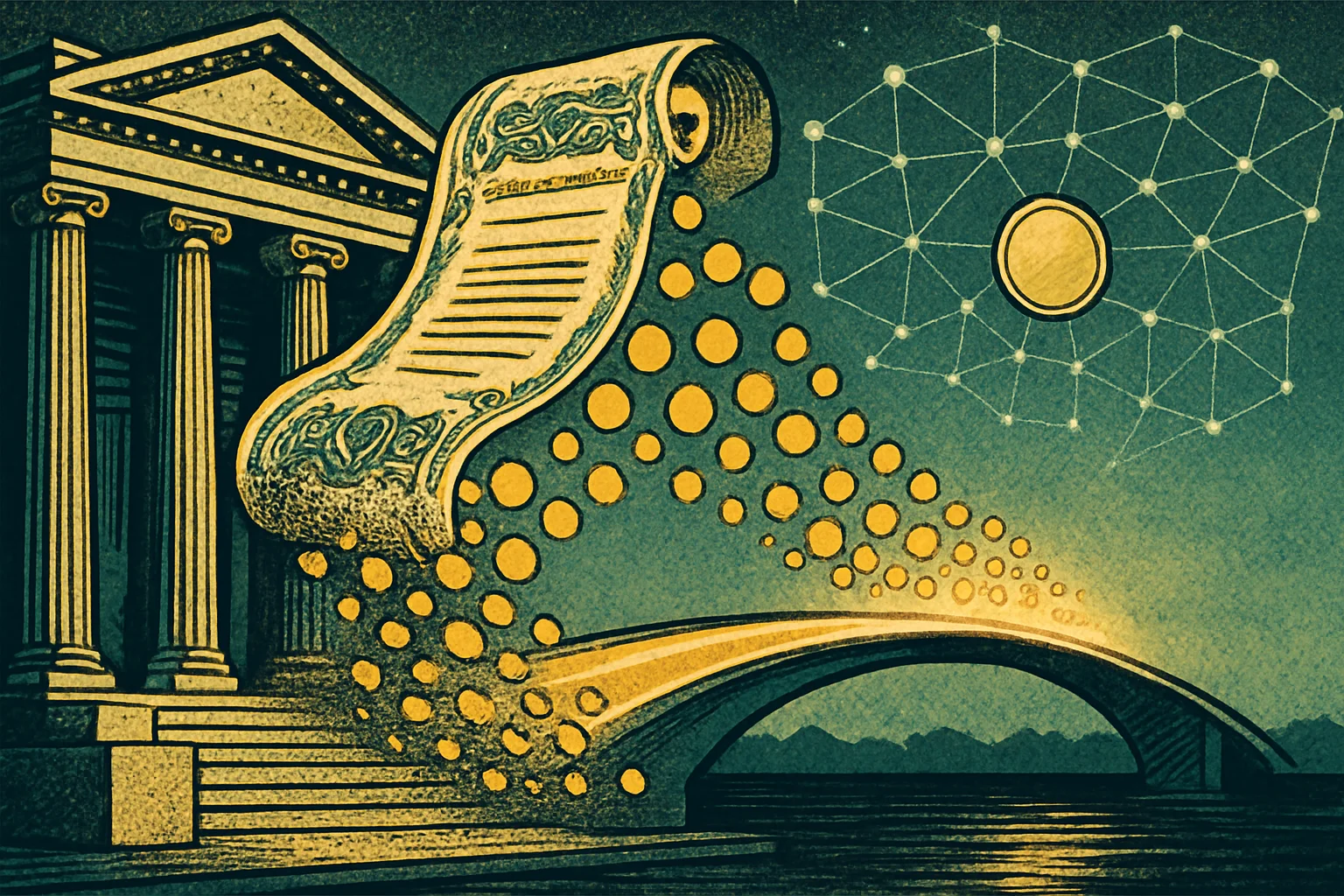
New York Life's $800B Arm Makes Its Tokenization Debut With Centrifuge
On June 29, 2026, New York Life's $807B asset manager launched its first tokenized fund — an on-chain high-yield corporate bond strategy built with Centrifuge, settling in USDC.

A Legacy Giant Steps On-Chain
When an asset manager with more than $800 billion under management makes its first move into tokenization, it is worth looking past the headline and at the structure underneath. On June 29, 2026, New York Life Investment Management (NYLIM) — the asset-management arm of one of America's oldest insurers, managing roughly $807 billion — launched its first tokenized investment product. The data point matters less for novelty than for what it signals about where institutional finance is heading.
What Was Actually Launched
The product is the NYLIM Anemoy U.S. High Yield Corporate Bond Segregated Portfolio, an on-chain version of a high-yield corporate bond strategy. It was built in partnership with Centrifuge, the tokenization platform supplying the on-chain infrastructure, and settlement runs on Circle's USDC — subscriptions and redemptions are handled in the regulated stablecoin.
The detail I want to underline is what *did not* change. NYLIM continues to actively manage the underlying bond portfolio and its investment strategy exactly as before. Tokenization here is the access and distribution layer, not a reinvention of the fund itself. Eligible investors can subscribe and redeem through blockchain rails, but the substance — a professionally managed bond strategy from a major institution — is entirely familiar. That separation between the asset and the rails is, in my analysis, the healthiest way for real-world asset tokenization to mature.
Why On-Chain Distribution Is the Interesting Part
The traditional fund-distribution stack is a chain of intermediaries, settlement delays, and manual reconciliation. Putting subscription and redemption on-chain compresses that into programmable, near-instant settlement, with USDC providing a stable, dollar-denominated unit of account at the edges. For institutional clients, that can mean faster movement and cleaner record-keeping without giving up the regulated wrapper they need.
The broader market context supports the direction. Tokenized real-world assets now exceed $30 billion (excluding stablecoins), and Citi has projected that figure could reach $5.5 trillion by 2030. Forecasts are forecasts — I treat them as scenarios, not certainties — but the trend line of established managers building on-chain access is unmistakable and accelerating.
The Signal Worth Watching
As Thomas Sy, head of multi-asset solutions at NYLIM, framed it, "Tokenization represents a compelling evolution in how investment solutions can be accessed, managed and distributed." That is exactly the right altitude: an *evolution* in access, not a speculative leap.
What makes this encouraging rather than hype-driven is how unglamorous it is. There is no price prediction here, no promise of outsized returns — just a marquee asset manager deciding that on-chain distribution is a better way to deliver a traditional product. That is how durable infrastructure gets built: quietly, by serious institutions, one regulated step at a time. For anyone tracking the convergence of traditional finance and blockchain, NYLIM's debut is a clean, constructive marker on the map.
Sources: CoinDesk — "New York Life's $800B asset manager makes tokenization debut with Centrifuge fund" — June 29, 2026.
More Crypto Stories
SEC Crypto Custody Proposal: What It Means for Advisers
The SEC proposed crypto custody rules on Oct 1 letting advisers and funds use state trust companies and self-custody. Public comments run for 60 days.

Evernorth XRPN Nasdaq Debut: Inside the 473M XRP Treasury
Evernorth won its SPAC vote and plans to list on Nasdaq as XRPN on October 8, holding about 473 million XRP backed by over $1 billion in funding.
Roughrider Coin: How 90+ North Dakota Banks Settle on Solana
Fiserv's digital asset platform is live with Roughrider Coin: a dollar-backed stablecoin linking 90+ North Dakota banks on Solana. Here is how it works.