
Mistral's Physics AI Turns Engineering Simulation Into Seconds
Mistral's new physics AI predicts full physical fields in seconds, letting engineers explore thousands of design variants and power real-time digital twins.

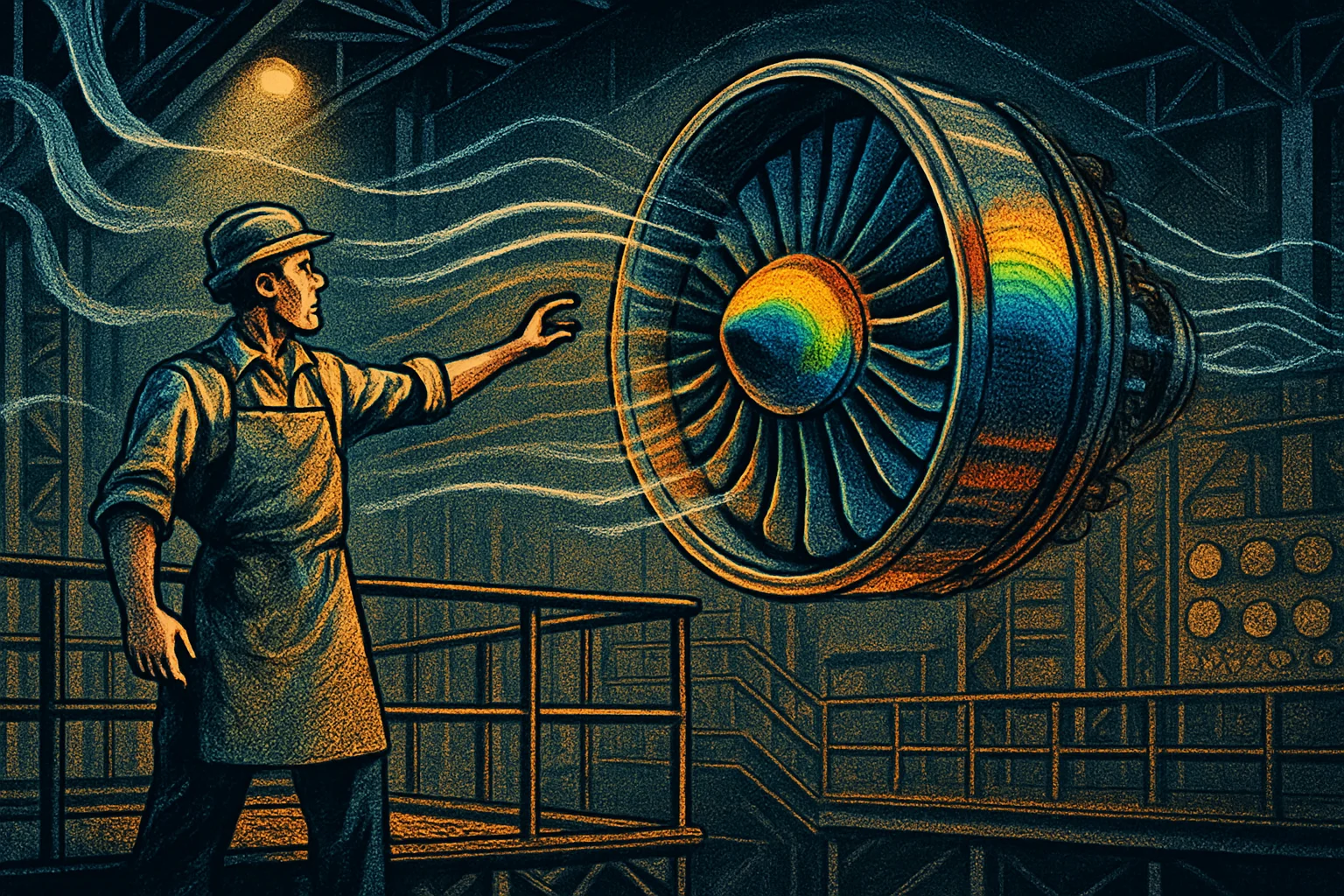
When we talk about the bottleneck in engineering, we are usually talking about the solver. Designing a turbine blade, a chip package, or an aircraft wing means asking how a physical system will behave under load, heat, or airflow, and the traditional way to answer that question is numerical simulation that grinds through equations cell by cell. On May 27, 2026, Mistral AI introduced a class of physics AI models for industrial engineering that reframes this problem. Rather than iterating toward a solution, the model maps a system's geometry and boundary conditions to its full physical fields in a single forward pass, in roughly seconds on one GPU. That shift, from solving to predicting, is the part worth understanding.
What a physics AI model actually does
A conventional solver discretizes space into a mesh and marches through coupled differential equations until the residuals settle. It is accurate and principled, but expensive, which is why engineers typically evaluate a handful of designs before committing. Mistral's approach trains a model to approximate the mapping itself: give it a shape and the conditions at its edges, and it returns the predicted pressure, stress, temperature, or velocity fields across the whole domain at once.
This is an instance of what the research community calls a neural surrogate or operator-learning model. Instead of learning a single answer, it learns the function that turns inputs into a field of outputs. The accuracy depends on training data drawn from real simulations or measurements, so the model is best understood as a fast, learned stand-in for the solver, not a replacement for the physics it was trained on.
Why a single forward pass matters
The economically interesting consequence is throughput. When one evaluation drops from hours to seconds, an engineer can sweep thousands of design variants rather than a few. That changes the character of the work. Optimization stops being a careful walk between expensive checkpoints and becomes a broad search across a design space, where promising candidates can later be confirmed with full-fidelity simulation. The AI does not remove rigor; it widens the funnel before rigor is applied.
Three places this lands first
Mistral describes three application areas, and each maps cleanly onto a different stage of an asset's life.
The first is accelerated product design for vehicles, aircraft, and chips, where early exploration benefits most from rapid iteration. The second is tooling and manufacturing optimization, tuning how things are actually produced rather than only how they are shaped. The third is real-time digital twins for operational assets, where speed is the entire point: a model fast enough to run continuously can mirror a working machine and predict its state as conditions change.
That last category is the clearest payoff of the seconds-scale inference. A digital twin is only useful if it keeps pace with the physical system it represents, and a learned surrogate can deliver field predictions at a cadence traditional solvers cannot match.
Built on acquired expertise
The capability is grounded in Mistral's acquisition of Emmi AI, a physics-simulation startup whose work underpins these models. That detail matters because surrogate quality lives or dies on the simulation know-how behind the training data, and folding in a specialist team is a credible way to acquire it.
The collaborator list signals where validation will come from. Airbus, BMW, EDF, ASML, Safran, and Siemens Energy span aerospace, automotive, energy, and semiconductor manufacturing, which is precisely the range of physics, from fluid dynamics to thermal and structural behavior, that a general industrial offering would need to prove itself against.
What to watch next
The honest open question for any neural surrogate is generalization: how well predictions hold for geometries and conditions outside the training distribution. The disciplined pattern emerging across the field, and the one to expect here, is hybrid: AI for fast, wide exploration, classical solvers for final verification. If that division of labor holds, the meaningful result is not that simulation gets replaced, but that engineers get to ask far more questions before they have to commit to an answer.
Sources: Mistral AI, May 27 2026; The Next Web, May 2026; HPCwire/AIwire, May 26 2026
More AI Stories

Strands Decider 2B: What Amazon's Free Decision Model Does
Strands Decider 2B is a free 2B-parameter decision model that picks options in about 115ms on a single GPU. Here is how it works and where it fits.

Meta Muse Gadgets SDK: Build Your Own AI Agent Hardware
Meta's open-source Muse Gadgets SDKs bring its Muse agent to Raspberry Pi and ESP32 builds, and 5,000 free Home Link dongles are going to subscribers.

AstaBrief 8B: Ai2's Open Model for Cited Science Reports
AstaBrief 8B is Ai2's Apache 2.0 open model that writes cited research reports in 51 seconds, 3.5x faster than its Claude pipeline. Here is how it works.